Sunday Summary: The Beat Won’t Stop!
By The Editors June 7, 2026 9:00 am
reprints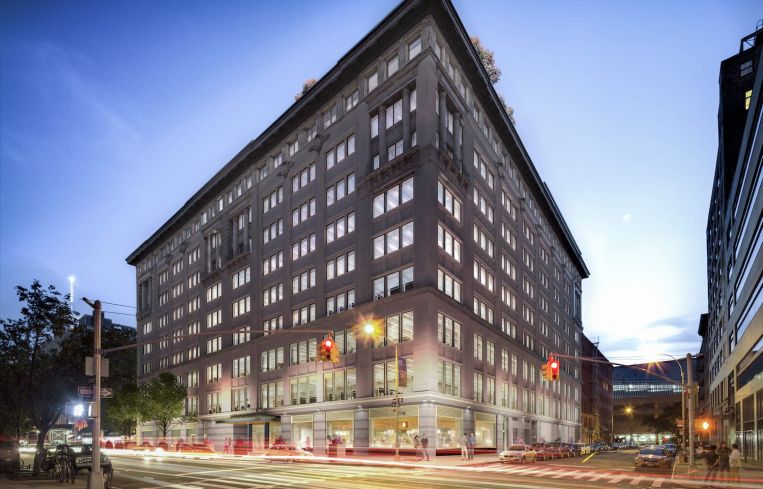
We all have our doubts about the future prospects of the real estate sector from time to time, but the last week — actually, no, make that the last month — should dispel any of those nagging worries. (Ditto the overall employment sitch, which got much better-than-expected news on Friday.)
For example, Simpson Thacher & Bartlett took 916,000 square feet at Extell Development’s 570 Fifth Avenue — which is 200,000 square feet more than the law firm was originally talking about taking back in September.
Another healthy sign for the market: Google is renewing 410,556 square feet at Jack Resnick & Sons’ 315 Hudson Street.
And these six-figure leases were not even a strictly Manhattan phenomenon: Brooklyn Defender Services (BDS) took a 31-year, 212,000-square-foot lease at Tishman Speyer’s 422 Fulton Street in a big consolidation of their offices throughout Brooklyn.
But, praise to Brooklyn notwithstanding, we’ll admit that it was Manhattan that showed its true strength. Office leasing was up 17.3 percent from the previous month, according to a report from Colliers, making Manhattan leasing 50 percent-plus more robust than the 10-year monthly average.
“There’s so much that can change month to month … [but] if demand continues at the same pace it’s been going, we would have more than 47 million square feet of leasing volume, which would be the highest single year of leasing since 2000,” said Colliers’ Franklin Wallach.
And one sees why office is valued pretty well in Gotham. We also learned last week that SL Green Realty is selling 10 East 53rd Street to Jeffrey Kaplan’s Meadow Partners for a pretty healthy $312.2 million.
Of course, New York wouldn’t be as healthy if it was just office leases and just 100,000-plus footprints. Ulta Beauty inked a 26,000-square-foot lease at Jeff Sutton’s 1551 Broadway in Times Square. And Andrew Sargent, the winner of Netflix’s cooking show “Next Gen Chef,” announced he was opening his first New York City restaurant, Caroline, at 16 West 18th Street.
Likewise, Atria Health and Research Institute took a 52,000-square-foot lease to fully occupy Access Industries and Witkoff’s One High Line in West Chelsea, and Veeva Systems — the data, software and AI firm for the life sciences sector — took 62,000 square feet at Vornado Realty Trust’s Penn 2.
There was a lot more retail and office and sales and ground leases, but that should give you some sense of how CRE has been playing out in Gotham.
Loan star state
The lending keeps continuing throughout the country. Just last week Lincoln Property Company and Austin Capital Partners landed an $870 million construction financing package for the Four Seasons Private Residences Lake Austin, making it one of the largest construction loans for a residential project in the history of Texas, courtesy of Tyko Capital.
Blackstone Real Estate Debt Strategies (BREDS) provided $244 million in acquisition financing to Alterra IOS for a whopping 37 industrial outdoor storage properties spread throughout 27 different markets. (Man, everybody loves IOS!) But any discussion of Blackstone usually involves two or three simultaneous deals closing or in the planning stage.
Just last month BREDS announced a $78 billion debt platform for housing construction. And, beyond the lending, they’ve also been selling. Link Logistics, the industrial arm of the company, just sold an 8.5 million-square-foot light industrial portfolio to BKM Capital Partners and Kayne Anderson Real Estate for $1.81 billion.
Lending — and particularly alternative financing — was on our mind last week. CO interviewed PGIM’s Bryan McDonnell about his role as one of the largest real estate asset managers in the world.
We also took a dive into C-PACE lending, which seems to be only getting more ambitious with time.
Yes, people are on the move. Colliers tapped Sarah Cafaro to be its new senior vice president and charged with expanding the company’s retail platform.
Thomas Gammino is bidding farewell to Lee & Associates NYC in favor of becoming executive vice president in the New York office of the Nashville-based Matthews.
And Allyson Bowen was elevated to the role of vice chair at Savills after her previous position as managing director and broker (and after clocking 22 years at the firm).
Political postulating
Los Angeles had a primary on Tuesday and … we still didn’t know with 100 percent certainty the results as of EOD Friday.
But it looks likely that incumbent Karen Bass will square off against Spencer Pratt.
In the days leading up to the primary, Bass defended her record as mayor, pointing to initiatives to fast-track affordable housing, clean up Downtown L.A., expand adaptive reuse and speed up permitting to rebuild after the Palisades fires. All the while, housing has been a cornerstone of the political conversation.
But it is in every state. Indeed, in New York, Gov. Kathy Hochul signed two bills late last month (as part of her budget) to exempt infill housing and several types of public infrastructure projects from lengthy environmental review.
The real estate community was pleased.
“New Yorkers are facing some of the highest housing costs in the nation because construction is too expensive, too slow, and too bureaucratic,” said Steven Fulop, the president and CEO of the Partnership for New York City. “This legislation removes unnecessary obstacles to building housing, gives the mayor the boost he needs to make his housing growth agenda a reality, and lays out a path to faster, more affordable homes in New York.”
However, real estate honchos will always blow hot and cold on the government and the role it plays in the business.
“I think it’s great,” Billy Macklowe, CEO of the William Macklowe Company, said of Mayor Zohran Mamdani’s administration at CO’s recent residential forum. “He’s really doing terrific things for the city. He’s really embracing business, and he’s saying our doors are open. We want capitalism, we want business, we want New York to survive as a city.
“And then I woke up,” he said.
“Seventy million dollars to build a free grocery store is insanity,” Macklowe continued. “There are no free buses. A rent freeze will be great… I’m old enough to remember the `70s — wasn’t great. It’s going to take us back in time. So, there’s a wonderful retro appeal. What he should be thinking about is how to approach the city like a business. Proper fiscal governance, run the city like a business, don’t bloat it, and understand that New York City real estate taxes are 39 percent of the budget. That’s a lot of money. We don’t need to add taxes onto that to chase people away.”
See you next week!