L.A. Mayor Karen Bass On Fast-Tracking Housing and Reviving Downtown
The incumbent made her case to L.A.’s commercial real estate industry ahead of the June 2 primary
By Greg Cornfield June 1, 2026 2:50 pm
reprints
With Los Angeles’ primary election this week, housing and affordability have dominated the election, as voters and the real estate industry question whether the city can build enough homes, reduce homelessness and speed development.
Mayor Karen Bass defended her record on fast-tracking affordable housing, expanding adaptive reuse, reforming permitting after the destructive Palisades fire, and pushing to revitalize downtown through safety, investment and major events.
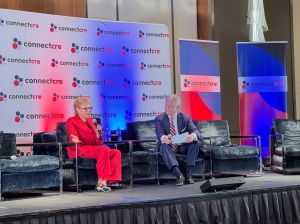
In a conversation with Lew Horne, president of CBRE’s advisory services in Southern California, during a Connect CRE conference on May 28, Bass talked about bureaucracy, homelessness, public safety, development reform, and what it will take to make Los Angeles more livable and investable.
This conversation has been edited for length and clarity.
Lew Horne: You’ve been on the job now for three and a half years, and I’ve heard a lot of people say the two toughest political jobs in this country are the president of the United States and the managing of large urban communities. Give us your thoughts on not just the condition of the city, but the future, too.
Karen Bass: It has been the honor of a lifetime to serve in the city where I was born and raised, and a city I was really concerned about when I was in Congress, which led to me wanting to come home.
One of the first challenges I wanted to take on was homelessness, because homelessness was having such a devastating impact on everybody, not just the people on the street, but the people who have businesses, who work, are going to school — just really disrupting the quality of life.
So I do feel good that for the first time, two years in a row, we have a reduction in street homelessness. We’ve had spikes in crime, but overall the city crime rate is way down, especially with violent crime and homicide.
And then affordability is kind of the umbrella over it all, and coming in and really disrupting the system of building. Everybody told me when I was first running that you can’t get anything built here, people prefer to build in another city, and so I really tackled that immediately as well, because it’s all interconnected.
We now have 42,000 units of affordable housing being fast-tracked, and 6,000 of those units are currently under construction. We took adaptive reuse, which was just relegated to a specific part of town down here, made it citywide, and now when you drive down Wilshire Boulevard, especially in Koreatown, many of those office towers are turning into housing.
We were told a couple of years ago, “You can’t do that, it’s too difficult to change from office space to housing.” But a couple of developers have figured out the magic and are making it happen, and I think that’s going to be one of the real keys to revitalizing downtown.
When you took the job, you were facing overlapping crises: housing affordability, homelessness, public safety issues and post-pandemic recovery. What did you believe was needed to fundamentally change how City Hall operates? And how do you feel about it today?
Yes, tackling the culture, because the culture, in my opinion, is slow, and really having to be disruptive, up to and including a lot of leadership changes at the general manager level.
When I came in, City Hall was basically closed, and we were still struggling. We wanted the workforce to come back, obviously, five days a week. I had to build an organization, and my rule was five days a week. I even had people come into work when I was in Congress in the middle of the pandemic.
One of my backgrounds is in health care, so I knew how to do it safely. But I think the remote work really kind of destroys part of work culture that I still believe is necessary. But tackling the culture and the bureaucracy and disrupting it.
I have much more I want to do. For example, in development services, we learned a lot. We tried a number of things around homelessness in terms of expediting the red tape. We applied some of those lessons to the rebuilding of the Palisades, then taking some of those lessons and applying them citywide.
So I just did an executive directive. I know you were involved in advising us on that, and I was saying to Lew that we have much more that we need to do, because I really want to reorganize.
We have 12 different city departments, and anybody that’s filed — and I know there’s plenty of you here — you go to one department, they tell you one thing, another department tells you something else, then you get toward the end, and Department of Water and Power stops the whole thing.
All of that stuff has to change, and it needs to be centralized, and even with DWP, by the way, I’m happy to let everybody know that under the new general manager, we are going to be releasing a concierge service.
Could you tell us a little bit more about CHIP, and simplify the approach you took there, and what was Executive Directive 1 (ED 1) all about?
ED1 was about fast-tracking affordable housing and eliminating as much red tape, speeding the approvals. After that work, then we wanted to take it beyond affordable housing, but the CHIP program — the Citywide Housing Incentive Program — is really about rezoning parts of the city to comply with the state-mandated goals, the Regional Housing Needs Allocation goals that say that we need half a million homes or apartment units.
So we did that program to rezone to make housing available where it can be built to 500,000 units, and we did that with a lot of input, a lot of participation from people, and just yesterday we celebrated the one-year anniversary of the CHIP program. There’s now 30,000 units being fast-tracked. We were at the groundbreaking of one of the buildings yesterday.
This is an extraordinary statistic, but it used to take anywhere from six months to a year to get a permit processed through the city. Now the average is 67 days after the wildfires. I think there’s close to 500 homes that are currently under construction. Tell us a little bit more.
It was the lessons that we started with ED 1. In terms of the Palisades, we looked for every way possible to expedite. We wanted, and still want, people to get back in their homes as soon as possible. So, at this point, we’ve issued over 2,600 permits for about 1,100 properties.
The big impediment in the Palisades now is banking and insurance. So, there’s a lot of people that have all of their approvals, but they have not started rebuilding because they’re worried about financing, they’re worried about their existing mortgage, and then they’re worried as to whether or not they’re going to be able to be insured at all.
One of the things that was happening before the fires is the companies were unilaterally canceling policies, and then you have the FAIR Plan, which is never enough, especially in a neighborhood like the Palisades. The cap of what you can get is lower than what the property value is worth.
So then I switch my role in terms of power that I might have. I can’t impact the bank — these are private industries — but what I can do is advocate.
My last two years in the state legislature in Sacramento, I was speaker of the House, and so I’ve been able to work on legislation in ways that, if I didn’t have that history, I just wouldn’t have access in the same way I do. And the same on the federal level — you might have seen that I was with County Supervisor Kathryn Barger about a month ago meeting with President Trump, and basically asking him to give us our FEMA money.
How’d you do on that?
Really good. He was very amenable. We need several billion dollars to get the infrastructure rebuilt in the Palisades. I think he was very open about it, but, you know, those tweets are powerful.
I also wanted his advocacy in terms of that. And he tweeted on insurance, he tweeted on banking, but I think both industries all of a sudden were a little more responsive.
You did this whole idea around self-certification for development. Tell us a little bit about that.
It was slow in the beginning because the architects were worried about liability, they didn’t really utilize it, but everybody figured out a way.
One of the other things that we did, too, was working with developers on a series of pre-approved plans if people want to go even faster. We were basically looking at every possible avenue to make it go faster to make people whole as soon as possible.
We also added the use of artificial intelligence for plan approvals. And, in the Palisades, we co-located all of the city offices, so you could go to one location to go to the 12 different departments.
But you still have the problem of going to one department and then you know that person leaves on vacation, and somebody who was in their place has totally different ideas and wants you to do everything differently, and that’s crazy.
So we’re working on that now, putting everybody in one place. First, we were in West L.A. when the debris was being removed. But after the debris was removed and building started, Palisadians wanted us to move to the Palisades, so we’re right there in trailers, and they can literally go to a set of trailers and touch on every city office.
We did webinars twice a week with Palisadians. They were constantly giving us feedback about what was working and wasn’t working, and we tried to be very proactive and aggressive in addressing those concerns.
Homelessness was central to your campaign. It remains one of the city’s biggest challenges. I have seen a reduction in encampments. Tell us a little bit about your initiatives.
When I came in, I did not want to take a year studying something that had been studied to death. I thought the mandate from voters was to act to get rid of the encampments, and so we started a program called Inside Safe. I have a team of outreach workers — all of them I say are graduates of the University of Hard Knocks.
We know how to get people off the street, but what we do is we move them into housing. We don’t just shift them from one side of the street to the next. There is a program that does that — it’s not Inside Safe, it’s the power-washing the streets for health reasons, and the city does tell them to move from one side to the next and moves them back. I want to see that program go away.
We spent millions of dollars cleaning up streets rather than housing the people. But I think probably around 20 years ago, it’s important for people to know that we made a strategic error in the city and the county that led to the explosion of street homelessness. We decided to rigidly believe in housing first, in the sense that people can stay on the street until something is built for them, and I don’t care how fast you build it, it still takes a while. And then we set up policies that then accepted street homelessness.
New York didn’t do that. New York has 80,000 homeless people, 97 percent of them are in some form of housing or shelter. What we do is different — when we go out, we clear the entire encampment, we put people in a motel, because we know what to do to make it much more cost effective, using city-owned land and using a lot of different structures.
The old way was shelters, where it’s a big room like this with cots all over. That’s what people don’t want to go to. But the market has produced new and improved shelters, so that’s the next generation where we’re going, and we’ve already broken ground and have these things underway, but we need time for there to be much, much more.
What have you done, and what has the city really done, to try to stabilize what we’ve seen in terms of the exodus of some of the occupiers from Downtown? A lot of that is largely due to concerns around safety and homelessness. What do you see happening over the next 10 years with initiatives that you’re implementing today?
Well, first and foremost is safety. One of my passions from day one was increasing our police department. We see that 3.8 million people have a small department, about 8,500 officers in our city. Chicago has 2 million people and 12,000 officers. So, we are increasing enforcement Downtown on a lot of levels — not just black-and-white cars, but bikes.
But I’ll tell you what’s really going to make L.A.’s downtown safe is that thousands and thousands of people don’t want to come if they don’t perceive it as being safe. So wanting to strategically take advantage of the events that are coming our way — obviously, the World Cup won’t be played Downtown, but there will be massive watch parties — but also getting the convention center expanded, because we were losing major conventions. So that is underway.
We already have companies and professional organizations signing up to bring their conventions back.
And with fast-tracking the “graffiti towers” — it’s terrible, it’s called Oceanwide, but I think it’s known around the world as the “graffiti towers” — which is an absolute eyesore, and that’s been going through the court, so there’s progress on that.
With the World Cup here, and the Olympics right around the corner, are we ready?
And before the World Cup, we have the U.S. Open for golf for women, and then literally four days later is the World Cup. We are essentially going to have watch parties, festivals in neighborhoods — about 100 of them around the city — because I believe very passionately in “games for all.” That is our theme for the Olympics, the World Cup, the Super Bowl.
I’ve been holding business summits. Two years ago was the first one. Our third one is going to be this fall. We have 1,000 small businesses that we’ve been working with to get them ready, because a lot of times small businesses don’t know about requests for proposals for related projects, or they find out about it the day before, so we’ve been getting people ready.
When you look beyond immediate challenges, what gives you optimism about L.A.’s future, and what do you want Angelenos to feel and to see about where L.A. is headed over the next decade?
The city that I was born and raised in, we are the center of creativity for the world, and we have so much to offer in the city, and what I see for our future is a city that is safe, a city where people are fine walking down the street.
I want people to experience that this is a city that’s affordable, that you’re not walking on human beings in squalor and misery, that it’s safe. I do remember when L.A. was affordable — for those of us that are a little more seasoned, you might remember.
And I want the world to know who Los Angeles is as a whole, not just three or four neighborhoods. They come to L.A. for the first time, they go to three or four places and say they’ve been to L.A. I want them to know how vast and diverse our city is.
You’re in the middle of a chaotic, crazy election process, but you’ve got an audience here of some of the most significant real estate development communities in this incredible market. Any parting comments?
Homelessness was only going up until we came in and started clearing out the encampments. We know how to do this. We can clear our streets. They should have never happened in the first place, and there’s no reason for it to continue.
Our city should be safe. There is no reason why we have a small police department. I’ve been in a battle with the City Council over it. I signed the budget today, by the way, which was nice, because it was rather boring, and that’s what we want. We don’t need the trauma of last year with a $1 billion deficit.
I was able to get them to agree to finance 510 more police officers. Obviously, we need three times more than that, but that is a start that keeps us from losing officers.
But we need easily 1,000 or 2,000 more. Recruitment has not been the problem. The problem has been the city’s bureaucracy. So, I had to make major changes there, including multiple leadership changes to finally get the debris out of the way, so that we could hire officers so our city will be safe and our city will be affordable.
We have all of this in the pipeline, and it’s about having the determination, which I do — I’m very impatient. I know what this city can be, what we have been, and I am very positive about what we will be.
Gregory Cornfield can be reached at gcornfield@commercialobserver.com.