Fierce Demand for Brooklyn ‘Cool’ Faces Political, Economic Roadblocks: Forum
Brooklyn’s real estate community is eager as ever for policymakers to strike a better balance between density, economic vitality and affordability
By Emily Davis June 4, 2026 4:21 pm
reprints
There’s a clear consensus among commercial real estate industry leaders devoted to Brooklyn: The cultural and economic transformation of the borough is at odds with painfully high development costs and stymieing government policies.
That refrain echoed through the concrete-lined event room at Williamsburg’s 25 Kent on Wednesday morning during Commercial Observer’s 2026 Brooklyn Forum. Industry leaders in real estate investment, commercial leasing and affordable housing celebrated Brooklyn’s rising star, but were united in their skepticism (or downright pessimism) about the feasibility of new projects under today’s economic constraints.
Poor policymaking, construction hurdles and widespread retail vacancies were shared sore spots for the gathered panelists. Bright spots shone through, however, in the form of wealthy buyers, eager office tenants and the burgeoning residential face of the borough’s Gowanus neighborhood.
Alvin Schein, a partner at Adler & Stachenfeld, got the conversation started in a keynote session with Justin Elghanayan, principal and president of Rockrose. The multifamily developer landed in Brooklyn in 2019. This year, it’s busy piecing together a multi-parcel assemblage in Cobble Hill and wrapping up its 49-story rental tower the Everly at 180 Ashland Place in Fort Greene.
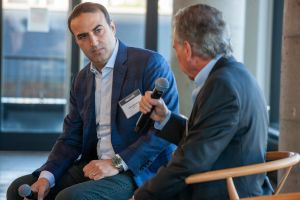
The changing demographic makeup of Brooklyn, and an accompanying shift in local housing preferences, was first on the docket. The exodus of Manhattan’s trust funders to the other side of the East River has accelerated the borough’s high-end market, Elghanayan said. This broader cultural trend, which he dubbed “the luxury-ification of cool,” is giving Brooklyn a gravitational pull.
“We go where things are popular and where people want to live, and people want to live in Brooklyn,” Elghanayan said.
As a consequence, Rockrose is planting its flag only in “the cream of the crop,” or established neighborhoods, like Brooklyn Heights and Cobble Hill, where it believes investments will appreciate faster.
Deep-pocketed buyers have little impact on the chronic challenges of high construction costs and the high demands of the city’s 485x tax incentive. Schein pointed out the persistence of developers stringing along 99-unit buildings to skirt the program’s wage rules. The task of building 100-plus-unit buildings is an increasingly difficult one, Elghanayan said, with higher labor costs , onerous reporting requirements and severe penalties for developers that slip up.
“Even if you believe in doing something, if the numbers are too high, it’s hard to justify doing it,” he said. “I’m not convinced that it is feasible under the current framework. The current framework has to change.”
Schein and Elghanayan, like the day’s later panelists, expressed hope that the political establishment will take notice of what’s not working, and be willing to fix it. Elghanayan suggested the build-more crowd could use better PR, switching from “abundance movement” to a “make more housing and the rent goes down movement.” The gathered crowd appeared on board.
The rising costs and rapid absorption of Brooklyn’s cool factor carried into the first panel of the event, “Brooklyn 2026 Market Outlook,” moderated by Dan Marks, CEO of TerraCRG.
Randy Peers, president and CEO of the Brooklyn Chamber of Commerce, said Brooklyn has become an international brand, citing the pop-up of a Brooklyn Made Store opening in Tokyo this summer. In the borough itself, however, the health of retail varies widely, with stubbornly high vacancies in neighborhoods like Williamsburg and Downtown Brooklyn, Peers said, and a net loss of 1,000 businesses citywide reported last spring.
But the gathered investors can still hang their hats on the borough’s strong housing market. Shawn Katz, president of Silverstein Capital Partners, the lending platform of Downtown Brooklyn’s Brooklyn Tower owner Silverstein Capital, said the conversation has shifted from enormous supply to rapid absorption.
In Williamsburg, the first phase of Naftali Group’s waterfront megadevelopment Williamsburg Wharf has seen a 90 percent lease-up in less than six months, according to David Hochfelder, Naftali’s chief investment officer. Condos are averaging $2,000 per square foot. Compared to just five years ago, Hochfelder said, the numbers are staggering.
“People used to look at Brooklyn as a low-cost alternative. It’s no longer a low-cost alternative,” Hochfelder said. People are moving for a better lifestyle, he said, seeking more bang for their buck on space and amenities.

Panel members shared their own grievances over the encumbrances of NIMBYism and construction woes, with Hochfelder acknowledging that high costs, insurance and interest rates mean that “large rental buildings don’t pencil for us.”
Due praise was given, however, to policies like City of Yes. Katz said City of Yes dramatically improved Silverstein’s ability to increase its retail and commercial offerings at Brooklyn Tower, which include an 80,000-square-foot Life Time gym. Peers chimed in that there’s positive signs in Mayor Zohran Mamdani’s new Block-By-Block plan, with two major rezonings slated for the borough.
“There are some elements that might be uncomfortable to some people in this room,” Peers said, referencing tenant protections. “But beyond that, let’s acknowledge the fact that it’s a comprehensive approach to bringing much more supply into the marketplace.”
A panel on “Brooklyn’s Economic Engine” followed, in which leading commercial brokers zeroed in on the neighborhoods and sectors driving demand. Alyssa Zahler, managing director of commercial leasing at Two Trees Management, said that just 10 years ago, selling office tenants on Brooklyn was “exhausting.” That’s all changed.
“I don’t sell Brooklyn anymore. Brooklyn sells itself,” Zahler said.
Williamsburg’s The Refinery at Domino, the current apple of Two Trees’ eye, has found success in its mixed-use approach to tenant curation, Zahler said.
Alexander Radmin, director of leasing at Global Holdings Management Group, which manages 25 Kent, added that Brooklyn’s commercial sites require amenitized spaces and institutional, highly curated retail to succeed in today’s market, and leasing office space to smaller Brooklyn tenants requires flexibility.
Retail softness remains the biggest story in Downtown Brooklyn, Regina Myer, president of the Downtown Brooklyn Partnership, told moderator Zachary Bernstein, partner at Fried Frank. While closures like the neighborhood’s historic Macy’s store are troubling signs, the area has found success in retail that meets the needs of its booming residential population, including three new supermarkets on Fulton Street.
When it comes to the borough’s next big submarket, all signs point toward Gowanus.
“We’ve been buying quietly for the last couple of years there,” Zahler said, which had the crowd of attendant competitors leaning in a little closer.
Global Holdings’ long view on Gowanus is evident in 450 Union Street, its mixed-use residential project along the canal, where they just kicked off retail leasing. The vote of confidence, Radmin said, comes down to fundamentals.
“There’s amazing access to transportation, you’re surrounded by some of the best neighborhoods in Brooklyn, some amazing school districts,” he said. “I wouldn’t say we were early. I would say we were right on time.”
He referenced the nearby arrival of Life Time. The oft-cited luxury gym appears to be a Brooklyn developer’s signpost for ROI.
The final panel of this year’s forum, “The Borough’s Residential Report,” was less rosy than preceding panels. Moderator Zachary Steinberg, executive vice president of the Real Estate Board of New York, led the discussion that delivered a clear verdict: Affordable housing policy is not making affordable housing builders’ lives any easier. Gowanus, however, received some more flowers.
The current uptick in building should’ve happened 20-plus years ago, said Sam Charney, founder and principal of Charney Companies.
“It’s infill between Park Slope and Carroll Gardens,” Charney said. “That is just such an easy place to look to create housing, and really, it’s the smartest blend of public and private partnership working together to clean up contaminated soil to create affordable housing and preserve a lot of the culture that is there.”

Kieran E. Harrington, CEO of RiseBoro Community Partnership, said it’s his group’s intention to keep Brooklyn a home for all New Yorkers, not just the fortunate few. Serious obstacles remain in their way. Changing requirements on soil remediation forced Charney Companies to undertake an unplanned project of filling 30 feet of concrete below a Gowanus project, Charney said. The rezoning timeline, too, remains a sticking point.
“The [Gowanus] rezoning took about 15 years,” said Kirk Goodrich, president of Monadnock Development. “And if you care about housing and creating the kind of dynamic housing market where people can build and affordability is naturally occurring, you can’t take 15 years or 10 years or six years.”
Ofer Cohen, co-founder and principal of Ailanthus, said the disconnect between the capital markets and city policy has left affordable housing developers looking for loopholes, rather than collaborating with policymakers. Policies that align with the realities of the capital markets, he said, yield better results.
Progress in upping Brooklyn’s social housing could come in the form of incentives for large-scale sites in proximity to housing authority developments, Goodrich said. Charney would like to see massive upzoning occur in neighborhoods like Crown Heights, where blocks of three-story buildings could accommodate 12- or 15-story replacements.
Emily Davis can be reached at edavis@commercialobserver.com.