In Commercial Real Estate Financing, Clear Shifts Mean New Approaches
Top lenders and brokers at a recent Commercial Observer forum talked candidly about strong and weak asset classes as well as private credit vs. banks
By Brian Pascus and Andrew Coen May 4, 2026 12:03 pm
reprints
Rockefeller Center, a historic landmark that for decades symbolized New York City’s financial and entertainment might, provided a fitting setting April 30 for Commercial Observer’s annual spring National Finance Forum, where some of commercial real estate’s biggest players gave their temperature checks on the state of an industry besieged by new challenges.
The semiannual event was held for the first time at Convene Quorum at 1221 Avenue of the Americas steps from 30 Rock. It also came a day after the CRE industry was confronted with another reminder of the sustained elevated borrowing costs the past four years when the Federal Reserve paused interest rates for a third straight meeting.
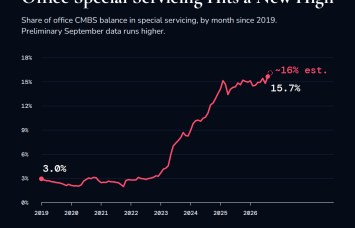
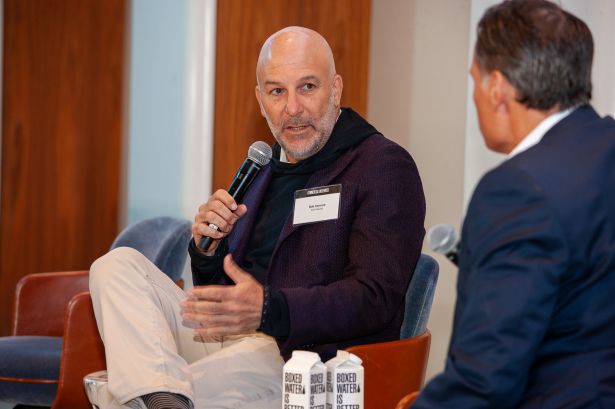
The symposium opened with an opening keynote featuring Rob Verrone, principal at Iron Hound Management, who spoke about the state of distressed loans in the commercial mortgage-backed securities (CMBS) market. Verrone, whose advisory firm negotiates CMBS loan restructurings on behalf of borrowers, said losses are mounting far more now than during the height of the COVID-19 pandemic.
“In COVID you didn’t see a lot of people taking losses because you weren’t going to sell your property when the world was shut down,” said Verrone in the kickoff keynote moderated by Joseph Barbiere of law firm Cole Schotz. “But now five years later the proof is in the pudding, and there are people actually transacting and doing A and B notes or discounted payoffs or consensual loan sales. … We’re actually taking the losses if the people who own the bonds can afford it and if the price is right.”
Verrone noted that the office sector is the largest part of its pipeline of restructurings, but Iron Hound is also heavily involved with navigating troubled loans in other asset classes. He stressed that beyond the property type, other factors weigh heavily on whether a loan can secure a workout. That includes who is in control of the debt and how many bonds are left in the sector.
The duration of workouts has gone up, often taking more than two years. Verrone attributes that partly to delay tactics often instilled by borrowers trying to wait for a better bond market. He added that the CMBS business has also gotten more complex, with a greater number of forms and legal documents that need to be filled out as parties conduct sufficient due diligence to avoid legal troubles.
The forum’s second session, “Market Outlook: Defining the Finance Landscape in 2026,” explored a large mismatch taking shape in the CRE market between equity and debt-deployment in deals. Tightening cap rates are driving the mismatch.
Yorick Starr, managing director and investment officer at Invesco Real Estate, said compressed cape rates coupled with a recent rise in the 10-Year Treasury yield makes it far more challenging to get investors on board with CRE deals.
“Fom an equity standpoint, unless you’re investing in a sector that has high cap rates to begin with, the room for error is really minimal,” Starr said.
Demand remains strong on the debt side, according to Eric Ramirez, managing director and head of Eastern region originations at Acore Capital. He noted that there are now often about 25 lenders bidding on some deals compared with around four or five in 2015 when he began at ACORE. Ramirez said there have been more requests for construction deals to be priced at an 80 to 85 percent loan-to-value ratio since developers are confronting increasing challenges in raising equity.
The market outlook panel — moderated by Jay Neveloff, partner and chair of U.S. real estate at HSF Kramer — also featured Rebecca Bayard, managing director of the real estate financing group at Goldman Sachs, and Nick Scribani, vice chairman of global debt and structured finance at Newmark.
Bayard said the current market environment has resulted in Goldman Sachs tackling more “straightforward” deals that are largely “asset-class agnostic” rather than taking on “overly complex projects” that were focused on alternative property sectors.
Scribani said lenders are eyeing opportunities in the office sector outside of just New York, including markets like San Francisco and South Florida.
“There’s a ton of lenders who now really focus on the office activity, and I think in part because there’s still incremental yield to earn relative to some other food groups,” Scribani said. “For a while, office might have been one of the red line asset classes for most of the lenders we work with, and now it’s almost at the top of the totem pole.”
The evolving fluctuations in the CRE debt markets over the last few years were addressed in the event’s third session, “Pivoting in a Changing Market: Staying the Course From Stability Through Volatility.”
Dylan Kane, managing director in the capital markets group at Colliers, said the last six years have presented “relentless volatility” starting with the onset of COVID-19 to the Russia-Ukraine war, rising interest rates and tariffs. Kane said structuring deals is very fluid as borrowers seek more flexibility to improve their leverage levels.
“We really approach it all, especially when trying to figure out the equity part of the stack, whether that’s pref, mezz or some sort of structured capital,” Kane said. “We just try to be as fluid and flexible and creative as we can.”
The panel — moderated by Aron Zuckerman, partner at Simpson Thacher & Bartlett — also featured Robert Rothschild, managing director at InterVest Capital Partners; Carina Kalaw, managing director and head of real estate syndications at City National Bank; and Michael Trachtenberg, president of ground lease specialist Safehold.
The volatility has spurred more equity players to pivot to private credit space, where they’re now encountering increased competition from banks stepping back into CRE lending as interest rates stabilize, Rothschild said.
“Private credits are getting kind of squeezed out a little bit on the real estate side because the banks and CMBS market are pushing up leverage,” Rothschild said. “I think that just leads to a rethinking of how one wants to deploy capital depending on what yield expectations are.”
Kalaw said a number of banks are back in the CRE lending game, with competition particularly fierce in the syndication arena. She does not foresee anything hindering the banks from CRE deals in the near future outside of “a major catastrophe.”
After a short break, Kara McShane, Wells Fargo’s managing director, executive vice president, and head of commercial real estate, sat down with Bonnie Neuman of law firm Sidley Austin to discuss how her bank is navigating a more competitive lending landscape.
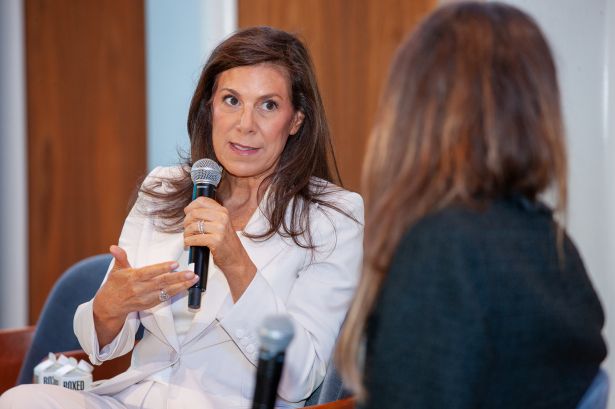
McShane noted that her bank completed $83 billion in originations across balance sheet and capital markets in 2025, and that Wells Fargo has focused on execution and leveraging a diverse product slate to create a competitive advantage against peer banks and even the growing private credit space.
But McShane added that, contrary to what some might assume, her bank views private credit firms as both clients and partners, rather than solely as competitors in a deep market.
“We have more of a symbiotic relationship and provide a lot of back leverage and financing to the private credit space,” she said, adding that Wells Fargo’s CRE capital solutions are often provided in conjunction with private credit. “They need us to exist, and we need them to exist.”
McShane also emphasized that, despite what the headlines might say, commercial real estate is largely insulated from the current turmoil in the private credit space, which she argued is more connected to troubled corporate credit.
“I don’t think it’s having a spillover impact — we’ve seen this before, particularly around redemptions for non-traded REITs,” she said. “It’s more likely this volatility pushes capital toward hard assets, so commercial real estate is a net beneficiary.”
The next panel featured William F. Davis, vice chair of real estate at Cozen O’Connor, holding a discussion with three market leaders on where capital is converging across asset classes in the early months of 2026.
Paul Vanderslice, head of CMBS at BMO Capital Markets, led with numbers, noting that the data center space secured $600 billion of capital expenditures in 2025, mainly through projects sponsored by the Big Five hyperscalers (Meta, Microsoft, Amazon, Google and Oracle).
But he also pointed out the sizable risks involved in any investment into the data center space.
“What is your collateral? It’s the building, it’s the racks, it’s the cooling towers. It’s not the chips, it’s not the servers,” said Vanderslice. “As for the risk, the power grid connections — in some markets already, like Virginia, it’s impossible to get new power, so you see data centers built in other areas.
“It’s a risk that hasn’t grown up with the CMBS business,” he added.
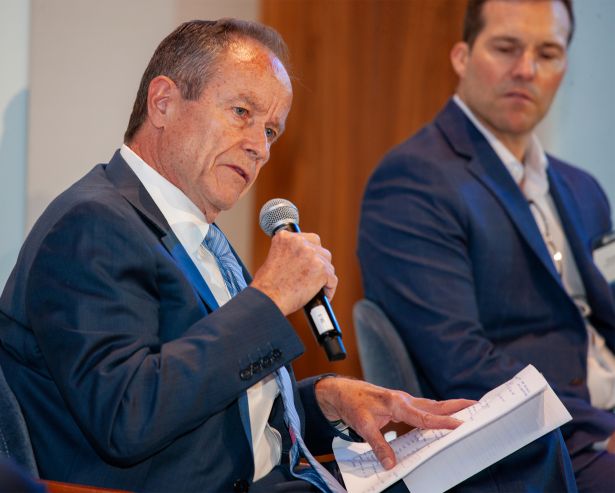
Justin Horowitz, senior managing director at Cooper-Horowitz, a firm that specializes in industry outdoor storage (IOS), noted that the data center space is impacting IOS by creating a new subsector — electrical IOS — and that his clients are trying to examine their portfolios through the lens of how much electrical power they can bring to their sites, even amid the shadow of growing data center construction.
“There’s a clear advantage to having power, if it’s available,” Horowitz said. “It’s definitely a new part of the asset class and is certainly being viewed by our clients today”
Morris Betesh, founder and managing partner of Arrow Real Estate Advisors, a debt brokerage, noted that a new industry of “wildcatters” has quickly developed, where entrepreneurial investors buy up huge tracts of land, secure power to the sites, get zoning approvals, and use that leverage to work through a multiyear data center development process before an asset is even fully built.
“It’s an extremely risky business, but the returns are massive,” said Betesh. “Given how much demand there is, now everyone is a wildcatter. Everybody is out there tying up these sites, trying to get power.”
Moving away from data centers, Chris Lawton, managing director and head of originations at Nuveen Green Capital, spoke on how his firm has used Commercial Property-Assessed Clean Energy (C-PACE) loans to rightsize numerous capital stacks — the firm did $2.1 billion in C-PACE loans in 2025 — and that his firm has become more a senior position lender than mezzanine or preferred equity in recent transactions
“We’ve closed with over 300 co-lenders at this point,” said Lawton, noting that on a recent $465 million office deal his firm’s C-PACE loan took the senior position. “It’s either a syndication partner for a bank around the country or an A note.”
The sixth panel, moderated by Joe Lanzkron, a partner at Cleary Gottlieb Steen & Hamilton, examined the state of CRE lending in the early months of 2026.
Catherine Chen, managing director at Apollo Global Management, discussed how despite the market experiencing “ebbs and flows,” and pockets of distress, the sheer number of insurance companies, debt funds and banks in the lending space has created multiple options for borrowers.
But she emphasized that Apollo does not let the day-to-day or month-to-month swings affect its strategy because the firm is a balance sheet lender and relatively conservative by nature.
“I do think across the board there’s marginal shifts — because there’s competition — so maybe a tweak here or there to be competitive … but it feels like the market, or real estate lenders, has not skipped a beat over the last month,” she said. “All the noise hasn’t changed the overall lender demand.”
Tim Richards, managing director and real estate financing at Goldman Sachs, said that the office financing resurgence — particularly in the CMBS space — has been powered by increased leasing in major U.S. cities.
“It goes back to the return to office,” he said. “You look at markets like Boston, Miami and San Francisco, and there’s a lot of demand for office.”
The resilience of the lending market and demand for assets like office and multifamily have compressed spreads and given the advantage to borrowers across the board, according to Marko Kazanjian, senior managing director at Institutional Property Advisors.
He gave an example of how bids on a large construction loan, with 60 percent loan-to-cost, went from 365 basis points over the secured overnight financing rate nine months ago to the most recent bids for the same deal a mere 230 basis points over, a phenomena fueled by competition.
“Borrowers do have a little bit of an upper hand today,” Kazanjian said. “For more down-the-middle, more traditional financing, there’s lots of options out there.”
The final panel was a discussion between Sean Reimer, managing director of capital markets at Walker & Dunlop, and Tony Fineman, senior managing director and head of originations at ACORE Capital, which was moderated by Noam Haberman, partner at Gibson Dunn.
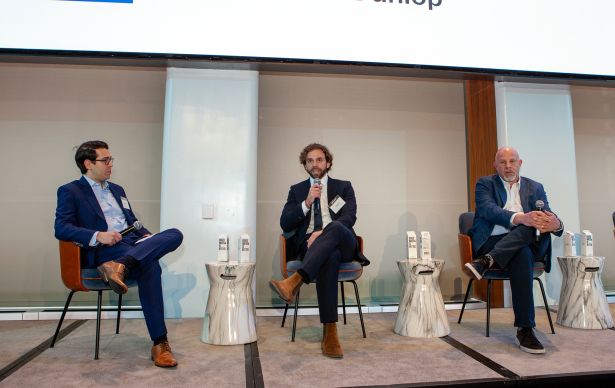
Fineman began by speaking to the sheer amount of capital in the debt space and why the number of options and increased competition have made it “a really good time to be a borrower.” Reimer said that, while the credit side is thriving, the equity is a bit more challenging, before he broke down what’s most liquid.
“From a deal profile perspective, cash-flowing assets are super liquid, so a business plan like a new acquisition with value-add business plan [are liquid],” he said. “On the asset class side, it’s anything housing, data centers or digital.”
Fineman gave a contrarian take on data centers, which he argued is a part of the market that is poorly understood and has secured capital due to hyperscaler tenancy from tech firms that are among the highest credited tenants in the country.
“I would venture that a high percentage of the debt capital is being deployed in the space not because they understand the product but because they understand who will sign the lease,” said Fineman. “But it’s very hard to understand what a data center really is — people go to work in an office, or live in an apartment, but when you go to a data center, you see metal boxes and lights.”
Fineman closed the forum on a note of optimism, arguing that the market has adjusted to the volatility.
“With some of the recent events in the world and in our country, the impact they had on our space is very little. I think we’ve gotten used to the fact that there’s chaos around us,” said Fineman. “You have to lean into the risk, and lend to the right sponsors and the right basis.”
Andrew Coen can be reached at acoen@commercialobserver.com and Brian Pascus can be reached at bpascus@commercialobserver.com