

Office Distress Dominates Largest U.S. CMBS Markets
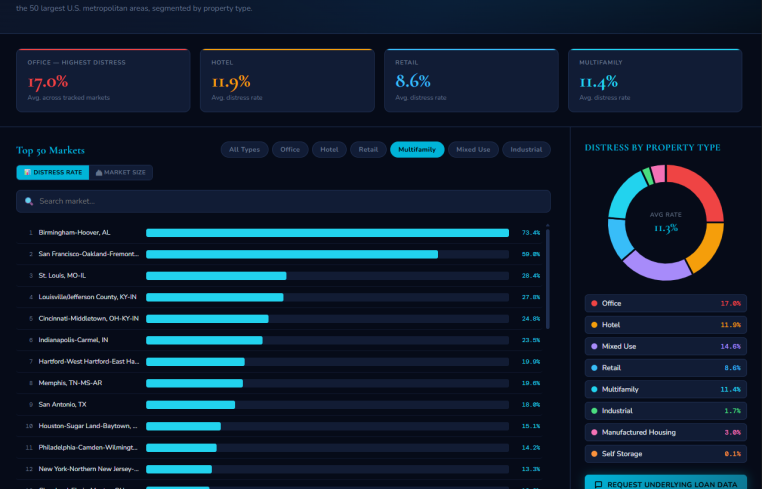
Across the 50 most populous U.S. metropolitan statistical areas, CRED iQ’s proprietary loan analytics platform recorded an aggregate commercial mortgage-backed securities (CMBS) distress rate of 12.2 percent as of April. The overall distress figure encompasses loans that are delinquent, in special servicing or classified as real estate owned (REO) — providing a comprehensive view of loan-level stress within each market.
Office remains the most distressed major property type at 17 percent, followed by mixed-use at 14.6 percent, while industrial continues to post the lowest distress reading at 1.7 percent
Among individual markets, Providence-New Bedford-Fall River (a metro area in Rhode Island and Massachusetts) ranks first in the top 50 cohort with a 71 percent distress rate, followed by Hartford-West Hartford-East Hartford (Connecticut) at 44.1 percent and Denver-Aurora (Colorado) at 42.3 percent. At the other end of the spectrum, major Sun Belt metros including Miami, Phoenix, Dallas, Houston and Atlanta continue to post sub-10 percent distress rates, reflecting more resilient loan performance underpinned by population growth and stronger absorption dynamics.
Which large markets are seeing the highest multifamily CMBS stress?
Multifamily — long considered a defensive asset class within CMBS — has emerged as a growing source of distress in several top 50 markets, with the aggregate multifamily distress rate across the cohort reaching 11.4 percent in April 2026. This represents a meaningful shift from the sector’s historically low stress profile, driven by a combination of rent normalization, elevated floating-rate debt service burdens, and loan maturity pressure on vintage 2021–2022 originations.
San Francisco-Oakland-Fremont (California) stands out as the most stressed major multifamily market within the top 50 universe, with the sector posting an elevated distress rate reflective of outsize rent declines and elevated vacancy in tech-adjacent submarkets. Minneapolis-St. Paul (Minnesota, including Wisconsin) also logs notable multifamily stress, reinforcing a broader pattern of elevated distress in Midwest and legacy gateway markets where rent growth has stalled and cap rate expansion has pressured values.
By contrast, markets including Dallas-Fort Worth, Nashville and Charlotte, N.C., continue to report low multifamily distress readings, consistent with stronger demand fundamentals and less severe debt service compression.
What is driving overall distress in Chicago, Denver and Minneapolis?
Three of the most populous metros in the top 50 cohort — Chicago (25.6 percent), Denver (42.3 percent) and Minneapolis (39.5 percent) — account for a disproportionate share of total distressed loan balance across the universe.
In Chicago, office and hotel exposure drives the bulk of distress, with central business district office vacancy continuing to weigh on debt service coverage across a concentrated pool of conduit loans. Denver’s distress rate has increased materially from prior periods, reflecting accelerating office impairment and select mixed-use exposure. Minneapolis distress remains elevated across both hotel and office categories, with several big single-borrower, large loans in special servicing contributing to the market’s outsized reading.
Mike Haas is the founder and CEO of CRED iQ.


