AI Is in the Office in New York, and Other Observations
Experts at Commercial Observer’s State of Office Forum were frank in their assessments of the fast-growing technology’s risks and rewards
By Mark Hallum May 19, 2026 12:15 pm
reprints
Artificial intelligence firms are filling office buildings at an accelerated pace recently, but that doesn’t bring much comfort to landlords and brokers tracking layoffs in the tech industry thanks to machine learning taking the jobs of the programmers who made it.
The troublesome topic came up several times over the course of Commercial Observer’s 2026 State of Office Forum on May 14 at the Assembly event space at 2 Park Avenue, with real estate executives and others expressing uncertainty that the current leasing momentum in the tech sector is sustainable.
Megan Abraham, CEO of the Goldie Initiative, a nonprofit aimed at advancing women in commercial real estate, opened things with a keynote.
She was followed by Empire State Realty Trust CEO Anthony Malkin and Newmark’s New York tri-state president, David Falk, who discussed how the real estate investment trust is using AI to sift through its tenant roster and hedge itself against its exposure to AI, ultimately in an attempt to sidestep the potential technological matriphagy.
“When you look at what jobs are most suspect to be replaced by AI, these are the things where rote actions are required,” Malkin said. “There’s the underlying issue of what AI will mean in the future as far as investment. I think we have to look at it from the perspective of the buildout of the railroads and fiberoptics. Huge land grabs, massive destruction of capital investment and a few winners.

“One thing you have to know about AI is that things change overnight,” Malkin added. “So the company you think has a killer app, there’s a competitor who designs a better version of it two months later.”
But the office leasing market across sectors may be strong enough that any setbacks with AI and tech leasing could be easily absorbed, he added.
The first panel of the day, called “Market Forces Defining the Road Ahead,” was moderated by law firm HSF Kramer’s Josh Winefsky with owner RFR Holding’s AJ Camhi, the Real Estate Board of New York’s Keith DeCoster, JLL’s David Giancola and WeWork’s Peter Greenspan.
“Along with the robust traditional leasing growth that everyone is talking about, we’re seeing — historic for us — strength in all the markets in Manhattan,” Greenspan said. “There are still a lot of questions about how long [tech tenants] want to stay at a particular [WeWork] location. There are a lot of question marks about the future of headcount, of how people want to work. Even if the headcount goes up, based on this AI boom, it’s a question of where they want [to go] and how often they’re going to be there.”
The second panel, called “Tenant Trends: The Flight to Quality or Value Play — the Driving Factors Behind Office Leasing,” was moderated by M.G. Engineering’s Michael Gerazounis with Convene Hospitality Group’s Ryan Simonetti, software company Cove’s Adam Segal, owner the Durst Organization’s David Neil, owner Marx Realty’s Craig Deitelzweig and corporate buildout specialist Unispace’s Zachary Davis.
The supply of choicer Class A and trophy space is tapped out. To catch residual demand, Class B and C office owners can use the surrounding businesses in Manhattan to act as amenities, and craft an atmosphere that brings people to the office, panelists said.
“Many of our tenants on the coworking side of our business grow out of us and don’t go to a trophy office building,” Convene’s Simonetti said. “What we’re seeing there are well-located spaces. … I do think that you can still do the intentional things like design a great pre-built experience, it’s amazing what an extra $15 per square foot will get you if you have actual taste — very few people have actual taste. … As someone who designs things for a living, you can have taste without having to spend a ton of money.”
Law firm Greenspoon Marder’s Jonathan Weiss moderated the panel called “Behind the Headlines: Conversations With the Owners and Occupiers Driving Leading Workplace Trends” with ServiceNow’s Nishar Fatema, owner Sage’s Jonathan Iger and architect firm Kohn Pedersen Fox’s Andrew Werner.
Iger drew an audience reaction with one hot take: Utilization rates are a pastiche metric. But hear him out.
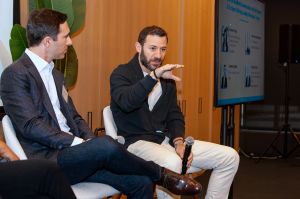
“Nobody buys a Porsche and says, ‘I need to use this 42 days a year to get my value out of it,’” Iger said. “But that’s what real estate is becoming. It’s becoming more of a differentiated luxury product as opposed to a commodity product. So I don’t think utilization matters. It’s a flight to experience. The office itself provides services, it treats you as a customer — not just a tenant, but as a customer.”
Law firm Fried Frank’s Michael Werner moderated the keynote session one-on-one with BXP’s Hilary Spann, in which they discussed the construction of the owner’s 343 Madison Avenue, a 930,000-square-foot office tower anticipated to cost about $2 billion, and 3 Hudson Boulevard, its project that will be roughly twice the size and cost about $3.5 billion.
With AI powering leasing momentum in Manhattan, Spann, who runs BXP’s New York-area business, doesn’t see a reason to shy away from seeking tech tenants.
“You’re starting to see an acceleration of demand from AI companies for leasing great products in Midtown South and spreading around the rest of the market,” Spann said. “You make the argument that AI is going to eliminate jobs for some young people, but you have to have very, very good programmers and data analysts to run AI. … You put the best talent in New York and the lowly paid people in secondary markets. I don’t see it as a big threat for us, I see it as an opportunity.”
Commercial Observer Editor-in-Chief Max Gross moderated the final panel of the day, called “Demand Drivers: Shrinking Class A and B Space and the Future of NYC Office Inventory,” with owner Elecor Properties’ Peter Brindley, owner GFP Real Estate’s Jeffrey Gural, WiredScore’s John Meko and Alchemy-ABR Investment Partners’ Brian Ray.
While there are concerns about where AI is headed and how staffing cuts could impact office footprints, Meko made the case that if there is a machine learning bubble, it will be harder to predict than previous tech meltdowns.
“If you look at the advent of the Internet, it took seven years to get to 100 million users, it took smartphones four years to get to 100 million users, and it took ChatGPT two months to get to 100 million users,” Meko said. “The scale and the speed of the adoption of this technology and the productivity gains it’s enabling is unprecedented, so, as a landlord, I would be trying to find your Amazon. Who will survive the dot-com crash and avoid the Pets.com to ultimately stay relevant?”
Meanwhile, Gural said he believes the tenant roster in his office portfolio is designed to hedge against the destruction of any single sector, as his portfolio is mainly a mix of smaller tenants whose space can be backfilled without significantly impacting GFP’s balance sheet with any vacancies.
Mark Halum can be reached at mhallum@commercialobserver.com.