Ed Hogan Has Quietly Shaped Much of How New Yorkers Shop
The former Brookfield and Vornado exec, who also chairs the Fifth Avenue Association, looks back on the last 30 years of retail
By Mark Hallum May 19, 2026 12:00 pm
reprints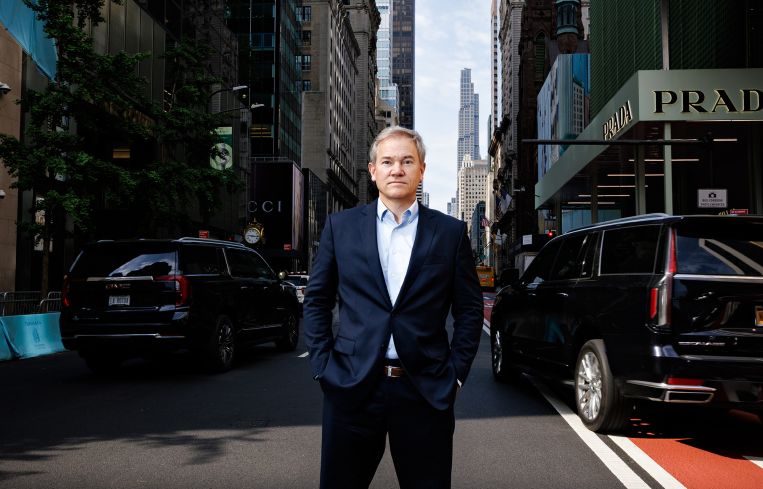
With the eye of an architect but the instincts of a retail professional, Ed Hogan has helped transform some of the dingiest crevices of New York City into highly sought-after locations and kept one of the toniest corridors in the five boroughs an elevated shopping destination.
But, now, after helping curate the retail experiences in Brookfield Place, Pennsylvania Station and Moynihan Train Hall, and crafting a vision for Fifth Avenue’s future, Hogan decamped from Vornado Realty Trust in January, where he was executive vice president and head of retail leasing, for real estate investment fund JVP Management. In doing so, he seems to be leaving his contributions to the public sphere for a seemingly more private chapter of his career.
Hogan will stay put as chairman of the Fifth Avenue Association, however.
As head of the city’s oldest business improvement district, Hogan has found himself in conversations that led to some of the biggest retail deals in New York’s collective living memory, helping convince Prada, Kering and Rolex that, despite the rise of luxury markets such as Brooklyn’s Williamsburg, Fifth Avenue would continue to be the center of high-end shopping culture.
The redesign of Fifth Avenue will begin in 2028, and is scheduled to wrap roughly seven years later.
Hogan sat down with Commercial Observer toward the start of May to discuss his journey in real estate, beginning with an early childhood interest in architecture, a role he pursued as an adult before flipping the script toward retail planning.
This interview has been edited for length and clarity.
Commercial Observer: How did you get into real estate?
Ed Hogan: I decided when I was 5 years old that I wanted to be an architect, and I went to undergraduate school at the University of Illinois and studied architecture, then worked for a small developer for two years in Manhattan, and then went back and got my master’s in architecture.
I was working at Skidmore, Owings and Merrill part time in Chicago and learning more about the profession, and it just dawned on me that I don’t know that I want to be an architect. I think I want to be a developer or owner of real estate, because it seemed like all the fun decisions were not being made by the architect. They’re being made by the client.
I ended up getting another master’s at New York University in real estate, and when I finished that up I was able to get a job with Olympian York, which is a predecessor to Brookfield. So I was kind of the last employee hired by Olympia in New York. About a month after I was hired, they went through a bankruptcy and were restructured as Brookfield.
This was the beginning of Brookfield’s expansion into New York. How did it evolve that you took such a prominent role in the planning of Lower Manhattan’s Brookfield Place?
When I started in `96, the World Financial Center was two stories of retail and 8 million square feet of office, and I oversaw leasing the retail there. And it was challenging. It was not designed well. It was kind of leftover space that they crammed retail into. So, after 9/11, everything was getting built downtown.
I went to [then-Brookfield Chairman] Ric Clark and asked, “Can we rebuild this so I can lease it? I’ve heard every reason why people don’t want to lease this for the last five or six years. If we physically make changes to the space, it’ll be much more desirable and leasable.”
So I worked with the design team and really acted as a client. It was very specific on how I wanted the flow and the layout of what is now Brookfield Place to work. It had about 180,000 square feet, and we needed to pop it to about 300,000 square feet. I came up with the idea of putting the food hall on the second floor, which has really been kind of a heartbeat for that project.
I said, “We should go after luxury.” At that time, there was really no luxury in Lower Manhattan. And my thesis was that there was so much money being invested in Lower Manhattan after 9/11, and, concurrently, leading up to 9/11, Tribeca was going from a marginal neighborhood to a very desirable neighborhood. So the buying power of people that live in Tribeca and Battery Park City was only increasing.
I made the argument that the class of office workers are going to have higher buying power. We were already seeing the residential buying power increase significantly, and now we were getting a much larger segment of the tourists coming to Lower Manhattan [with the 9/11 memorial].
Did you find that your dual background in architecture and development provided a common language between designers and potential tenants?
You can understand space, and it’s interesting to talk to some of the most creative fashion designers in the world. They can design the most beautiful outfit in the world, but they can’t visualize how their store might fit in a space. I could not tell them how to design clothing, but I can talk to them as a designer and say, “Hey, do you know your store in Beverly Hills — how, when you come in, it’s about 30 feet wide? So this is about 30 feet wide.”
If you can visualize how a brand would use the space, and, if you’re able to communicate that to the client, it’s a huge sales point.
You worked for Vornado for 10 years. How did their perception of retail change over that time, and how did you help them plan major transformation projects like the Penn District, Penn Station’s retail corridors and Moynihan Train Hall?
I, quite honestly, had spent most of my time in New York avoiding the Penn District area because I just never found it a hospitable place to be. So now it was my job to work on transforming that. Vornado had spent a lot of money hiring many of the best architects in the world and saying, “What would you do if we let you do whatever you want?”
They had study after study of what could be done, and what they saw was certain ideas kept coming up in different architectural solutions. So they really studied the area more than I’ve seen any other developer study an area. And that was really exciting to me — that so much thought was put into design and placemaking.
A lot of Moynihan was designed to eliminate the unpleasantries of Penn Station. They didn’t want people loitering. They didn’t want narrow corridors, they wanted wide corridors. They wanted sight lines, all the things that make people feel safe and welcomed. So it took more than a minute to convince the railroads, and anybody else, that we would benefit by having a food hall.
Every restaurant will have 10-plus employees working in there, and all those employees will look into the seating area. There’s not going to be any place to sit and hide and cause trouble. You’re going to be seen by a lot of people if you’re sitting in the seating area. We put a bar in there to energize it even further.
That project was different from Brookfield Place in that you had the railroads and other people that you had to bring on. It wasn’t just one decision-maker.
What were some of the factors that made the Penn District such fertile ground for retail investment?
We have a ton of office space, we have a ton of people coming into Madison Square Garden. We’re on top of the busiest transportation center in the Western Hemisphere. Why aren’t we servicing the needs of the people coming out?
So we started adding a lot of food to the neighborhood, knowing that fashion will follow food, and there’s a lot of fashion in the neighborhood. Thirty-fourth Street has always been a very productive street. You have the No. 1 Macy’s in the world. And, then, to the west, with Hudson Yards, Related built a beautiful project and brought in a lot of great retail brands there.
The problem with the streetscape is there’s only so many stores at street level, and Madison Square Garden is a big drum with no retail. So every store that you put in one of the Vornado buildings is very important because it cumulatively enhances and changes the neighborhood.
How did you get started rethinking Fifth Avenue with the Fifth Avenue Association? What were some of the problems you wanted to solve?
It was kind of an ugly street. The lampposts are old and they need painting. If I counted the trees that were thriving, there may have been 10 at the time. And I’m, like, this is not a beautiful streetscape. There was no street with more buses than Fifth Avenue, and up to 40 percent of those buses were empty. They’re just going back to the yard.
I started thinking about what could be done, and it’s more than planting some flowers and trees — we’ve got to make this better.
At the same time, under the de Blasio administration, the Department of Transportation was eliminating traffic throughout the city. Fifth Avenue has five lanes of traffic: two dedicated bus lanes, three vehicle lanes. They had a plan to make Fifth Avenue four bus lanes, one bike lane and no cars. This wasn’t making Fifth Avenue a place of beauty, and it’s certainly not going to be a place where people are coming together if it’s a bus highway. So I worked with all the members of the BID, and we went to City Hall and we stopped that plan from happening.
The answer can’t be that they paint the roadbed, put plastic barriers up and plastic furniture. We need to make those sidewalks new and beautiful.
We found out that the original width of Fifth Avenue was three lanes of traffic. The sidewalks were made narrower to accommodate cars in 1907, so going back to three lanes actually kind of made sense. Then we started studying the pedestrian flow during the month of December and, between 51st and 53rd streets over a course of an hour, you can have more than 24,000 people walk down those sidewalks. It’s basically Madison Square Garden emptying out on a block per hour, so the sidewalks are narrow, and it doesn’t make it a place people enjoy going to when it’s super crowded.
We hired FX Collaborative and Sam Schwartz, the engineering firm, and said “We need something bold but understated.”
Where did you draw inspiration from for the general concept of Fifth Avenue’s redesign?
You’ve seen the renovation of Times Square when they made Seventh Avenue into plazas. Retail asking rents doubled over the 10 years after they did that in Times Square. The High Line created significant value to all the buildings adjacent to it.
So renovating the front door made a lot of sense — not just to the retail workers, but to the office workers, the hotels. The thought was, if we have wider sidewalks, people can come together. There will be seating there as well. You can sit on the avenue. You can take a break. You’ll be in shade. It’ll just be a much nicer place.
At that point, as it was gaining steam, we hired Madelyn Wils [as the BID’s CEO]. She championed and led the development of Little Island [a public park off Pier 55] as president of the Hudson River Trust. She was in charge of that organization for years, so we were able to convince her to come over and spearhead this project. She was very instrumental in taking over the design, working with City Hall, and got the project through.
What are some of the factors complicating the Fifth Avenue redesign?
In the Adams administration, the project was fully funded with $350 million. Now our current mayor has just approved the first $36 million to be spent on design and engineering for the renovation of the avenue.
We recently found out that the New York City Department of Environment Protection (DEP) has been planning on spending $70 million to replace the water mains under Fifth Avenue, and they had a plan that really isn’t coordinated with anybody else, but it’s really going to be tearing up the avenue for over 10 years. We’ve also found out that Con Edison has their own plan to tear up the avenue to replace steam tunnels under that avenue. We have gone to Con Ed, we’ve gone to DEP and said, “The three of us are going to work together.” That’s where the engineering and the design is really taking place.
So two blocks can be torn up for no more than 12 months, and then you move to the next two blocks, but you could have multiple crews working at the same time. It’s very important to all the stakeholders that this project is very, very well planned and has a start and stop date that is reasonable. What’s fortunate is, if this project wasn’t happening, Con Ed would have done their project, and DEP would have done their project, and it would not have been coordinated.
I’m reminded of some of the earliest video footage of Fifth Avenue in the late 19th and early 20th centuries where the streets were wide and walkable.
I think it only makes sense to protect what is the most expensive real estate in the world. I believe a large part of that is that over 100 years ago New Yorkers were saying, “We want to make this street a beautiful place. We want to make this street a place where people come together.” They were really first to market in thinking about “What is a public space? How does it benefit everyone?”
Our goal is to continue that mission and that tradition. Lots of times, restoring things to the way they originally were built is the smartest decision.
You were involved in discussions with retailers like Prada, Kering and Rolex, which all decided in recent years to become the owners of the Fifth Avenue properties they operate out of. What was really the driving factor in that trend?
At some point, if you’re paying $4,000 a square foot in rent, you might as well just own the building. I think these retail brands also had a very, very good COVID. The luxury brands did very well during COVID, because people couldn’t fly to their house in Aspen, they couldn’t take a trip to Paris. So that clientele spent more on luxury, because they couldn’t spend in other ways. I think a number of luxury brands were flush with cash as a result.
The Fifth Avenue plan was very important to those buyers. They wanted to know the commitment of the city and the ability to execute the plan. It really said something to them — they’re making this investment, but the city also recognizes that it needs to make an investment as well.
They wanted to know the details. “These are beautiful renderings. This is great, but what are the details like? What is the commitment of the city? How is this going to be done? How fast will the project get built? How long will the sidewalk be torn up in front of my building?”
What are you expecting from ICSC Las Vegas this year?
ICSC is a really good gauge on what to expect in the year ahead. A busy ICSC means a healthy retail market. A slow ICSC usually means you’re going to be working hard, maybe not getting done what you want to get done for the next 12 months.
This is going to be a very, very busy ICSC. I can see the number of people going. I don’t know the count is, but I assume this is going to be one of their record turnouts. It’s gonna be different for me, because I’m joining my new company the week of ICSC. So I’m going into ICSC with a whole portfolio that I’m leasing and a full calendar.
What does JVP Management do, and what will your role be?
They invest in real estate, and they are also lenders on projects. I’ll be focused on a new project they’re developing in Frisco, Texas, which is called the Mix. It’s a 112-acre site that they’re building with 2 million square feet of office space, 350,000 square feet of retail and approximately 3,300 new residential units. It’s all new construction in a very dynamic part of North Dallas. So I’ll be working on that project.
They have other projects across the country, including New York, that I’ll be involved in as well. It’s going to be more entrepreneurial for me than the two publicly traded companies I’ve worked for in my past, but I’m looking forward to having the ability to be a little more creative and bring in business as well.
Mark Hallum can be reached at mhallum@commercialobserver.com.