Nashville’s Population, Business Growth Spur Commercial Real Estate Momentum
Major new projects in nearly every asset class are underway or recently opened, and the city is due to host the Super Bowl in 2030
By Andrew Coen June 16, 2026 12:00 pm
reprints
Something is brewing in Nashville.
In April, Starbucks announced plans to open a Southeast regional headquarters in Downtown Nashville that will house 2,000 employees. The $100 million investment that will involve leasing the entire 250,000-square-foot Peabody Union building is just the latest example of major corporations from a variety of industries noticing the Music City and gathering plenty of wind at the back of Nashville’s commercial real estate industry.
“It has become a pretty balanced economy that isn’t necessarily that reliant on one specific sector of the economy like, say, Dallas or Austin is,” said Andrew Donchez, partner and head of development at SomeraRoad who works in the firm’s Nashville office. “Health care is obviously a huge driver, but you’ve also got tons of tech [and] financial services with a number of big companies all looking at Nashville or already here.”
Technology companies have increased their presence in Nashville — long known for its thriving health care and music industries — and that tech trend will be amplified once Oracle moves its global headquarters to the city’s East Bank neighborhood. The 70-acre Oracle campus slated for completion around 2031 is part of a $4.5 billion investment by Oracle CEO Larry Ellison to relocate its headquarters from Austin, Texas, creating 8,500 Nashville-area jobs.
Music City’s CRE industry received more good news in early June when J.P. Morgan Chase announced expansion plans in Nashville with a 51,000-square-foot lease at 1600 West End Avenue in the city’s Broadwest area.
AllianceBernstein was one of the first financial services companies to make a big bet on Nashville in 2018, when the global asset management firm announced it was moving its headquarters there from Manhattan. The company relocated more than 1,000 jobs in a move that was projected to save $80 million per year in overhead and operational costs, according to a 2022 Bloomberg analysis.
Amazon also planted a flag in Nashville with a new downtown office complex that opened in 2021, housing more than 3,000 corporate and technology workers.
“Nashville was fiscally in a position to bring jobs and provide incentives, since they didn’t have a fiscal overhang that a lot of their competitive cities or older cities are are dealing with,” said Ian Ross, founder and CEO of SomeraRoad, who began investing in the city a decade ago. “It’s a city that people are excited to move to and be part of, and it’s a city that has embraced growth and change.”
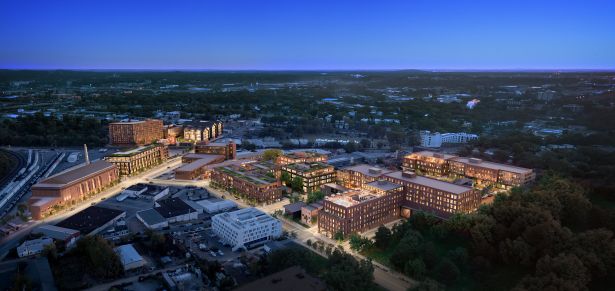
With more corporations humming along to Nashville’s business-friendly tune, including low corporate taxes, the city’s population has risen 5 percent since the 2020 Census to 726,586 residents. Nashville’s total metropolitan population has seen an average of roughly 80 to 90 new residents a day in recent years and a 14 percent population gain to 2.2 million since the 2020 census, according to data from the Federal Reserve Bank of St. Louis.
The population gains have benefited all the major CRE asset classes, according to Hutt Cooke, managing director in the Nashville office of brokerage firm Matthews, which relocated its headquarters to Nashville from El Segundo, Calif., in 2022. Cooke said rents have received a big bump from the rising population, particularly in the multifamily and retail sectors he is active in arranging investment sales for.
“With nearly 100 people a day moving here, there are going to be renters to occupy those multifamily properties,” Cooke said. “With retail, vacancies are less than 3 percent, and people are pushing rents even in an overall economic market where new construction rents are so high but retailers are still willing to pay it.”
Nashville experienced some oversupply issues on the multifamily front on the heels of the COVID-19 pandemic that pushed up vacancy rates, but Cooke said absorption rates have improved lately after construction leveled out the last two years.
Cooke also works heavily in industrial investment sales, and he said rents are increasing in Nashville logistics properties due to the city’s geographic proximity to a number of major markets.
Nashville’s hospitality market has also gotten a boost from the growing corporate presence, which means more business travel. This has prompted city officials to explore expanding Nashville’s convention center by approximately 587,000 square feet to help draw more conferences. The city’s hotels will also benefit from a new $2.1 billion enclosed Tennessee Titans stadium that can host year-round events and was selected in May to host Super Bowl LXIV in 2030.
Ben Weprin, founder and CEO of Nashville-based AJ Capital Partners, said hosting a major event like the Super Bowl will mark another big step in the city’s upward trajectory. He expects the stadium to also be in the rotation for other big sporting events like the NCAA Men’s Basketball Final Four.

“The momentum was already here, but every great city has a moment where they get magnified on a national and a global level that changes the trajectory of that city,” said Weprin, who served on Nashville’s Super Bowl host committee that advocated bringing the big game to town. “It’s a perfect city for events, and whether it’s the Super Bowl or NCAA Final Four or college football, they should all be here, and that facility will enable that to happen.”
Weprin, who moved AJ Capital’s headquarters from Chicago to a historic former factory in Nashville’s Wedgewood-Houston area, is now doing his part to transform the firm’s neighborhood with an 18-acre mixed-use project comprising 1.6 million square feet of office, retail and multifamily. The development has inked major office tenants that include the Academy of Country Music and entertainment giant Live Nation. It will also feature a 4,400-seat concert venue from Live Nation debuting this fall.
The Wedgewood-Houston project also opened a 109-unit luxury apartment building in early 2026 that includes ground-floor retail tenants. These include restaurants Momotaro and Alla Vita and whiskey bar Middleman, the first Nashville locations from Chicago-based Boka Restaurant Group. Tenants also include the boutique Perenn Grocery.
The wide mix of tenants the Wedgewood-Houston development has attracted coupled with high demand for the apartments in an area away from Nashville’s downtown reflects how the entire city has benefited from positive migration trends, according to Weprin. He said the presence of Vanderbilt University as one of the most competitive colleges in the nation and one of the top medical schools has further enhanced Nashville’s talent pool
“I think the biggest misconception about Nashville is that it’s a tourism story, as it’s actually a talent story,” Weprin said. “Talent attracts companies, companies attract capital, and capital attracts more talent.”
SomeraRoad’s longtime bullishness on Nashville was underscored by its decision to develop an apartment community at the former Grooms Engine warehouse property at 1414 Fourth Avenue South in Wedgewood-Houston, about half a mile from Weprin’s development. The 346-unit Emblem Park project with 13,000 square feet of ground-floor retail space was conceived on the 5-acre site after Ross acquired the property in 2019 with initial plans to use it for office space.
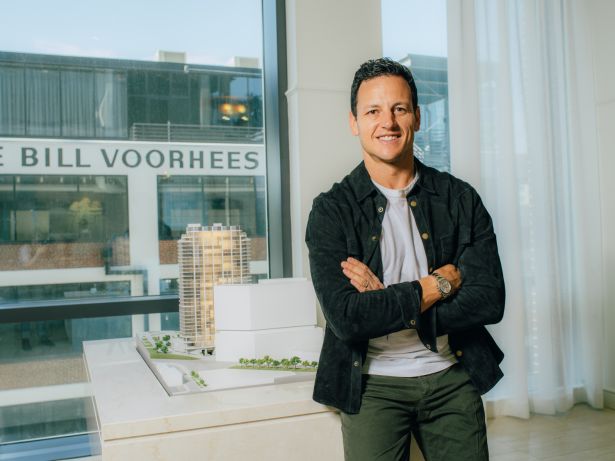
SomeraRoad is further planting its Nashville flag with the development of its Paseo South Gulch mixed-use district that, once completed, will consist of roughly 1 million square feet of residential, hotel and retail spaces. It is also exploring potential office use at the development, located south of Downtown Nashville.
The Paseo South Gulch development will include the Pendry Nashville Hotel & Residences, with 180 keys and 146 luxury condominiums. The large-scale project, which is more than half complete, includes a variety of retail tenants, including Carter Vintage Guitars, Mexican restaurant Maiz de la Vida, sandwich shop All’Antico Vinaio, Barista Parlor and Equinox.
Ross noted that the presence in the development of Maiz de la Vida, which USA Today in February named one of the nation’s best restaurants, epitomizes what makes Nashville a special market to invest in. SomeraRoad discovered chef Julio Hernandez on Instagram when he was selling tacos out of a school bus in East Nashville and decided to capitalize the business, resulting in the opening of its first brick-and-mortar location.
“Everybody’s trying to level up and keep up with this rapidly growing, rapidly changing, rapidly elevating market,” said Ross of the community spirit that often exists in Nashville’s business community. “Everybody is very supportive of the continued initiative to grow the city.”
As Nashville continues to scale new developments, however, rising property taxes resulting from reappraisals are causing growing pains. Nashville commercial property owners in July 2025 were hit with 26 percent and 39 percent tax hikes depending on where they were located, with those in the outer reaches facing the larger rate hike.
The escalating taxes prompted the early 2026 formation of the bipartisan Nashville Property Tax Coalition, featuring more than 300 small business owners, to advocate for tax relief from local lawmakers.
The population surge has also created infrastructure challenges, with increased street traffic in a city that has limited public transportation. Nashville Mayor Freddie O’Connell announced $100 million in transportation improvement projects last October, which SomeraRoad’s Donchez said marks an important first step toward further enhancing Music City’s ability to land further investments.
“For a city that had an explosive decade of growth, it’s catching up from an infrastructure, transportation, streets and road standpoint, but I’d certainly rather be in that position than in the opposite,” said Donchez, who moved to Nashville in 2022 from New York. “That’s a good problem to have — to catch up the city’s infrastructure to the growth that it’s experienced. I think they have the resources to do it, and they’re going to fight the battle and make sure that they set the stage for Nashville’s next 10 years of growth.”
Andrew Coen can be reached at acoen@commercialobserver.com.