

Can Nithya Raman Make L.A. a City of Yes?
Mayoral hopeful Nithya Raman offers a blueprint for more, faster housing development
By Patrick Sisson July 28, 2026 12:25 pm
reprints
In the race for mayor of Los Angeles, housing — and the subsequent problems of affordability, homelessness, economic opportunity and safety that are so closely intertwined — remains the issue of the day.
Progressive Councilmember Nithya Raman, who narrowly edged out realty TV personality Spencer Pratt to clinch a spot in the November runoff election, sees the crisis as one of the city’s own doing, and one that can be mollified with smarter policy that provides developers with certainty, speed, and more places to build.

“She sees there’re no silver bullets,” said Scott Epstein, director of policy at nonprofit Abundant Housing L.A. “I don’t think anybody should have the illusions that in the first year of the Nithya Raman administration, that everything is going to turn around and all of a sudden we’re going to have gangbusters housing production pipeline. But I think when you look at the totality of what she is proposing, it is really changing the culture around housing production in the city. It’s saying we’re going to be a city of yes.”
It’s a YIMBY-friendly approach that befits Raman’s technocratic nature. She’s an MIT-educated urban planner by training, and current head of the City Council’s Housing and Homelessness Committee who has long been in the weeds in the city’s housing debates. If elected mayor, her ability to issue executive orders and shake up city agencies could be a promising start to a mayoralty built on housing reform.
“Building in any city in California, especially Los Angeles, is complex,” said David Garcia, deputy director of policy for the University of California Berkeley’s Terner Center for Housing Innovation. “A lot of the solutions are to create certainty through simplification of the process. The kind of things she’s talking about in her housing platform speak directly to that issue.”
Raman’s campaign did not respond to opportunities to comment for this article by press time. But her policy blueprint promises to triple housing production and allow the City of Angels to remain “a city of opportunity that welcomes people looking to build their dreams here.”
And while it may seem like a candidate who aggressively seeks to upzone and make the city bureaucracy more friendly to builders would be an odds-on favorite for real estate interests, Raman is also seeking to strike a balance that has challenged other progressive mayors, such as New York’s Zohran Mamdani and Seattle’s Katie Wilson.
While all these existing and potential progressive city leaders have different approaches and philosophies, they broadly support efforts to make it easier to build, and are strong backers of robust tenant rights, and even social housing. Many real estate owners and operators will say that while making building easier is helpful, if it costs more to operate their building, that still weighs on their bottom line and ability to deliver new apartments.
“The city’s record on making this a place where landlords can do business is abysmal,” said Mott Smith, a founding board member of the Council of Infill Builders. He argues that Raman may push tenants rights issues in the election, because “there are a lot more renters than landlords who vote.” She’d previously supported just-cause eviction protections and strengthened the city’s rent stabilization ordinance. But he’s hopeful once in office she’ll govern more with a functional system in mind.
One of perhaps the few points of agreement across the political spectrum in Los Angeles is the need to reform its housing system. Homelessness remains endemic, with 45,194 Angelenos unhoused, according to the latest county data. (Raman, whose district saw homeless numbers cut in half, credits her council office’s “interventionist” approach to the local success.) The city also remains significantly off course to hit its state Regional Housing Needs Assessment goal of 456,643 units by 2029. Last year, L.A. permitted only 8,714 homes, and the pipeline, especially for multifamily, is shrinking.
“Both candidates are walking into a situation where the city needs to make drastic changes relatively quickly in order to make any progress towards getting anywhere near that major production goal,” said Garcia.
Raman’s vision encompasses zoning reform, including adding more high-rise districts, encouraging more missing middle apartment projects, and changing zoning in single-family neighborhoods, especially to allow more density near transit hubs.
A huge part of Raman’s housing plan seeks to accelerate development timelines. She proposes a shot clock that would limit delays on approvals and a variety of ways to cut red tape: single inspectors for most projects, the creation of a self-certification program, the start of a housing board to more quickly manage land use disputes without political interference, and the introduction of a strike force to speed up collaboration and utility approvals from the L.A. Department of Water and Power (LADWP). Smith says the No. 1 request he hears from builders is better project planning and delivery from LADWP.
While speed is a major benefit, the real advantage to these kinds of fixes to a city’s housing bureaucracy is certainty, said Garcia. Developers bemoan delays and long approval cycles that can stretch out carrying costs and make it more expensive to build.
“The homes just don’t materialize because you change the zoning,” said Garcia.
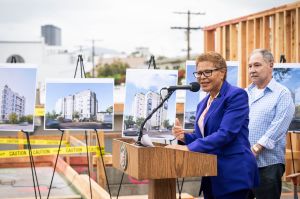
Raman’s policy platform also represents some significant breaks with the current mayor, Karen Bass. Raman has said she’s decided to run at the last minute out of a frustration at the lack of progress, while Bass has portrayed the two-term councilmember and member of council leadership as anything but an outsider.
Most significantly, perhaps, Raman has made a stronger commitment to new state housing laws that seek to densify neighborhoods around transit. Raman has been more full-throated in her support of SB 79, the state bill to allow more density near transit stops, including in single-family neighborhoods.She believes it will help densify and desegregate the city.
Bass, however, has often rolled back efforts to add density to single-family neighborhoods, including pushing back on SB 79. The city ultimately passed a much weaker version to delay SB 79’s impact, and Bass watered down the areas of applicability of her signature ED1 plan for adding non-subsidized affordable housing across L.A. (Raman has gone on record supporting ED1 projects in her district.)
Raman also faces an electoral landscape in which some real estate operators and investors feel unhappy with the state of leadership, according to real estate and eviction attorney Avi Sinai. First, there’s the successful re-election races for Democratic Socialists of America-affiliated councilmembers such as Eunisses Hernandez and Hugo Soto-Martínez. (Raman became the first DSA-endorsed candidate to win a city office five years ago.)

Then, there’s the city attorney’s race, where Marissa Roy — who has campaigned on stronger enforcement of tenant protections — made the runoff. There’s a sense that significant opposition to their policy platforms is gaining strength. Plenty of real estate players opposed Raman, especially for her tenant’s rights and anti-displacement stances, and backed Spencer Pratt earlier in the race.
“The DSA wing is here to stay, and it’s getting stronger,” said Sinai. “That’s really starting to settle in for many.”
But Raman doesn’t lack support from different corners of the real estate world, especially those who have firsthand experience with her longtime engagement with housing policy, and developers who are excited by her commitment to building in more corners of Los Angeles. Epstein said “there’s a lot of people in the real estate world excited about Raman,” and land use attorney Dave Rand has been outspoken in support of the councilmember’s campaign.
“Nobody is the ideal candidate for the real estate industry or for the community,” said Smith. “I would say the current mayor has been a grave disappointment in terms of making Los Angeles a place where builders can do business, let alone want to do business. And Nithya is a hopeful alternative.”
Fundamentally, Smith said, Raman isn’t political, she’s a technocrat, and one of the only politicians he’s come across willing to truly get into the weeds about the minutiae of housing policy and processes. While she may not be the perennial deal-maker, she can be persuaded by data, a trait demonstrated by her shift on Measure ULA, which began in April 2023. Raman was originally a huge supporter of the measure, dubbed the “Mansion Tax,” which added a sliding levy, starting at 4 percent, for sales of any building over $5 million, including multifamily units (though it’s since been a significant weight on multifamily transactions). The housing industry has been in stark opposition to ULA. Raman, however, persuaded that the policy isn’t working, led an effort to reform the measure in the City Council that ultimately failed.
“If whoever is in charge in the City of Los Angeles can be persuaded by reality, we’re five steps ahead of where we’ve been for a while,” said Smith.
The candidates’ takes on the twin issues of housing and homelessness might be deciding issues, despite the fact that each problem remains incredibly unlikely to get anywhere close to a solution in a single term.
“It’s hard from a politician standpoint,” said Garcia. “The challenges are easily identified: lack of supply and high costs. But the actual solution sets are complex. You can’t just say one thing on the campaign trail. You have to demonstrate you’re serious.”


