

CRE Loan Spreads Tighten Across Property Sectors
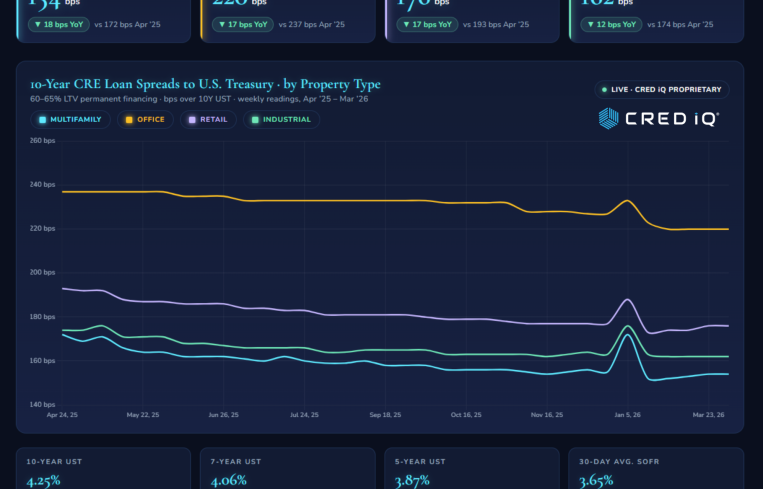
Commercial real estate loan spreads have compressed meaningfully over the trailing 12 months, improving refinancing conditions for borrowers across the four major property sectors. CRED iQ’s proprietary loan analytics show 10-year CRE spreads to U.S. Treasurys tightening between 12 and 18 basis points from late April 2025 through the end of 2026 first quarter, with multifamily leading the move and industrial lagging.
Where do CRE loan spreads stand as of Q1 2026?
As of March 31, 2026, CRED iQ-tracked spreads over the 10-Year U.S. Treasury on 60 to 65 percent loan to value (LTV) ratio permanent CRE loans stand at 154 basis points for multi-
family, 162 basis points for industrial, 176 basis points for retail, and 220 basis points for office. With the 10-Year Treasury at 4.25 percent as of April 8, these spreads translate to implied coupon rates of roughly 5.79 percent for multifamily, 5.87 percent for industrial, 6.01 percent for retail, and 6.45 percent for office. The 66-basis-point gap between office and
multifamily captures the persistent sector-specific credit concerns still embedded in lender pricing.
How have CRE loan spreads moved over the past year?
The tightening has been broad-based but uneven. Multifamily compressed 18 basis points from 172 bps in late April 2025; industrial tightened 12 basis points from 174 bps; retail tightened 17 basis points from 193 bps; and office tightened 17 basis points from 237 bps. Office spreads were particularly sticky through mid-2025, holding near 233 to 237 bps until a stepwise tightening began in November 2025. The most meaningful leg of compression across all four property types occurred in the first quarter of 2026, coinciding with moderating Treasury volatility and renewed conduit issuance activity.
Why does office still price as an outlier?
Despite the year-over-year improvement, office remains roughly 66 bps wider than multifamily and 58 bps wider than industrial. CRED iQ delinquency and special servicing data continue to show elevated distress in the office sector, and lenders are pricing that credit risk into spreads on even well-
underwritten permanent loans. The wider office pricing also reflects continued caution around rollover risk heading into the 2026 maturity wall. Retail and industrial have converged closer to multifamily as credit performance in those sectors has remained comparatively stable.
What does this mean for 2026 CRE refinancing?
Tighter spreads combined with a 10-Year Treasury anchored around 4.25 percent and the 30-day average Secured Overnight Financing Rate near 3.65 percent are creating a more constructive refinancing backdrop than borrowers faced 12 months ago. CMBS conduit 10-year pricing currently sits near 250 basis points over the benchmark, while life company 10-year quotes have narrowed to roughly 170 bps at 50 to 65 percent LTV. For sponsors facing 2026 maturities, the current environment may offer the most executable refinancing window since the post-2022 rate shock.
Mike Haas is the founder and CEO of CRED iQ.


