

Erik Rutter and David Weitz’s Oak Row Equities Has Proven a Master of Miami
The 8-year-old development firm known for splashy projects is undertaking its most audacious one yet in Miami's Brickell neighborhood
By Julia Echikson April 28, 2026 12:00 pm
reprints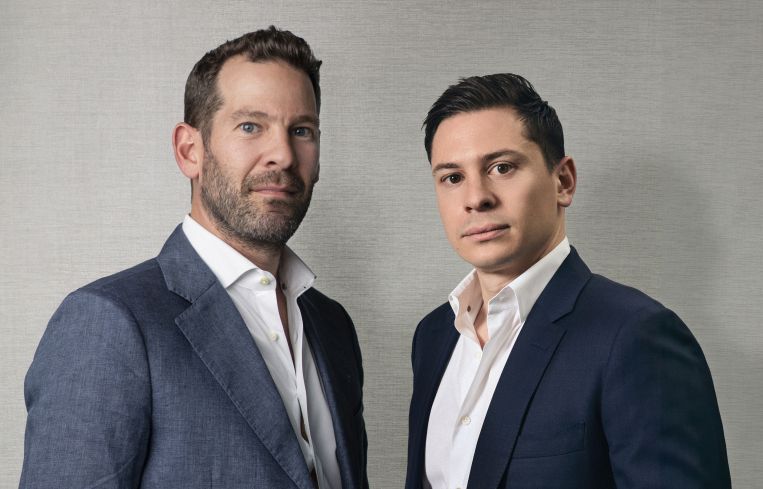
Erik Rutter and David Weitz met as recent grads while working in New York at Tishman Speyer. After just three years at the real estate behemoth, the two struck out on their own, launching the firm now known as Oak Row Equities in 2018.
The initial goal was to develop in Miami the kind of real estate they themselves wanted to inhabit, since the two were only 25 and 28 years old at the time, far younger than most real estate principals. It also certainly helped to have the backing of Weitz’s father, Perry Weitz, a lawyer who made a fortune fighting on behalf of workers who had been sickened by asbestos.
Still, Oak Row has made a name for itself in the years since by developing properties that have helped drive the growth of Miami neighborhoods, including Wynwood. The Miami district was transforming from an area laden with warehouses into one filled with new housing, restaurants, and clubs. But companies were slow to adopt.
Rutter and Weitz helped change that. Their first project, the Oasis, turned an old ship engine repair firm into a mixed-use development that attracted Spotify, which signed a 20,000-square-foot lease.
The firm followed with Wynwood Plaza, partnering with blue-chip investors, Shorenstein, a major office investor in San Francisco, and New York-based L&L to develop a 1 million-square-foot campus. The 3-acre, mixed-use project, which was completed last year, landed Amazon as a tenant as part of a 75,000-square-foot deal.
Now, Oak Row has set its sights on its most audacious project. Late last year, it closed on a 4.3-acre waterfront parcel in Brickell for a record $520 million with Oko Group, a major South Florida developer whose founder and CEO Vlad Doronin also owns the Aman ultra-luxury hotel chain.
In gross terms, the price set a record for Miami land, although Rutter and Weitz point out that the comparables per acre fall below the threshold, including the $363 million acquisition of a nearby, 2.5-acre site by billionaire Ken Griffin.
Commercial Observer caught up with the real estate prodigies to talk about their start and what’s to come.
This interview has been edited for length and clarity.
Commercial Observer: What gave you the confidence to start Oak Row?
Erik Rutter: I think that we probably had a lot of misguided confidence. We didn’t know what we didn’t know, and we thought that it might be easier to do. After working at Tishman Speyer, which was really an amazing place to start our careers and to learn the business, we felt that we had a unique perspective on how to create places that people want to live, work and play.
David Weitz: We were the target demographic of renter and buyer. So we knew what people like us wanted out of the spaces they were living in. I think that’s a unique perspective. If you look at the age — the vintage of managing partners and creators of real estate companies like ours — they’re typically much older, and with that comes a lot of gray hair and experience, but they kind of miss out on the nuances.
Can you give me a concrete example?
ER: When we identified Miami as a market that we wanted to invest in — Dave and I actually were both living in New York at the time — we rented an apartment in a submarket that we wanted to build in. We shared a two-bedroom apartment in Wynwood at the newest
multifamily building in the neighborhood.
I can guarantee you this: No other managing partners of real estate development firms that are doing deals the size that we’re doing are living in a rental product in the sub-
market that they’re building in.
It allowed us to understand pain points like vehicular and pedestrian access. How hard is it to get in and out during a regular Tuesday to go to Brickell? To go to your office? What happens to the neighborhood during periods of great influx and during a calm evening?
It’s one thing to have an idea and a vision. But how do you go out and secure a partner? Did you have one for the Oasis?
ER: We didn’t have a partner. It was an old ship engine repair firm, owner occupied. If a cruise ship dry-docked, they would repair the engine in these heavy industrial buildings, single-story warehouses that surrounded an asphalt parking lot.
We toured the Oasis with a friend, the Lombardi family, who were one of the first investors in Wynwood. They were actually representing it as a broker selling the site. They walked us into the building that’s now Spotify’s headquarters. There were 30-foot clear ceilings, completely column free, around massive engines from these cruise ships.
We knew that it would be amazing creative office space. We surveyed the market, and we realized the market didn’t really have any genuine creative office space, like you would find in Brooklyn or in the Meatpacking District in Manhattan. We felt in our gut that there was coming demand.
That’s the core thesis of our business from 2018 to today and going forward, which is that Miami, and really South Florida in general, should be home to every great company. It doesn’t have to be their headquarters, but every great financial services firm or tech firm should have an office in Miami in the same way that they have an office in New York, Boston, Chicago, L.A. or San Francisco.
It’s a gateway market where employees want to live. It has the red state benefits of taxes and tremendous quality of life. Pricing, of course, is crazy, but still generally lower than these other gateway markets. At a time when Google was building huge campuses on the far West Side of New York and in California for employee retention, their employees would start to push toward Miami.
You got Amazon to sign at the Wynwood Plaza. How did those talks happen?
ER: Amazon put out a market-wide RFP for 50,000 to 100,000 square feet of space in Miami-Dade County. And they had identified the classic three to four submarkets: The Gables in the South, Brickell, and the Wynwood-Midtown Edgewater consortium submarket. And then they were looking sort of east on the beach at any new construction. Amazon became a classic example of a tenant that cares about the quality of building that they’re in.
DW: We built the building anticipating a tenant like Amazon would come to this market. When we initially launched the Oasis in 2018, Spotify, Microsoft, Google, Amazon, Apple had all toured. They all subsequently signed leases in Miami. So we knew that the quality of the tenant was interesting. But the problem was the existing stock of office space in Wynwood was like a comedy of errors.
The size of the typical piece of land averages around like 30,000 square feet. With the zoning, you’re capped at 12 stories, and you’re governed by [residential] units per acre, not floor area ratio. What developers typically do is they’ll maximize their unit count in whatever footprint. And with the leftover space, they’ll fill it in with office, say around the liner of a parking podium.
That ultimately results in sacrifice uses on the multifamily and office side. The office ends up with a small lobby, no amenities or shared amenities with the residences. It’s just a type of office that no great caliber tenant would pay high rent for.
We needed to find a huge swath of land to build not only the stand-alone multifamily building that has its own suite of amenities, but also a stand-alone office building that stood true as a trophy asset that didn’t sacrifice amenities. That’s really what allowed us to win the Amazon deal. They wanted to be in Wynwood, but they needed to be in a building that was representative of who they were as a company.
How did the Wynwood Plaza come together? This time, you partnered with big names, Shorenstein and L&L.
ER: We ultimately acquired and assembled 15 parcels off market. On the corner of 29th and Northwest First Avenue, which was anchored by the former Rubell Museum. We put everything else under contract, leading all the way up to the Gateway office building.
DW: There were five different sellers in the peak of COVID, which we had to make all coterminous, so we could all close at the exact same time without any of them knowing about it. It was one of the craziest 12-month periods of time in the trajectory of our business.
How did you pull it off?
ER: Relationships. At the end of the day, real estate is still a relationship business. That’s part of why David and I love it so much. One of the sellers was a 90-year-old man who owned a single-family home and who was blind and had health issues. We built a relationship with him, his son and his caretaker. And we have a long-standing relationship with the Rubell family. They were at my wedding, and one of the evenings of my wedding was at the new Rubell Museum [in Allapatah.]
They weren’t mad with you when they found out about the broader transaction?
ER: We let them under the hood at the right time. The original reason for obfuscation was because we didn’t want the price to creep up and everybody to feel like they had holdout power. But once we had developed real relationships with everybody, they all understood what we were doing.
Dave and I pride ourselves on the fact that we bring a little bit of a different perspective on how to build a business in the real estate industry. Real estate has a reputation for a lot of hard-knock guys that will blow up relationships, burn a bridge to make a buck. That’s not our perspective on this whatsoever. We’re trying to build a business that’s going to be here for generations to come.
We knew we wanted to build this big office component: 270,000 square feet of office as a stand-alone part of the project. We wanted to bring in the best office developers in the country.
We had known David [Levinson] and Rob [Lapidus of L&L] throughout our careers in New York. It came together at the right time. They were expanding into Miami. They understood the Wynwood market. They did their due diligence, and ultimately partnered with us to buy the land.
And then we launched a large-scale capital markets process to raise the equity for the project, and we probably went out to somewhere in the range of 30 to 40 groups. Shorenstein, for a number of reasons, was the right partner to select on the equity side. And Bank OZK, who’s become one of our largest lending relationships in the market, was our senior debt.
Now I’d like to learn more about your most audacious project yet… I think you know what I’m talking about.
DW: Our eyes light up when we talk about it.
It took you a year to close the acquisition in Brickell. How did that play out?
ER: It’s one of those sites that, when you go, you just can’t help but smile. The sun is always shining on it. It’s 485 feet of bay frontage, 4.5 acres of developable land, two existing buildings spitting off cash flow today. One is a multifamily building, the other is a commercial building. It has so many unique and rare components for ultimately what can be, in our opinion, the site of the best-quality hotel and condo development in the city of Miami.
OKO, in our opinion, is at the helm of the best-quality product in the city of Miami and globally, really. We brought it to Fran [Scola] and to Vlad [Doronin]. And ultimately they toured it and also fell in love with it. We created a partnership to move forward and close on the site.
The vision is to build the best-quality condo that the city of Miami has ever seen. Miami Beach certainly has real luxury coming on the sand. But I don’t think the city of Miami yet has true luxury that’s been delivered on the condo side. And so the goal here is to deliver true luxury on the condo side.
DW: That’s the core ethos of our business. Our goal is to be the developer who builds best-in-class products in whatever market we are electing to build in for every different tax bracket and wage earner.
A lot of companies toured that site from what I heard. They were interested, but weren’t willing to pay over $500 million.
ER: That’s not necessarily true. [Aimco, the seller] had offers in the $600 million range, but with less accretive structure. There were a number of developers, some bigger names, that had prices that were above ours, but had closings even further kicked out. And given where Aimco is as a company, time was important to them. [Editor’s note: Aimco is now liquidating its 2,524-unit portfolio and various holdings.]
What do you say to critics who think $500 million is too much for land?
ER: The proof will be in the pudding. And if you look at it on the metrics — dollar per acre, dollar per buildable foot, dollar per buildable unit — that’s not what the comps would say, either.
What does best in class really mean? Miami has lots of luxury condos, like the Cipriani development nearby.
ER: The Cipriani project is totally different — it’s not on the water.
DW: More units and not nearly as highly amenitized than what we’re going to be bringing.
When do you plan to start construction?
ER: ASAP is our goal.
It’s been reported that you chose Janu, Aman’s new brand targeted at a younger audience, over Aman itself.
ER: That’s inaccurate.
Are you looking elsewhere? What markets do you like?
ER: We are looking outside of Miami Dade County. The obvious growth for us would be north in South Florida, so moving up into Broward and Palm Beach counties. We are actively pursuing opportunities in both.
We have another project in Miami Beach that we’re working on. It’s taking us a little bit longer to crack that best in class.
Lastly, how do you make your partnership work?
DW: Our partnership is built on a friendship more than anything. At the end of the day, he’s family. He’s like a brother. To have someone alongside me as we go through this together that is a friend before a business partner, it goes a long way. We’ve navigated uncharted territory together.
Julia Echikson can be reached a jechikson@commercialobserver.com.


