New York Office Market Leaders On Talent Retention, Affordability and AI
A recent Commercial Observer forum couldn’t help but elicit some braggadocio about 2026’s leasing pace and rising rents — but there were cautionary tales too
By Emily Davis November 5, 2026 5:36 pm
reprints
The movers and shakers of New York City’s office market converged upon Rudin’s 3 Times Square on Wednesday for Commercial Observer’s 2026 State of Office forum. Despite the competitive nature of their business, the gathered landlords, brokers and executives seemed almost convivial. The warm atmosphere was understandable, fostered by a scorching hot 2026 office market.
The gathering, kick-started by Hannah Rosenberg, senior analyst of portfolio management at U.S. Logistics Partners, was a victory lap for 2026 successes — record rents, a booming technology industry, months of leasing momentum and new supply lows — yet sour notes of rising interest rates and declining affordability tempered celebrations.
The balance between the boom time and challenges ahead was perhaps best described by Bruce Mosler, chairman of Cushman & Wakefield’s global brokerage and moderator of the forum’s first panel.
“We’re in a place that we haven’t been for a long time, a very healthy place in New York, and now the spillover from everything that’s happening in Class A is affecting the lease-up in Class B, and even parts of downtown,” Mosler said. “With that said, we also have rising interest rates, and we have inflation on the horizon.”
Mosler’s introductory conversation with Bill Rudin, co-executive chairman of Rudin, and Edward Forst, administrator of the U.S. General Services Administration, covered familiar ground for office market observers. The best offices are filling up, the industry veterans agreed, and New York City remains a magnet for talent. Just look at 350 Park Avenue, Rudin’s 1.9 million-square-foot trophy tower with hedge fund Citadel, or at Rudin’s 32 Avenue of the Americas property.
“Frankly, the space was sitting for a significant time,” Rudin said. “In the last six months, we have signed a lease for 100,000 feet, and we have a 200,000-foot lease out.”

In addition to announcing the appointment of Cushman & Wakefield’s Mark Weiss to become GSA’s public buildings commissioner, Forst shared the federal government’s mission to up the office occupancy of its top 24 agencies to at least 60 percent. While he cast doubt on the agencies’ ability to achieve that legal mandate by year’s end, there will be ample opportunities for deal-making as hundreds of thousands of federal office leases come up for renewal in New York City over the next few years.
The trio’s conversation continued to circle back to New York City’s ability to attract talent — including talented folks like legendary songwriter Paul Anka, whom Rudin ran into and secured a selfie with on Tuesday night.
“Companies want to be where the talent is, and the talent is here,” Rudin said. “Now, is that a God-given right? Absolutely not.”
Next came the day’s keynote panel, Inside the Office Deal of the Year, in which Dino Fusco, chief operating officer at Silverstein Properties, discussed the machinations and implications of American Express’ 2 World Trace Center deal. The panel was moderated by Jonathan Mechanic, Fried Frank’s chairman of real estate.
The message behind the financial giant’s 2 million-square-foot commitment was loud and clear to Fusco: Lower Manhattan is strong. Fusco argued that the area’s office vacancies, a years-long weakness, are now a magnet for tenants pushed out of Midtown.
Fusco and Mechanic discussed the downtown area’s relatively recent cultivation as a 24/7 community able to attract a younger workforce. Fusco used the example of consultant firm McKinsey & Company moving down to 3 World Trade Center eight years ago.
“They moved to 3 World Trade Center because the people they want to hire to work very long hours are the 22- to 35-year-olds,” Fusco said. “Those folks, these days — my children make up that workforce — want to live and work and have fun in the same neighborhood.”
Praise for Lower Manhattan flowed into the following panel, titled From Reset to Rebound, in a forward-looking conversation moderated by Jonathan W. Knipe, co-chair of real estate at Cozen O’Connor.
Dan Birney, RXR’s senior vice president and director of leasing, said the company’s Financial District office tower at 32 Old Slip is on track for about 350,000 square feet of leasing volume this year. The momentum there and throughout Lower Manhattan came as a welcome surprise.
“We have not done a significant deal there since pre-COVID,” Birney said. He added that prebuilds are the market’s hot-ticket item, particularly in Midtown South, and he’ll have his eye on office traction along Brooklyn’s waterfront next year.
Office rents will continue to rise at pace with the rebound, said Peter Riguardi, chairman and president of JLL’s New York region. That doesn’t mean building will get any cheaper, said David Levinson, chairman and CEO of L&L Holding Company, even with helpful tax abatements.
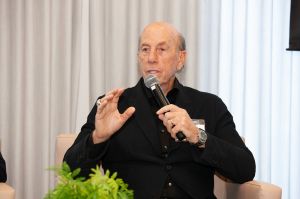
“This is a union city, it costs a ton of money, and it’s a very heavy bureaucracy,” Levinson said. “I build outside of New York City. What I build in Miami in 20 months would blow everybody’s mind in New York.”
The fourth panel of the event, Leading Workplace Trends, saw Josh Winefsky, partner at HSF Kramer, questioning panelists on the modern amenities that actually attract tenants and talent.
Despite the current market being filled with tight move-in timelines, David Goldstein, Savills’ New York tri-state region president, said occupiers are starting to move toward long-term planning as space becomes scarce, in what he called “a more scientific approach to labor and location strategy.”
Rising rents also promote the use of coworking, prebuilt spaces and flexible lease structures for tenants, said Chris Roth, chief operating officer at Global Holdings Management Group.
“A good old-fashioned blend and extend is a great way to keep the lights on while getting some good rent, reducing the amount of capex that goes out the door, and keeping everybody happy,” Roth said.
While Sage CEO Jonathan Iger has found midsize companies’ decisions remain largely driven by C-suite preferences, a “flight to experience” is turning his focus from amenities to high-quality service.
Reverdie Group’s founder Aisling Gregory shared her team’s efforts at the Woolworth Building to curate hospitality and brand partnerships, activating spaces at limited capital cost and creating a “self-containing, rich ecosystem.” That same approach was reflected in IBM’s consolidation of 10 office locations into a single site at 1 Madison Avenue, said Jennifer Stewart, IBM’s head of global real estate.
Next up, executives including Peter Brindley, head of real estate at Elecor Properties, and Gerry Lifrieri, senior director of international real estate at Omnicom Group, convened to discuss the looming 2026-to-2028 rollover wave in a panel titled The Great Lease Reset. The panel was moderated by Danielle Lesser, partner and chair of business litigation at Morrison Cohen.
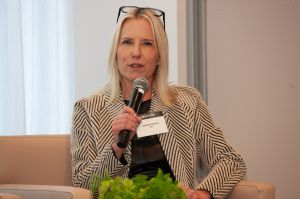
For owners of Class B offices, like Michael T. Cohen, principal at Williams Equities, and Ryan Kass, executive vice president at Empire State Realty Trust, today’s market has proven that Class B is far from obsolete, but the challenge ahead lies in delivering improvements while remaining financially sound.
“It requires a real measure of conservatism and a very long-term approach,” Cohen said. “But you’ve got to make sure the money’s there.”
Lifrieri said Omnicom Group is seeking shorter terms and more flexibility, and that means fewer 10-year leases.
“We don’t know where the directions of the market are going, and we need to be nimble,” Lifrieri said.
The morning’s penultimate discussion, Reposition, Repurpose or Redevelop, was moderated by CO’s own editor-in-chief, Max Gross. The choice between the three R’s comes down to the selectivity of capital, said Kevin Hoo, managing partner at Cove Property Group.
“From a capital perspective, the investable universe is significantly shrunk,” Hoo said.
“If you time the market really well, even at the bottom end of the spectrum, there will be reasons to reposition and do well, but I think we’re sticking to our knitting,” he added.
But Brian Steinwurtzel, CEO and principal at GFP Development, is finding opportunities in the broken capital stacks and “zombie buildings,” provided equity and debt holders are willing to transact.
Keith DeCoster, vice president of market data and policy at the Real Estate Board of New York, argued that more owners are willing to put more capital into buildings today, pulling some office buildings out of conversion considerations. Steinwurtzel said such efforts depend on the rents.
“When you have buildings that can be repositioned, highly amenitized, and the rents that you can achieve are well north of $80, then the tenant improvement packages to create gorgeous space are worth doing. There’s capital that will support it,” Steinwurtzel said. “The biggest challenge is when you have rents that are below $80 a foot.”
Adaptive reuse is a growing part of the KPF portfolio, said Andrew Werner, director at KPF. Panelists agreed that adding air, light and access to the outdoors is crucial to repositioning a building. Dynamic workplaces for hybrid schedules are in demand, as well, said Keith Fordsman, senior project executive at Gilbane.
“They’re reprogramming to expand capacity within the same square footage, or they’re looking to accomplish a renovation and end up moving assets,” Fordsman said.
Grossman welcomed Steven Rotter, executive vice chairman at Newmark, for the forum’s closing keynote, which largely focused on the AI wave. While AI leases still only account for 12 percent of the market, Rotter said, these companies are growing exponentially.

“We have clients who have zero employees today, will grow to 40 employees in six months, and then call us on a Thursday and say we need 100,000 feet by Tuesday,” Rotter said. “They’re growing that quickly, and the market is so crazy in SoHo, West Village, Meatpacking, and it’s created a lot of chaos in the market.”
While San Francisco is still top dog in the AI industry, Rotter described the West Coast city as a hub for early-stage development, while New York is the preferred spot for maturing companies.
AI tenants want amenities for talent retention and proximity to the venture capital their industry thrives on, Rotter said, and their demands are leading to bidding wars and off-market deals. Brokers have gone so far as to track companies’ fundraising to find “shadow opportunities.”
Rotter doesn’t believe AI’s rapid growth represents a fragile bubble, but he said high valuations don’t always mean a tech company is creditworthy. But what about AI’s disruption to Rotter’s own industry?
“People joke with us, ‘Is AI going to take over real estate?’” Rotter said. “I tell them that unless ChatGPT can bully and negotiate rents better with landlords, then hopefully our jobs are safe.”
Emily Davis can be reached at edavis@commercialobserver.com.