Small Real Estate Operators, Developers Commit the Most Deed Theft: Brooklyn DA
By Mark Hallum June 18, 2026 12:54 pm
reprints
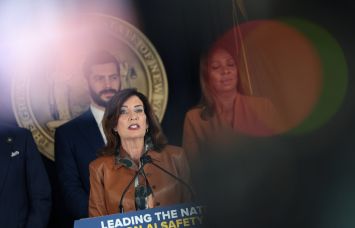
New York Gov. Kathy Hochul and Brooklyn District Attorney Eric Gonzalez visited a stately home in Bedford-Stuyvesant, Brooklyn, on Wednesday afternoon to brainstorm how to prevent deed theft.
While Hochul admitted that scammers will always find ways to defraud homeowners out of their properties, her administration has invested $44.5 million in prevention through education and legal services and is looking for the next step to curb a trend that is primarily hitting the outer boroughs.
But sitting in the dignified living room of Maurice and Marilyn Reid, members of the community organization Brownstoners of Bedford-Stuyvesant, Gonzalez provided a rare insight into who is behind these thefts, which seem driven by the scalding hot New York City residential market. Many of those behind the thefts are cunning real estate veterans.
“Some of them are on the finance side, some of them are real estate agents and Realtors. What we’re seeing is that they are networks of people looking to steal homes,” Gonzalez said. “The question is, ‘What is their interest?’ Some people are just trying to steal homes, others are trying to steal the land to build apartments. A lot of these homes have big footprints, so they want to build a nine-story building.”
Despite this general description, the range of scammers is still diverse enough to make it difficult to identify a specific type of person engaging in fraud, according to Gonzalez.
“[But] they’re strictly people who know they can make money by finding people who are vulnerable or behind on their mortgage or taxes, and then the question is, ‘What do they want to do with the property?’” Gonzalez said. “They’re small realty executives and developers that have 20 or 30 properties that they’re renting.”
By the time many victims realize that their deed was transferred to someone else, either through forgery or misrepresentation, they’re unprepared for a legal fight, according to Gonzalez.
They show up in court without representation to fight a deep-pocketed individual or set of individuals with a legal team defending their actions.
One example can be found in the case of Sanford Solny, an investor and attorney who was found guilty in 2024 of possession of stolen property, scheming to defraud and grand larceny. In a case prosecuted by Gonzalez’s office, Solny was sentenced to up to seven years in prison for stealing 11 homes across the borough and transferring the titles to 12 shell corporations he owned.
In the Reids’ home, Hochul announced that her administration has reserved $44.5 million from the New York State budget to combat the persistent problem, but with only $4.5 million of that going directly to support enforcement, community outreach and prevention through education.
The Brownstoners are one such organization that goes door-to-door arming homeowners with information about how real estate scams work.
The rest of that state funding will go toward housing counseling and legal services organizations around the state that help victims of deed theft, which occurs when a homeowner is tricked into turning over the deed to someone else in one form or another.
The new funding is a sign that the state will continue taking a holistic approach, as deed theft enforcement has proved difficult over the years and scammers continue to find unscrupulous ways into the New York City housing market.
There were about 3,500 deed theft complaints filed in New York City from 2013 to 2023, with 517 complaints in 2025 alone, according to the New York attorney general’s office.
Deed theft, surprisingly, wasn’t technically a criminal offense until 2024, when Hochul signed legislation classifying it as grand larceny, punishable by time in prison.
One state law that gave activists working against deed theft hope was 2023’s LLC Transparency Act, which forces limited liability companies to disclose the names of beneficial owners.
The act was somewhat declawed in its process of being approved by lawmakers and Hochul. Instead of the names of the people behind shell corporations being made public, those people’s identities are transparent only to some government entities, such as the attorney general’s office and the New York City Department of Finance.
This leaves nonprofits that are actually on the front lines with few options to actually know who they are contending with, sources told CO back in May.
Another law put in place in 2023 allows prosecutors to halt evictions and foreclosures in suspected cases, void fraudulent deeds, and extend the criminal statute of limitations to eight years.
While deed theft has been difficult to track — or even clearly defined — by the government, it has made its way into the spotlight in recent months.
In mid-April, New York City Councilmember Chi Ossé was arrested by the New York Police Department in front of a home in Brooklyn where the resident had been fighting eviction after the deed was transferred out from under them.
Mark Hallum can be reached at mhallum@commercialobserver.com.