Union Leaders Cite Inspection Process in Pfizer Conversion’s Near-Collapse
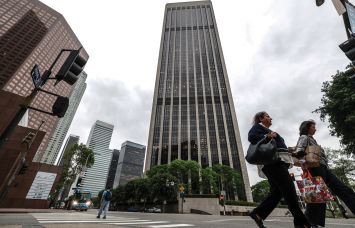
New York City for decades has allowed developers to hire third-party inspectors to certify the safety of projects such as 235 East 42nd Street
By Mark Hallum July 14, 2026 1:39 pm
reprints
The jury may be out on the direct cause of the near-collapse of the former Pfizer headquarters in Midtown last week, but union officials say the city can prevent such disasters with better inspections.
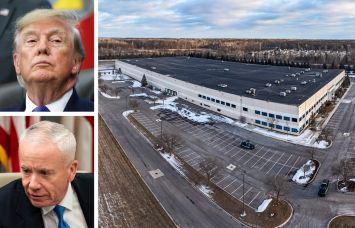
The swaying, sagging and shattering of 235 East 42nd Street put the commercial real estate industry, the local government and anyone within a five-block radius on high alert on July 7. Meanwhile, Nathan Berman, the main developer of the office-to-residential conversion at the former corporate headquarters, downplayed in the media what could have been a catastrophic disaster, further enraging the organizations who advocate for public and worker safety.
For now, there are no definitive answers as to what really happened — but organized labor has a pretty good idea of where to start finding them.
Union leaders shocked and angered by the near-disaster spent the last week railing against the city’s Professional Certification program and third-party Special Inspection Agency (SIA) approval process. Developers typically hire SIAs rather than have New York City Department of Buildings (DOB) officials approve work themselves.
In the case of 235 East 42nd Street, Berman’s Metro Loft and David Werner Real Estate Investments hired Domani Inspection Services to certify the work. Domani had decided work was done properly before the steel beams on the 21st floor began to buckle, leaving floors sagging up to four inches and windows shattered.
Domani has been associated with numerous violations in other projects and was widely cited in documents pertaining to the Pfizer building’s office-to-residential conversion project, according to The New York Times.
“The developer has publicly characterized this breach of integrity in the structural steel as a construction mishap — this is not a mishap, this is much more serious,” Gary LaBarbera, president of the Building and Construction Trades Council of Greater New York, told Commercial Observer. “On this project, they hired a company that was certifying to DOB, and I completely disagree with that model. … The fact of the matter is that DOB doesn’t have enough inspectors, and that’s an issue that has to be addressed.”
LaBarbera is waiting for the city to complete what is expected to be a very long investigation by the DOB to determine whether the near-collapse was the result of a material failure and if the integrity of the columns in other parts of the building are likewise compromised. In the meantime, he and other union leaders believe it’s time for a change in the inspection process.
“It is very clear to me that the owner made a conscious decision to maximize profits at the expense of a skilled and trained workforce and, frankly, at the expense of safety,” LaBarbera said. “If it is a [structural and material deficiency], that should have been picked up by the inspection company, which unfortunately it was not.”
The “open-shop” job had only a few union members on the worksite, and the non-union bid for the contract on the construction job was 50 percent cheaper than the union bids, according to LaBarbera.
“What about the rest of the building?” LaBarbera said. “If there are structural integrity compromises and the third-party inspection process is like, ‘No, it’s OK,’ can you imagine if this happened a year from now and there were people living in the building?”
LaBarbera plans to hold talks with city officials urging them to staff the DOB with more inspectors, following an understaffing issue that led the city to begin self- and third-party certifications to begin back in the 1960s.
Cliff Johnsen, business agent of Steamfitters Local 638, made similar statements on July 9, pushing back on Berman’s public comments that the collapse was a “freak accident.”
“Is it an installation issue? Is it an engineering issue? Possibly. But it is not a freak accident,” Johnsen told Commercial Observer. “From my point of view, if you take a Local 40 ironworker, 40 years experience, and you hand him a print — that steel setup, due to his experience, I believe he would have said, ‘Hold on, this doesn’t look right. Let’s take another look at this.’”
Johnsen said earlier in a press conference that day that inspections should be performed by DOB staff and that unions would trust the local government to ensure safety, especially on job sites that are not union contracts.
But the DOB argues that at least the third-party inspections have done more good than harm up until this point, and have been in use for almost 60 years.
“New York City has some of the strongest construction safety requirements anywhere in the world,” DOB spokesperson Andrew Rudansky said in a statement. “Special Inspection Agencies were first introduced in New York City’s regulations in the 1968 NYC Construction Codes, when they were known by the name ‘Controlled Inspections.’ These inspections performed by qualified independent third-party inspection companies are a standard in the construction industry across the country and are included in national model codes. Special Inspections have been an instrumental component of our development process here in New York City and have led to thousands of safe new building projects across the five boroughs.”
Ultimately, DOB is budgeted for a total headcount of only 1,837, according to Rudansky.
The SIAs have to provide technical reports to the DOB throughout the life of a project and can be audited, leading to fines. In 2008, the city passed laws requiring that SIAs register with the DOB, develop qualifications for inspectors, and set standards for inspections.
SIAs also have to be state-licensed professional engineers or registered architects.
But LaBarbera believes the practice of SIAs and self-certification is ultimately flawed, considering that those inspectors are hired and paid for by the developers.
“Essentially you’re policing yourself,” LaBarbera said. “It’s our intention at the Building Trades to have a significant amount of conversations with both the mayor’s office, DOB, and the City Council about what’s going on here, and I feel that there should be some additional rule changes. I will advocate for more inspectors to be brought into the DOB, where they’re not being paid by an owner to certify what the owner is doing is right. It’s an insane model.”
To Real Estate Board of New York President James Whelan, however, what happened at the Pfizer building is more the exception than the rule.
“By every appearance, this appears to be an isolated incident and not a systemic indictment of office-to-residential conversions,” Whelan said in an interview. “New York has been doing conversions for decades now. … I think there’s a moment of reflection and analysis going on by many parties right now — owners, developers, lenders, government — to assess what happened and why. I’m sure everybody is reviewing their own projects to make sure that everything is OK.”
Over the last few decades, according to Whelan, about 30,000 housing units have been created through office-to-residential conversions.
“In the last few years, city and state leaders have done a really good job putting together one of the best conversion programs in the country, and it’s shown, coming out of the pandemic, how the frequency of conversions are picking up,” Whelan added.
In terms of reforming the inspection practices that have been in use, Whelan does not see a trend that would require the government to reconsider how it greenlights the quality of construction.
“It’ll be an opportunity to see how the system is working, but, by all indications, the system is working very well,” Whelan said. “We’re not running into a spat of construction accidents throughout New York City.”
Isolated though such accidents may be, assertions of poor construction quality have plagued Berman in recent months, almost enough to be a trend.
At the condo tower at 443 Greenwich Street, the A-list celebrity residents have been suing Berman for $375 million for alleged construction defects during the residential conversion of the property. That list includes names like Rebel Wilson, Harry Styles, Meg Ryan and Jennifer Lawrence. The condo board launched the lawsuit against Metro Loft in 2022, claiming breach of contract and fraud, along with defects leading to flooded penthouses, the New York Post reported.
Domani did not respond to a request for comment.
Berman and Werner’s conversion project at 235 East 42nd Street and the adjacent property at 219 East 42nd Street is set to deliver 1,600 apartments to the market. It’s also just one of the 16 office-to-residential projects Berman has spearheaded since 1997, and the largest project of its kind in the country. It will surpass SoMA, Metro Loft and GFP Real Estate’s 1,320-unit conversion project at 25 Water Street in Manhattan’s Financial District, which was completed early last year.
“We continue to work closely with the Department of Buildings, and our focus remains on ensuring the site remains safe and that we can complete the repair work necessary to move forward with the successful completion of the project,” a Metro Loft spokesperson said in a statement.
New York City has seen at least three high-profile building collapses in the last decade, but never quite on this scale.
In 2022, the DOB ordered the landmarked 14 Gay Street in Greenwich Village to be demolished after Nazarian Property Group took renovations in the cellar beyond the scope approved by the city.
In 2021, the historic buildings at 44-54 Ninth Avenue had to undergo drastic repairs after a registered design professional reported that the facades of the brick 1840-built properties were detaching from walls as Tavros Capital renovated the buildings and built a new structure behind them. The DOB ordered that the facade be brought down to prevent disaster, and Tavros rebuilt them.
In 2019, a construction worker was killed while crews worked to rebuild the Beth Hamedrash Hagadol synagogue on the Lower East Side after a blaze destroyed the historic structure.
Mark Hallum can be reached at mhallum@commercialobserver.com.