Culver City’s Housing Strategy: Don’t Be L.A.
Culver City (pop: 40,000) shows neighboring Los Angeles how to supercharge multifamily building
By Patrick Sisson June 22, 2026 12:23 pm
reprints
It’s not shocking to see heavyweights such as Lendlease, Lincoln Property Company and Hudson Pacific Properties building apartments in Southern California. What’s unique about this moment is that all have substantial projects centered around a city of just 40,000 residents that has barely seen its population budge for the last few decades.
Culver City, located in the “Heart of Screenland,” a nickname bestowed due to its handful of historic early 20th century movie studios such as Metro Golwyn Mayer, is encircled by part of the Westside of Los Angeles.

But this small, landlocked, Los Angeles County municipality, just about 5 square miles, has become a darling for developers due to city planning, a favorable business environment and smart economic strategies. It’s home to Sony Pictures Studios and the significantly expanded Amazon Studios, and it also has roped in big names such as Apple, TikTok and Chinese toymaker Pop Mart. And the city has pushed pro-growth housing policies, which include simply avoiding the same mistakes that have plagued neighboring L.A.’s moribund multifamily market.
“Culver is one of the hottest markets in L.A.,” said Taylor Avakian, a multifamily broker and founder of the Group CRE. “It’s the only submarket in L.A. where you have the tech story, the media and entertainment story, and there’s institutional capital, all converging at the same time.”
The city’s current pipeline of projects, just over 4,500 units, could add as much as 20 percent to the city’s population. Unlike larger metros such as L.A. (pop: 3.8 million), which has slow-walked many housing reforms and been reluctant to upzone single-family neighborhoods, Culver City has actually committed to building.
“We could have said no to housing,” said Culver City Vice Mayor Bryan “Bubba” Fish. “We could have skirted around it like so many other cities did.”
To help solve California’s ponderous housing crisis, the state government has mandated housing goals, known as the Regional Housing Needs Allocation, or RHNA. Cities need to zone to allow for a certain number of new homes or face penalties, including the so-called builder’s remedy that overrules local zoning control for municipalities that fall short. (Currently thousands of units are set to be built in Beverly Hills via builder’s remedy due to this intransigence.)
But Culver City is “blowing its RHNA numbers for market-rate housing out of the water,” said Fish.
“Culver City didn’t just put together something to make the state happy. They put together a plan that they wanted to actually implement, and that’s very rare,” said Spencer Kallick, a land use attorney and partner at Allen Matkins with multiple projects in Culver City. “A lot of cities talk about building housing. Very few make it a really clear priority.”
Culver City hasn’t always been such a draw. At one point, it used to make half the movies in the nation, but movie production declined in Culver City after World War II, and the small city became a bit of a suburban drive-through town with a conservative-leaning population. Large draws in town, like the Culver City Stadium and the Culver City Airport, slowly closed. For decades, its population has remained relatively flat. It held steady at roughly 38,000 people from 1980 to 2010. In the mid-1980s, the city stopped building multifamily due to Reagan-era tax reforms, said Fish.
But, in recent years, as the Silicon Beach phenomenon brought big tech companies and employment to L.A.’s Westside, and the 2016 extension of the Expo Line better connected the city to transit, Culver City has emerged as an alternative office destination with a shorter commute from Downtown and the Eastside. That in turn has attracted residential developers.
“What changed is the scarcity of land on the Westside, and a very clear focus on attracting and maintaining businesses in Culver City,” said Kallick.

Now, Culver City has cultivated new business tenants, including design shops around Ivy Station, a development adjoining a light rail stop, and the 11-acre Helms Bakery District, a historic bakery complex that now boasts an Ikea store.
The big housing policy shifts happened only in the last few years, when elections produced a pro-housing City Council majority that quickly took action. Fish credits part of the shift to a recent change in elections, from off years to more regular cadences in correlation with state and national election cycles, which raised voter turnout and allowed more pro-housing candidates to win elections. Now, said Kallick, a majority of the council is aligned on building more housing.
The city also legalized micro-unit apartments in 2020, and in 2022 the city became the first in L.A. County to abolish parking minimums, a textbook YIMBY move that, paired with transit-oriented development, helps cut development costs while decreasing car usage.
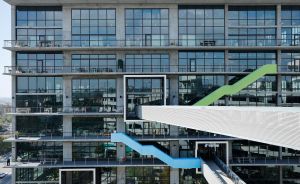
Culver City’s 2024 General Plan and recent Housing Element added more multifamily zones, which expanded the share of the city that was zoned for residential construction from 50 percent to 80 percent. That included areas like Fox Hills and the Hayden Tract, an industrial corridor that’s become home to experimental architecture and creative offices, which have been nexuses of new projects.
Other policy shifts will further encourage more development and density, like legalizing accessory dwelling unit sales and embracing SB 79, a statewide upzoning law that encourages more building near transit stops. Culver City has four stops that qualify, and Fish said the change will help build up the bustling downtown even further.
“Every little barrier we knock down is a victory, and the victories stack on top of each other and become a politically positive feedback loop,” said Fish.
Success also comes from what leaders didn’t do. The city never passed inclusionary zoning, which mandates affordable units and can challenge pro formas for new projects. Instead, the city included a density bonus. Fish sees it as a misstep narrowly avoided. The city also has its own rent control and a transfer tax that, while the same concept as L.A.’s dreaded Measure ULA, doesn’t hinder development or make investors wary of finding an exit, Avakian said.
CityView CEO Sean Burton said his firm was one of if not the most active multifamily development company in the City of L.A. up until recently.
“We are down to our last new development in the City of Los Angeles, and it’s a deal that pre-dated Measure ULA,” Burton told CO. “We are not underwriting new development deals in Los Angeles. We’re building in Culver City, San Diego, Irvine, Walnut Creek, Seattle, Denver — so it’s not like we’re not building. But L.A. has become near impossible to build new housing because of ULA.”
Meanwhile, Culver City’s development pipeline has dramatically expanded in just the last year. Hudson Pacific Properties, a prominent studio and office real estate investment trust that developed a media campus downtown, is turning the former NFL Network office campus into a mixed-use project with 508 apartments and retail space. Dallas-based Lincoln Property has two Culver City projects, at 11111 Lincoln Avenue and 1238 Lincoln Avenue, which will add hundreds of new units. Alliance Residential is helping redevelop the Fox Hills area, a former planned community and office park, with 100 Corporate Pointe, which includes 351 units. Nearby, Link Logistics got the green light to knock down low-rise office buildings near the Westfield Mall and build more than 1,000 units. And the 6201 Residences by RCB Equities and REDA will add another 846 apartments.
“Any developer I’m talking to doesn’t see a reason not to go into Culver,” Avakian said.
It doesn’t hurt that Culver City also stands out as a live-work environment. Situated east of Interstate 405, it’s more central and car-accessible than other Westside options like Santa Monica. The city has faced significant affordability challenges like any fast-growing city, but it has hundreds of affordable units within its larger list of projects. The city even purchased a gun store on Washington Boulevard for $6 million in 2024, to prevent it from remaining a gun store, and sold the site to a developer, West Hollywood Community Corporation, which will turn it into 87 units of deed-restricted affordable homes.
While many of the city’s larger tracts have been spoken for, there’re still development opportunities. Fish spoke of the city’s desire to continue to densify via encouraging so-called “missing middle” housing, midsize multifamily that can be built on smaller lots.
Culver City also introduced a suite of policy changes to encourage this segment, including becoming the first city in California to legalize “single-stair buildings,” which feature a single, central mode of egress, and opens more floor space for bigger units in four- to six-story buildings. Avakian said he believes that redeveloping vintage, smaller `70s-era multifamily projects, due to the opportunities unlocked by the zoning changes, present a compelling case for investors to cash in on Culver City.
He’s even seeing developers target areas of L.A. just outside of Culver City, since it’s such a magnet. Wiseman Residential, for instance, is developing new projects on Venice Boulevard in L.A., near the Culver City border and light rail stop. In May, Lendlease began renting out space in Habitat, a mixed-use space with 260 luxury apartments and office space “on the corner where Culver City meets L.A.” Lendlease Managing Director Meg Spriggs said the project was buoyed by the tech giants in town and the magnetism in Culver, which is attracting more developments nearby and only getting stronger.
“They’re open for business,” said Avakian. “It’s crazy, but, if you let businesses thrive, then the whole city and neighborhoods will thrive. It’s not hard. Look at L.A. and Culver, and someone is doing it right.”