For Bank Lenders in Commercial Real Estate, Higher-for-Longer Rates Are a Test
It's one they hope to pass through greater selectivity and other strategies
By Andrew Coen November 17, 2026 11:09 am
reprints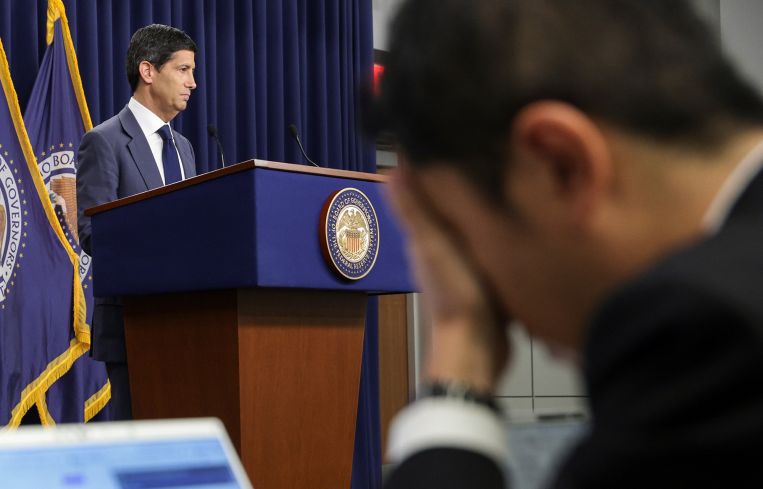
Meet the new boss, slightly the same as the old boss.
The closing lyric of the hit 1971 Who song “Won’t Get Fooled Again” is only part true when it comes to comparing new Federal Reserve Chair Kevin Warsh with his predecessor, Jerome Powell.
While both central bank leaders are hawks when it comes to fighting inflation, Warsh has sought to change other long-standing Fed policies like future guidance and the number of yearly meetings held to set interest rate policies.
The hawkish approach is top of mind, though, for the commercial real estate industry, and for bank lenders who are still processing the effects of higher-for-longer interest rates from the last nearly five years as they look to navigate more challenging conditions executing loans. While CRE bank lenders aren’t completely sidelined amid the prolonged elevated interest rate climate, they have grown increasingly selective about what debt to add to their balance sheets.
“Deals haven’t disappeared, they’re just taking longer,” said Joseph Fingerman, president of CRE at Peapack Private Bank & Trust. “As rates change during the due diligence process, both lenders and borrowers may need to revisit their assumptions.”
Fingerman noted that while other banks have pulled back from lending, Peapack remains active in the debt market and sees strong opportunities in “well-located properties with experienced, well-capitalized sponsors.”
The Fed’s Federal Open Market Committee (FOMC) raised its benchmark interest rate on Sept. 16 for the first time since July 2023, before enacting a pause at its Oct. 28 meeting. The 10-Year Treasury yield spiked ahead of the September FOMC meeting, crossing the 5 percent threshold on Sept. 14 two weeks after Warsh stressed inflation concerns during the Fed’s annual symposium in Jackson Hole, Wyo.
The FOMC’s dot plot grid released in September signaled one more rate hike is likely by the end of 2026, with the federal funds rate remaining at around 4.1 percent through the end of 2027.
Kurt Stuart, co-head of commercial term lending at J.P. Morgan Chase, said the bank has prepared well for the reality of sustained higher interest rates by staying disciplined when rates started to rise. Stuart said the multifamily sector he focuses on is shaping up to see an active lending year in 2027 from J.P. Morgan and other large banks that have proactively prepared for the moment.
“Whether interest rates are up or down, it’s more about whether or not a market participant is prepared for that situation, and this is a situation we’ve forecasted for a long time,” Stuart said. “We’ve been ready for it, and so we look forward to taking advantage of it.”
Stuart noted that J.P. Morgan is the largest provider of multifamily finance in the U.S. that isn’t a government-sponsored entity and serves around 19,000 rental housing operators. He stressed that the volatility of long-term interest rates in the bond market is what most often hinders transaction volume and makes planning for price changes on properties more difficult.
Eric Newell, chief financial officer of EagleBank, said many commercial banks stepped away from CRE lending over the last few years amid higher interest rates. Since returning, those banks have faced increased competition from private lenders.
Newell said EagleBank stayed largely sidelined from CRE lending in 2024 and 2025 due to heavy exposure to office properties in the Washington, D.C., region, but its lending pipeline is now growing for a number of new credit opportunities, particularly in the multifamily sector.
“The fact that we have the dry powder will allow us to grow that portfolio in a risk-adjusted way that’s appropriate given what is happening in the market in terms of interest rates,” Newell said. “I’m very optimistic that we’ll be able to grow our CRE portfolio in 2027 given our re-engaging in the market.”
Newell noted that EagleBank’s balance sheet has seen more than $1 billion of CRE payoffs over the past year, which has helped bring down the bank’s CRE concentration ratio to around 250 percent compared to nearly 400 percent back in 2023. The bank recently hired Ces Escamilla from Truist Bank as senior director of CRE strategic growth and Matthew Nader from Pinnacle Financial Partners as senior market executives for CRE to help reconnect with the real estate debt markets.
While EagleBank is better positioned than bank competitors who have more legacy CRE debt from before interest rates spiking, Newell stressed that elevated Treasury yields coupled with high inflation are pressuring cap rates. That means owners face more obstacles boosting net operating income (NOI), which will make it more challenging for the banking sector in the near term.
“If interest rates continue to stay at the level that they’re at and the expectations for growth of NOI decline, the cap rate will go up, and then, all else being equal, the value of the property will go down,” Newell said. “If they underwrote a loan and there was a 60 percent loan-to-value and then you fast forward to today’s environment, that 60 percent loan-to-value could be something much higher, and that could compromise the bank’s ability to resolve any type of situation that might come up with a project.”
Warsh has stayed committed to the FOMC’s long-standing goal of a 2 percent annual inflation rate, which was last met in February 2021.
The consumer price index (CPI) released Oct. 14 showed an annual inflation rate of 3.7 percent with a 0.6 percent month-over-month jump. No official yearly inflation rate was posted in the latest CPI report unveiled Nov. 10 since an October 2025 federal government shutdown prevented baseline data collection, but the report showed inflation rose 0.4 percent between September and October 2026.
The CPI report data prompted the 10-Year Treasury yield to rise past 5 percent again on Nov. 10 to 5.012 percent. Treasury yields closed Nov. 12 up 12 basis points to 5.12 percent.
Peapack’s Fingerman noted that the challenge of meeting this inflation goal has weighed on CRE owners, with swings in long-term rates driven by bond investors.
“Changing the target after missing it for five years would be a tough sell,” Fingerman said. “The Fed has to rebuild credibility first.”
Since assuming the Fed chair position this past spring, Warsh has pushed for the FOMC to remove its long-standing “forward guidance” approach to shape future monetary policy decisions. Warsh has not participated in the FOMC’s dot plot matrix as part of his efforts to dismantle this policy.
Fingerman said fewer data tools by the Fed means every inflation and jobs report will move rates more than previously, while also impacting underwriting of future deals.
“When the Fed stops telling you where it’s headed, the bond market fills in the blanks and charges more for the uncertainty,” Fingerman said. “Without a Fed forecast to lean on, borrowers and lenders have to plan for a wider range of rate outcomes.”
Andrew Coen can be reached at acoen@commercialobserver.com.