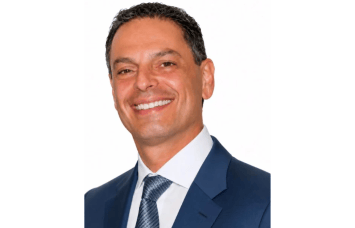
Wells Fargo’s Steven Caldwell on Leading in Vogue Large Loan CMBS
More commercial real estate borrowers are turning to the financing vehicle, and the ex-civil engineer’s team is among the busiest lenders
By Cathy Cunningham November 17, 2026 10:00 am
reprints
Eighteen months ago, Steven Caldwell joined Wells Fargo as the bank’s head of large loan commercial mortgage-backed securities (CMBS) after more than a decade at Barclays.
The past six years have been an interesting ride for commercial real estate, to say the least, but the CMBS veteran took his new seat at 30 Hudson Yards at an especially important time for his particular niche: single-asset, single borrower (SASB) loans, a sector that has dominated the CMBS market this past year.
According to CREFC, total private label CMBS issuance reached $150 billion through Oct. 30, up 16.6 percent compared to the same period last year. SASB transactions account for $86.5 billion of that total, and Wells Fargo is at the forefront of several of them, with buzzed about deals including the $1.9 billion loan for BGRE’s 2 Manhattan West, the $1.65 billion refinance for SL Green Realty’s One Madison Avenue and the $750 million Shops at Crystals retail financing in Las Vegas, to name but three.
Commercial Observer sat with Caldwell in early November to hear how the former civil engineer’s first couple of years at Wells are going, the market opportunities he sees today, and how his year is wrapping up.
This interview has been edited for length and clarity.
Commercial Observer: You’ve been at Wells Fargo for 18 months now. What drew you to this role, and how has your time been so far?
Steven Caldwell: It’s been an amazing 18 months. My primary reason for joining was relevance, because I think Wells Fargo is the strongest CRE platform on the Street, but it’s broader than that.
Wells is an incredible institution that offers a very deep product lineup with really phenomenal professionals across all products , whether that’s the REGAL [real estate, gaming, lodging and leisure] banking team coverage in the M&A universe or what we’re doing in specialty realty finance, the hotel space, the data center space, multifamily capital, or traditional balance sheet — as well as what I spend my day doing in CMBS land — joining something that’s really well integrated was really exciting to me.
I’d been at Barclays for more than 12 years, and the Barclays platform is more focused on pure play CMBS — although we also did balance sheet — but this is just a much deeper bench of professionals with great expertise.
Thinking about some of the market challenges of the past 18 months, what stands out as the biggest?
I think the most obvious challenge has been the rate environment. Over the past six weeks it’s caused our clients, and us as their advisers, to re-examine leverage, structure and what we’re able to do in terms of positioning an asset and loan to find liquidity in the market and depth of interest from investors.
A lot of that involves stressing valuation considerations as well as material credit events in the underlying credit profile — so tenant rollover, etc. With higher cost of capital, you really want a clear view of valuation. But even if we’re just looking at office loans, for instance, and we need cash flow after debt service to be applied to certain credit situations like tenant rollover, there’s less money to do that in a higher rate environment. So, it’s required a lot of time and energy to be focused on how we structure transactions in the right way to make investors comfortable.
I imagine there’s a far stronger advisory element to your role today, given all the complexities in the marketplace?
Yes. There’s an abundance of capital available, and so what we’ve experienced in the past year is that the breadth of credit profiles that we’ve been able to execute with has been pretty high. Most of what we do is pretty down the fairway from a credit profile standpoint. We’ve done a lot of industrial portfolios and I’d say nearly a third of what we’re transacting on is office, which other product types, for the past several years, have really stayed away from.
Within the office segment, we’ve done a ton of trophy transactions, but also transactions that are not only not trophy but are higher leverage deals. We’re still able to find interesting places in those capital stacks, albeit at a different price point than where trophy office is.
Overall, investors feel like the CMBS structure offers them a lot of liquidity, irrespective of where they are in the capital stack. We’re also happy we’re able to execute some transactions that you used to not see in CMBS, and I think we’re finding stuff that’s a better execution for borrowers overall when we’re mixing private credit interest, particularly in the bottom of the capital stack, with investment-grade bonds as well.
What do the deals you typically wouldn’t see go to the CMBS market look like today?
Previously, we really didn’t stray into anything that was very transitional from a business plan standpoint, and now we are.
Investors are really digging into the quality of cash flow, so there’s a ton of focus on that. But there’s an understanding that, “OK, we can solve for issues with increased structure,” or there’s just a different pricing point to tolerate a higher risk profile. We’re seeing more of that than we had seen previously.
SASB CMBS issuance is en fuego this year. What’s your take on that?
Yes, the team is extremely busy. It’s great, and I think part of that is that we’re seeing a broader credit aperture being able to find liquidity in the market today.
As I mentioned, office has been a growing segment in terms of the range of credit profiles that we’re able to execute, but we’re also seeing data centers as an increasing component.
Then, we’re anticipating that multifamily will also continue to grow in CMBS executions, from the standpoint of underwriting constraints through the agencies, and some of these capital stacks finding liquidity in our market because perhaps we can get more leverage executed through the system.
Given the recent AI sell-off in the stock market, which has since rebalanced, are you hearing any people changing their view on investing or lending on data centers today?
I think data centers are going to be a continued significant exposure in our market. We continue to see stronger deals and a mix of multi-tenant transactions as well as some of the investment-grade tenanted hyperscale transactions. I think CMBS will continue to be a place where these assets exist.
Conduit CMBS loans are harder to originate today given the interest rate environment. What are you seeing in that part of the market?
I don’t spend a lot of time on the conduit side of the business, but it’s more, I think, a fixed- versus floating-rate issue. The primary issue that I think a lot of borrowers are struggling with is: Do I want to lock into a higher interest rate environment, or do I want to let my transaction float? What’s the best source of financing for that, and how does that dovetail into a business plan at the asset level?
Of what we’re up to, just to put that into context, I’d say over over 80 percent of the transactions that we’re doing are floating-rate transactions today. We’re still doing fixed-rate transactions. Even in the current market environment, we have clients who just want to tie things up and put their financing to rest, and they’re not as focused on trying to time or perfect their view on where interest rates go or end up for their execution, and that’s fine. But I’d say we don’t have many of those borrowers. Most are looking to let the rate environment play out a little longer.
What have some of the transaction highlights been for your team this year?
Some of the transactions I’m proudest of this year build on Wells Fargo’s long-standing lending relationships and firsthand knowledge of the underlying real estate. We’ve provided CMBS financing to take out our construction and repositioning loans, as well as acquisition financing for new owners buying assets we previously financed for the seller.
In both cases, we’re bringing years of asset-level knowledge and experience to the transaction — not starting from scratch — and translating that knowledge into a strong CMBS execution for the client.
We also love large M&A transactions, and we’ve had the opportunity to be involved with several of those deals. We think they’re great, and investors tend to really like the larger transaction size from a liquidity standpoint. We also haven’t seen many deals that are acquisitions relative to refis, so those large public-
to-private transactions always get a lot of attention, and it’s new equity coming into a situation. So, we really like those.
Then, prior to my joining, the appetite to execute transactions that were a little more transitional was not really there, but this year we’ve been able to execute deals that have really necessitated a lot more in-depth credit dialogue with investors because they aren’t as straightforward a credit situation. It pushes the team to be really thoughtful about how to arrive at the right structure, to understand why we’re focused on it, and why we’re confident in the execution and in delivering that message to a borrower — in particular, that we’re not just attempting something, but we actually have conviction in an outcome because we believe in the resilience of the real estate through the cycle, we believe in the trajectory of the business plan, and we’re going to find liquidity.
Those types of transactions where it isn’t just off the shelf are ones I’ve been really proud of.
With all this capital chasing deals, what do you think your competitive edge is, and exactly how competitive is it out there today?
It’s too competitive.
But, there are a few things that we really lean on. One is an integrated team. Even though we’re different product teams, we — from a senior leadership position down — people across products communicate really well, and so we’re able to really think about client needs from a cross-product mindset without an ego or pride of authorship mentality. People want to get the right results for a client, so it leads to more life cycle lending where you can think of balance sheet loans that perm into CMBS financing. Or, we might already have a relationship on balance sheet, and that borrower has a situation that is perfect for CMBS. That integration is really helpful.
Then, with the frequency of deal issuance that we have and the fact that we’re leading so many of our transactions — not just participating in a high number of transactions — we have the most direct investor engagement. And that’s across the capital stack, from investment-grade bonds to risk retention or mezzanine debt. I think we just have real engagement from investors because they know we’re constantly in the market, and we have a strong bench to make markets in the secondary markets as well.
I think all of those things are critically important to how we’re able to service clients better and provide realistic solutions and a real viewpoint with authority and leadership.
Are you working with any borrowers this year that are new to CMBS?
We are, and I think our process and our expertise has really made some of those borrowers permanent converts to CMBS. We’re used to educating clients on what’s happening at any point in the closing and securitization process, and we convey transparency and give them the right advice and let them make the right decisions in that process. But we also have them feel like, “OK, this isn’t something that I have to be scared of, but something where Wells Fargo can help me understand what my options are and what’s the best way to move forward.”
I think something that we have been really proud of is what happens post closing. We want to make borrowers comfortable with how decisions get made, what special servicing interactions are going to be like, and have them understand that we want to facilitate an ease of use, from making sure they’re in touch with the right people post closing, and that decisions on their loan can be made as expeditiously as possible.
I saw that you studied civil engineering. What was your initial career goal, and how did you end up in CMBS?
I went to Cornell, where I studied engineering, and I stayed on to do a master’s in engineering there as well. I loved being an engineering student. At Cornell, it was really a pure engineering focus. I knew nothing about business whatsoever, but I liked designing things. I focused a lot on tunnels and retaining walls, holes in the ground, and structural engineering as well, but, during my last internship, actually prior to going into my master’s program, I knew I just didn’t want to do that as a job for the rest of my life. My wife, who I was dating at the time, was at Cornell’s hotel school, and so were many of my friends, and I’m like, “They’re all going into business. That seems really exciting.” A lot of them were doing commercial real estate, so I decided to take a commercial real estate class during my master’s year. I focused on trying to do anything corporate and was trying to parlay engineering into something else.
So, my first job out of school was with Exxon Mobil doing project engineering, and my first big assignment there was working in Paris for a month on a project in Normandy. Then the next project was going to be a three-year stint in Beaumont, Texas, which is a less densely populated area. And my wife said, “I think this is where I leave you if you’re going to go there.” Like, “I’m not relocating there.” So, I did what you’re not supposed to do and I quit without having a job lined up.
My wife and I were long distance at the time, so I moved up to New York. I reached out to my friend’s dad, Gary Barth, who was at Greenwich Group International, which is a brokerage firm and said, “How do I get to do what you’re doing? I’ve been designing buildings, but I want to marry up this idea of building things I love and business.”
Gary, who I hoped would have just said, “Here, I’ll give you a job,” didn’t do that at all. He said, “Take a bunch of classes at NYU, do night school, do whatever you can.” I had taken a job at Arup, which is a really well-known engineering firm, just so I could pay my bills, but I had a desire to transition into CRE. Gary gave me his whole Rolodex and said, “Look, reach out to these people and tell them I would recommend you.”
This was shortly after 9/11, and the job market was terrible. I wore out lots of pairs of shoes, going door to door, being told no on the phone, and cold calling people.
Finally, I met with Harvey Schulweis, who was the CEO of Town and Country Trust, which is a public REIT. I could tell he was going to say, “No, I don’t really need you,” and I said, “Look, Harvey, I will work for free for two, three months, whatever you want, and then maybe if you like me, you’ll hire me for actual compensation,” and he said, “I like that idea. … I won’t make you work for free, but I’ll make it X, and then we’ll make it 2X in a few months if we like how this is going.”
I was there for a couple of years as an acquisitions analyst. Town and Country Trust was a multifamily REIT, and so it was not the best time. I looked at 200 transactions and I think we bought one. We also owned a site that we sold to Brookfield that ultimately became Manhattan West, and then the REIT was ultimately taken private.
I was young, and I knew I still needed to learn a ton, and I had a friend who had worked at Fitch Ratings prior to joining a CMBS business. He’s like, “Look, you’ll get a ton of experience working for a rating agency,” and that’s really where I got deep into this world. This was 2006, and I started doing managed CRE collateralized debt obligations, which are now called CLOs. I learned all about structured finance and deal structure.
I stayed at Fitch for about five years through the financial crisis and really wanted a shift into banking. I had a short stint at Ackman Ziff for about a year, then Barclays was starting its CMBS platform. I knew people there and really wanted to take my CMBS experience from Fitch and apply it into a sell-side role. It was a great opportunity to do that because it was in the very early stages. We were probably fewer than 20 people when I joined there, and, by the time I left, I think we were 65.
It was a business that became very relevant and was a ton of fun for a dozen years, and, then, ultimately an opportunity at Wells came around.
It must have been such an interesting time to be part of that platform’s build-out at Barclays.
It was, and it’s also interesting to be in what was effectively a startup in a large institution, and having Larry Kravetz as a mentor. Working for Larry was a dream, and Eric Wu was my boss at Barclays as well, my direct boss. It was an incredible experience.
Was there one moment that you knew that CMBS was going to be your ultimate career?
While I was at Fitch. All of the largest transactions were really happening in the CMBS world back then, and the variety of credit from an asset-type standpoint — but also just looking at the underlying credits within that — was always really interesting to me, as was the structural aspect of CMBS. I always found it very fascinating.
And, then, just tying it back to Wells, the largest commercial real estate transactions in the world are happening on the 15th floor of 30 Hudson Yards, and it’s just a lot of fun.
Any holiday plans to wrap up the year?
There has been no time off through Nov. 11, and that’s OK [laughs], but we’re thinking about going to Argentina, and hopefully my wife did some research on that today. I said, “I really just need you to run with this, and drive the itinerary,” as I’ve no time. So, this is actually a very topical question [laughs].
Cathy Cunningham can be reached at ccunningham@commercialobserver.com.