

CMBS Distress Rate Climbs to 12.07% in March
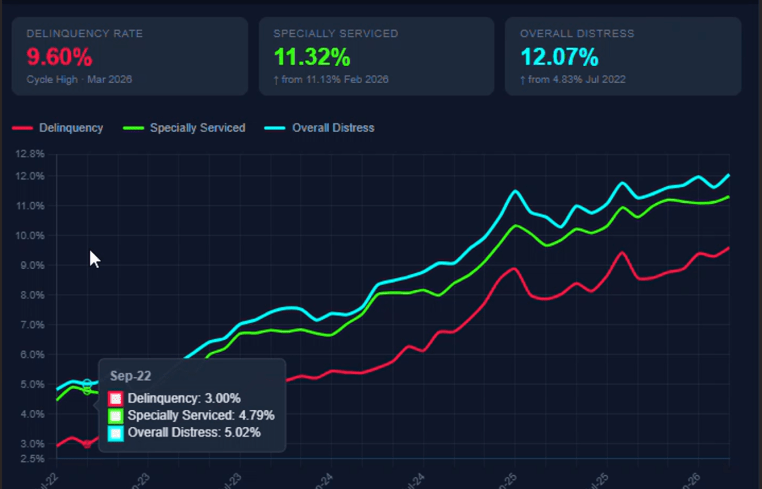
The overall distress rate for commercial mortgage-backed securities (CMBS) reached 12.07 percent in March 2026, according to CRED iQ data — the highest reading since the firm began tracking conduit loan performance.
Delinquencies rose to 9.6 percent, also a cycle peak, while the specially serviced rate climbed to 11.32 percent. For investors, lenders, and brokers navigating the current commercial real estate capital markets environment, these figures signal that the distress cycle remains firmly in expansion mode with no clear near-term floor.
As of March 2026, 9.6 percent of CMBS conduit loan balances tracked by CRED iQ are delinquent — loans that are 30-plus days past due, in foreclosure, real estate owned (REO), or matured with a balloon payment outstanding. That figure has more than tripled from 2.93 percent in July 2022, when the current distress cycle effectively began with the Federal Reserve’s aggressive rate-hiking campaign. The pace of deterioration has not been linear. A brief plateau in mid-2025, when the overall distress rate dipped toward 10.64 percent last March, offered a window of cautious optimism that proved premature. By December 2025, distress had re-accelerated to 11.7 percent, and the March 2026 print of 12.07 percent has now eclipsed every prior reading in the dataset.
Special servicer transfers: Volume remains elevated
The specially serviced rate of 11.32 percent in March 2026 reflects persistent loan workout activity across the CMBS universe. Special servicer transfer volume typically lags delinquency by one to three months, meaning the pipeline of loans moving into workout status continues to grow even as some resolutions occur. The gap between the delinquency rate (9.6 percent) and the specially serviced rate (11.32 percent) highlights how many loans are already inside the workout process but have not yet crossed into formal delinquency — a dynamic that suggests reported delinquency figures are likely understating true credit stress. Loan modifications, maturity extensions and forbearance agreements have become the dominant workout tools for special servicers, as lenders seek to avoid forced asset sales in a still-thin transaction market.
Capital markets implications
Elevated distress rates are reshaping CMBS spreads and new issuance underwriting in real time. Conduit deal flow in early 2026 continues at a measured pace as B-piece buyers price in rising loss expectations — particularly for office and retail collateral. Meanwhile, distressed debt buyers and special situation funds have deepened their engagement with CMBS REO and note-on-note financing opportunities, drawn by the expanding supply of underwater collateral. Cap rate compression in industrial and multifamily, which had provided a partial offset to office headwinds in prior years, has stalled as the cost of capital remains elevated relative to in-place income yields.
Outlook
With the delinquency rate at a cycle high and the distress pipeline still building, CRED iQ’s forward indicators suggest the overall distress rate could approach 13 percent by mid-2026 absent a meaningful shift in financing conditions.
The critical variables to monitor are the pace of loan modification expirations, the trajectory of the Secured Overnight Financing Rate and office property valuations — where bid/ask spreads between sellers and buyers remain wide. Until those gaps close, distress is likely to remain the defining story in CMBS credit markets.
Mike Haas is the founder and CEO of CRED iQ.


