

The Supreme Court Tariffs Ruling and Commercial Real Estate Investment: It’s Muddled
Some in the industry see little impact from the decision, while others lament the heightened market uncertainty
By Brian Pascus February 27, 2026 9:33 am
reprints
In the run of news headlines that have already seemed to define 2026, the Supreme Court’s 6-3 decision on U.S. trade announced Friday morning, Feb. 20., might be viewed as one of the more substantial ones.
In a somewhat surprising move, considering its clear conservative tilt, the high court ruled that President Donald Trump’s reciprocal global tariffs, which had been in place since April 2025 and rippled across the global economy, were, in fact, unconstitutional.
Stocks rose slightly following the decision — the Dow Jones Industrial Index hung around 49,000 points for much of February regardless, while the S&P 500 stayed strong at 6,900 — and bond yields held steady, with the 10-Year Treasury barely off its 4 percent metric in the days that followed.
Meanwhile, commercial real estate capital markets received the news with a mixture of relief and bewilderment, as the ruling served as yet another economic curveball for owners, operators and investors to grapple with.
“On one hand it provides some clarity as to the administration’s ability to single-handedly implement tariffs. On the other hand, being very frank, it seemed things had finally settled down, and corporate decision-makers had a position they could somewhat rely on,” explained Aasif Bade, founder and CEO of industrial real estate developer Ambrose, of the months prior to the ruling.
“So it did create a new uncertainty from that standpoint of ‘Where does this go and how will President Trump react?’” he added.
Trump, not surprisingly, reacted immediately, seemingly defying the Supreme Court’s ruling by playing fast and loose with what he can and can’t legally do as the country’s chief executive when it comes to import duties.
The court’s ruling applied to the International Emergency Economic Powers Act of 1977, or IEEPA, which Trump had used as the legal basis for his initial round of global tariffs. However, the ruling did not consider other, older tariff laws, leaving Trump the wiggle room he needed to announce a blanket 15 percent tariff on all imports just hours after the decision.
The Supreme Court’s ruling does not cover tariffs enacted under the national security concerns clause of Section 232 of the Trade Expansion Act of 1962 and Section 301 in the Trade Act of 1974. Trump used those laws as the rationale for 10 percent tariffs (with some countries expected to face 15 percent) on all imports for 150 days from just hours after the court ruling. He also used them earlier for higher import duties on steel, semiconductors, aluminum and other products from certain countries.
“Is this the one that will stick — 15 percent across the board?” asked Glen Kunofsky, founder and CEO of Surmount, a CRE investment firm. “Most likely it will probably change, but a lot of people in CRE world budget projects according to what [the tariff level is] at the time and can’t worry about the policy until it’s permanent.”
David Bitner, executive managing director of global research at Newmark, said that while he welcomed the court’s decision as an act of good jurisprudence, he is skeptical the ruling will do much to change the status quo of the global economy, mainly because the 15 percent tariffs will last for at least five months before they head to a Republican-controlled Congress for renewal.
He added that many of the other tariffs on steel and other commodities will serve as bargaining chips for renegotiated trade deals with other countries — keeping duties high for likely the rest of Trump’s final term in office.
“It was the appropriate decision in response to what seemed like a clear overreach by the executive … but, particularly speaking, does it matter for capital markets, leasing markets, and the U.S. economy? No, not really,” said Bitner.
Others, like Sam Chandan, director of the Chao-Hon Chen Institute for Global Real Estate Finance at New York University, noted how the economy grew at only a 1.4 percent clip in the fourth quarter of 2025, making clear how much relief was needed from what he called “unhelpful, tariff-driven inflation costs.”
“This ruling removes one of the key concerns relating to inflationary pressure from the supply side of the economy,” Chandan said. “Lower import costs translate into some margin restoration for businesses and purchasing power lift for households, both of which the economy currently needs.”
Moreover, some sectors of CRE are likely to be excluded from the worst consequences of Trump’s tariff-hungry appetite.
Mark Fitzgerald, head of research at Affinius Capital, told Commercial Observer that we’ve already seen carve-outs in recent trade deals for AI software and equipment, which the Trump administration recognizes is a national security priority, especially for the buildout of data centers. Fitzgerald said we should expect future exemptions for tariffs impacting construction materials used by homebuilders, especially with the U.S. in the midst of an affordability crisis.
“From a commercial real estate perspective, I don’t expect we’ll see a significant impact,” Fitzgerald said. “I just don’t think it changes a lot in the real estate sector.”
Holiday hangover
If CRE experts hold contrasting views on the significance of the Supreme Court’s tariff ruling, it’s probably because the industry is still recovering from the shock of April 2, 2025 — otherwise known as “Liberation Day.”
After Trump announced widespread, unilateral tariffs across nearly every U.S. global trading partner last spring, the S&P 500 and Dow Jones Industrial Index each fell more than 10 percent within weeks, while Treasury yields went haywire, rising 50 basis points one week in April and dropping 50 basis points before the month was out. Through it all, commercial real estate found itself placing deals on hold, postponing decisions, and pausing investment activity.
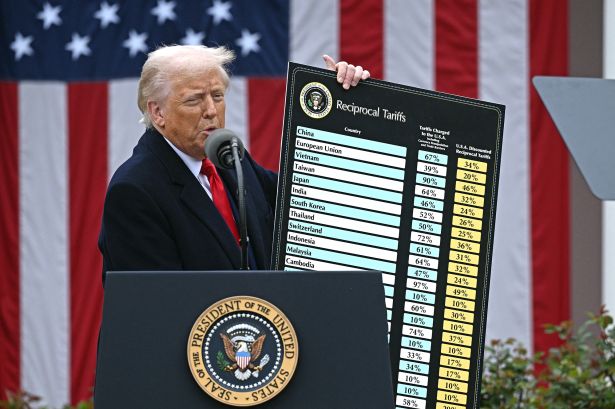
A post-Liberation Day survey of senior real estate executives conducted by the CRE Finance Council (CREFC) found that 80 percent of respondents expected worse economic conditions in the months to follow, with only 7 percent believing economic conditions would improve under higher tariffs. Moreover, CREFC’s sentiment index fell 30.5 percent that quarter alone.
“It created tremendous volatility, and I think back on that April and May time period as peak uncertainty,” said James Bohnaker, principal economist at Cushman & Wakefield. “We really saw a ton of volatility around that time, reflecting the regime change from a policy perspective in terms of magnitude and not knowing what’s next.”
David Greek, managing partner at Greek Real Estate Partners, said that the Liberation Day tariffs “were higher and much broader than the market had anticipated,” and that additional economic whiplash occurred after Trump added and subtracted tariff rates by fiat, changed targets, leaked rumors of trade deals, and announced trade deals without providing many details.
“That was almost as big an impact as Liberation Day itself — the amount of change that occurred over six months,” said Greek.
Greek added that capital markets require certainty. The recent Supreme Court ruling in some ways mirrors Trump’s announcements from last spring, he said, as it creates further questions around trade policy and will likely create a wary climate for decisions related to capital expenditures and investments.
“The Supreme Court ruling will be a similar outcome to what happened after Liberation Day,” he said. “This just introduces another vector of uncertainty, so now we need to be more cautious on how we’re spending money and making large capital decisions moving forward.”
Sentimental education
If the past is prologue, then it makes sense to look at whether the market’s temperature check from spring 2025 can tell us anything about how investors might handle spring 2026.
When speaking with CRE experts, industrial was selected (by wide consensus) as the main asset class to examine when attempting to grapple with the impact of tariffs.
Because of supply chain ramifications, and the fact that a typical industrial warehouse ships consumer and mechanical goods — from both domestic and international suppliers — if those goods are more costly to import, it stands to reason that entire business models will be placed in purgatory.
“We don’t know how it will play out given that the tariff policy is still in flux, but suppliers of foreign goods are strategically rethinking what the entire supply chain looks like, so that will have implications for industrial,” said Bohnaker.
Bitner said that even as the economy went gangbusters over semiconductor production and data center development in 2025, manufacturing on the whole still lost jobs last year. The Progressive Policy Institute found that U.S. manufacturing lost 108,000 jobs in 2025.
“It played into the manufacturing labor weakness we saw throughout the year,” said Bitner. “I’d feel confident in saying that our trade restriction, and the uncertainty attuned to that, was a factor in that weaker employment market.”
Ambrose’s Bade listed how most industrial supply chain projects involve large capital investments, usually ones that extend far beyond the physical real estate projects into robotics and mechanical handling equipment. The ongoing high tariff regime has thrown a wrench into C-suites facing down $50 million to $300 million of capital expenditures — making it likely 2026 will see more hesitation among major players across the asset class.
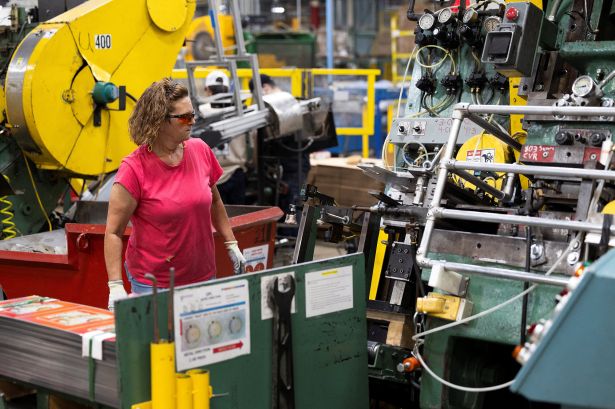
“From our view, somewhere between April 2 and September of 2025, any [industrial] C-suite said, ‘Do we really need to make a final decision on this enormous capital spend right now, or can we wait and gain clarity on how this shakes out?’” said Bade.
Even so, Bade and others pointed out that the high tariffs, and requisite onshoring of domestic production, resulted in the industrial sector having a great year, at least in terms of leasing.
Annual leasing in U.S. industrial rose 12 percent in 2025, hitting 941 million square feet, according to brokerage CBRE.
“I actually think tariffs have been a benefit to industrial,” said Surmount’s Kunofsky, who noted the incentives for domestic industrial production should ultimately raise demand and thus rents, and therefore offset the increased costs from higher import duties.
“The demand side outweighs the cost side of the tariff,” he said.
And then there’s the capital markets side of the equation.
Brad Case, chief residential economist at Homes.com, said that the direct impacts of tariffs on bond yields remains unclear — as the 10-Year Treasury and the 30-Year Treasury have settled down for the better part of the last six months after initially spiking after Liberation Day.
Case added that tariff revenues have had little to no impact on the federal deficit and are also not causing inflation to spike, either, creating the possibility that the tariffs of 2026 will be a veritable nothingburger.
“If we saw, a year ago, that Liberation Day tariffs had had a massive effect, like big revenues going to the federal government, then the Supreme Court decision would be important,” explained Case. “But we just didn’t see that. It didn’t have the effects we thought it would, partly because it was deployed in such a haphazard way.”
Case also said that he anticipated construction costs would go up, yet that also didn’t occur in 2025, at least not because of tariffs. Rather, he said, Trump’s immigration policy hurt construction bottom lines far more, largely due to the loss of immigrant labor.
“The announcements of high tariffs were more important than the high tariffs themselves,” said Case. “They were announced and pulled back, so the effective tariff rate wasn’t anything like the announced tariff rate.”
Chris Thornberg, founding partner at Beacon Economics, said that in the first three quarters of 2025, the federal government collected $170 billion in revenue from tariffs, which he emphasized is a pittance in a $32 trillion domestic economy. Moreover, he added, consumers only paid $30 billion of that moderate haul.
Thornberg cited Secretary of Commerce Howard Lutnick, who he claimed had it right when he argued recently that consumers were not the ones who paid the brunt of the tariffs. Those costs have been largely absorbed in the supply chain via corporate profits, domestic companies and exporters, according to Thornberg.
“Tariffs didn’t matter much — it’s as simple as that,” said Thornberg. “For all the sound and fury, the reality is the economic system handled it.”
Once the stock market recovered and inflation failed to spike, CRE investors carried on business as usual, especially as they saw tariffs more of a bargaining tool than a weapon, according to Affinius’ Fitzgerald.
“Investors are increasingly looking through the current tariff environment,” he added.
`Til the next plot twist
Regardless of how investors and CRE firms might feel about the significance of tariffs, there’s no doubt the Supreme Court’s decision created a bit of a macroeconomic mess, as the Trump administration must reshuffle its tariff deck on the fly, playing one law off another, to manufacture a tariff wall deal by deal, country by country.
“U.S. export partners may take comfort from the ruling, but relief could quickly give way to dismay if the administration identifies alternative mechanisms to maintain — or even increase — tariffs,” said Gaurav Ganguly, senior director of economic research at Moody’s Analytics.
Ganguly also told CO that the ruling now creates “the thorny issue” of compensation, with U.S. firms and other countries attempting to reclaim tariffs already paid to the federal government, a process that could prove highly contentious and likely litigious.
Ryan Majerus, a partner at law firm King & Spalding with a specialty in international trade and government affairs, pointed out that the Section 301 law, which justifies tariffs from perceived unfair trading practices and violations of other countries, is “incredibly broad.” He noted that action taken under Section 301 was upheld by federal courts in Trump’s first term, after he used it to place punitive tariffs on China, meaning any challenges against it this year will likely fail as well.
“They have so much flexibility, and with Section 301, those China tariffs were done in 2017, and we’re now in 2026 and those are still in place — Biden actually raised those rates on China,” Majerus said. “Trump can apply Section 301 to any country he wants.”
Cushman’s Bohnaker noted that the 2020 U.S.-Mexico-Canada trade agreement — which Trump negotiated to replace NAFTA — is due to be reviewed in July 2026, creating yet another ingredient for a strange tariff stew that might just bubble over.
“This throws a wrench into that,” said Bohnaker. “This will be a thing going on in the background for a while, so I wouldn’t view the Supreme Court ruling as something that dispels that.”
Majerus agreed with this point, and said that tariffs are “absolutely not going away with this administration.” He said the only way he can see a significant departure in trade policy would be if the U.S. enters a recession, the stock markets shave off 20 percent of their value, or if inflation once again spikes to 8 percent annually, as it did under President Joe Biden’s lone term in office.
But a stable economy is also an assumption capital markets are making, and it might be a misguided one.
Beacon’s Thornberg said that the Trump administration was counting on at least $250 billion in annual revenue from Liberation Day tariff duties to help reduce the budget deficit. Without that projected revenue — as well as the losses in revenue created by Trump’s corporate and personal tax cuts — the fiscal gaps will only grow wider and eat into the deficits as an unhealthy percentage of GDP.
“Time after time, the U.S. has proven itself unable to cut spending and increase taxes, and this will hasten the process of bond markets being forced to recognize what’s going on,” said Thornberg. “We don’t know when the bond markets will flinch — it could be six months or six years — but when they do it will be very ugly.”
Brian Pascus can be reached at bpascus@commercialobserver.com.


