

In Southern California, Aerospace and Defense Are Once Again Taking Off
A flood of fresh capital and demand for next-generation systems in the post-pandemic era has brought the spotlight back to a region that had lost some of its innovative edge
By Nick Trombola February 26, 2026 1:05 pm
reprints
In March 2025, drone manufacturer FlightWave Aerospace Systems inked a roughly 15,000-square-foot lease at a DWS-owned industrial property in Carson, Calif. By October, just seven months later, FlightWave signed a relocation deal for a facility in neighboring Torrance more than triple in size.
FlightWave’s business expanded so quickly that the defense contractor simply outgrew its former space in just a fraction of its original three-year lease commitment, Shawn Webb, FlightWave’s president, told Commercial Observer. In Los Angeles County’s South Bay — once the undisputed epicenter of U.S. aerospace and defense — FlightWave is just one of dozens of companies propelling the region as it reclaims that historic stature. It’s having a clear effect on the region’s industrial market, too. Industrial vacancy in El Segundo, for example, was less than 2 percent at the end of 2025, according to recent JLL research.
For Webb, the need for more space became quickly apparent after he took over as FlightWave’s president a few months after the Carson lease.
“I started looking at what the customer demand would be, what the capabilities in the market for this product is,” he recalled, “and said, ‘Wow, we’re going to need more space.’ … We increased our space by three to four times [in Torrance], and we’ve increased our workforce by more than four times in that same period. So it’s incredible growth, and you see it happening all around us. I think there’s going to be a real resurgence in the South Bay area, especially around this concept of drone dominance and U.S. manufacturing, rather than getting from some foreign sources.”
Following World War II, the region — which encapsulates cities of south Los Angeles County such as El Segundo, Carson, Torrance, Hawthorne and Long Beach — was the home of design, engineering and manufacturing for the aerospace and defense industries during much of the 20th century.
Northrop Corporation, Hughes Aircraft Company, the Aerospace Corporation, McDonnell Douglas and many others were either founded, headquartered or maintained a large presence in the South Bay for decades. Proximity to Los Angeles and Long Beach airports, the ports of L.A. and Long Beach, the Jet Propulsion Laboratory in Pasadena, and the Air Force Space and Missile Systems Center (now Space Systems Command) as well as the University of Southern California, Caltech and UCLA, made the region an easy choice. It’s also situated between the Vandenberg Space Force Base and Edwards Air Force Base to the north, and the U.S. Navy base in San Diego to the south — and none of those geographic advantages have changed.
Still, the end of the Cold War diminished the South Bay’s golden era, as defense spending and programs were cut back. Aerospace employment in L.A. County fell by as much as 50 percent in the late 1990s from its peak just a decade previously. Many companies were acquired or merged with former competitors: Northrop with Grumman, Lockheed with Martin Marrieta, Raytheon with Hughes’ defense business, and McDonnell Douglas with Boeing.
And, over the subsequent years, Southern California’s high cost of doing business and a bevy of strict regulations pushed companies out of the state entirely, many to the Sun Belt or the area around Washington, D.C.
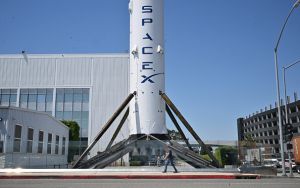
Yet, the rocket fuel never quite burned out. In December 2015, SpaceX, then a little-known Hawthorne-based aerospace firm that in 2012 became the first company to dock a commercial spacecraft with the International Space Station, achieved the first-ever vertical landing of an orbital rocket booster in Vandenberg.
That moment changed everything — reusability was no longer theoretical, inherent launch cost plummeted, new capital began flowing in, and SpaceX and others scaled dramatically, causing a regional hiring surge. Perhaps more important, it proved that aerospace innovation and disruption could fly from Southern California again.
The post-pandemic era accelerated that activity. Thanks to near-zero interest rates and federal stimulus, more capital than ever before flooded the region.
The U.S. Space Force established its headquarters in El Segundo in 2021 to consolidate efforts to develop, acquire and sustain military space systems. SpaceX’s launch cadence tripled within just a few years, and the firm began launching Starlink satellites en masse from the air base near Lompoc. Russia’s invasion of Ukraine brought drones and next-generation missile capabilities to the forefront of global military tactics, too.
In 2026, the South Bay is in a different league compared to where it was just 15 years ago. Dozens of startups have cropped up in coastal Silicon Beach cities. The aerospace and defense industries added 11,000 jobs to L.A. County between 2022 and 2024 alone, according to a recent report by the county’s Economic Development Corporation. Venture capital funding in L.A.-area defense technology surpassed $4 billion last year, more than double the amount raised in 2024, per the Los Angeles Times.
While average industrial asking rents have remained more or less flat since 2022, current vacancy rates for industrial properties are below 10 percent across the vast majority of South Bay submarkets, according to recent JLL research. In El Segundo, industrial vacancy is less than 2 percent.
“The ecosystem has evolved substantially,” Mac Burridge, a JLL managing director, told CO. “What’s happened since [SpaceX’s evolution], and with the addition of Anduril Industries down in Orange County, is that the ecosystem from the startup economy has scaled immensely.”
Key to the evolution, Burridge said, is that new founders are not necessarily coming from the “primes” — Boeing, Northrop Grumman, Raytheon, etc. Instead, they’re coming from the likes of SpaceX, or the 9-year-old weapons and autonomous systems manufacturer Anduril, with the new founders finding needs or inefficiencies and starting their own firms to address them.
“You can also add in the new Trump administration, and their focus on ensuring that there’s funding going to other folks outside of the primes to help advance and re-industrialize the American economy, as well as the American aerospace and defense economy,” Burridge said.
“And that’s where you see a lot of the funding from the government side, as well as from the venture side now outside of AI.”
Demand for space is coming from firms that run the gamut in terms of scale. Just within the past 12 months and aside from FlightWave’s expansions, Millenium Space Systems grew its footprint by 18,000 square feet at Boeing’s El Segundo campus; the Bill Gates-backed Heart Aerospace inked a 30,000-square-foot lease in Torrance; True Anomaly launched a 90,000-square-foot expansion into Long Beach; Trio Manufacturing tripled its space to 123,000 square feet in Gardena; and Anduril announced a $1 billion, roughly 1.2 million-square-foot development near Long Beach Airport.
Given the nature of their work, many of these companies require unique specifications for their facilities, such as state-of-the-art research and development space, high power capacity, high ceilings, secure layouts, and proximity to their partners and civil infrastructure. Most are also requiring high-quality, Class A office space to house their workers, not unlike recent office trends on L.A.’s Westside.
As these firms continue to scale their manufacturing capabilities, they could potentially look outside the South Bay or California entirely, Burridge said, such as Anduril’s quest to develop its 5 million-square-foot production campus in Columbus, Ohio.
“There’s a reason why AI is in San Francisco and New York, and that’s because it’s purely talent driven,” Burridge said. “Southern California is the epicenter for advanced manufacturing right now, and that is also talent driven. So, while I don’t anticipate the needs of these users to change in the South Bay … what we will end up seeing, and what we’re already seeing, is that when they hit scale for high-volume production, they’ll likely do that in a different state than California to accommodate the square-footage needs, as well as more significant state appropriations and alignment on incentives.”
The push by local municipalities to bring aerospace and defense back to the South Bay has played no small part. While each has its own priority, South Bay cities are sharing a harmonious, cyclical relationship regarding the industries’ real estate needs, El Segundo Mayor Chris Pimentel told CO.
Given their size and density, El Segundo and other small, coastal cities mainly host smaller firms and startups, Pimentel said. (Though his city does also play host to the likes of Northrop Grumman, Boeing, Raytheon and the Aerospace Corporation.) As a company outgrows its space, it tends to move east or south into larger cities such as Torrance or Long Beach, which are able to provide room for expansion.
FlightWave’s growth trajectory followed this path. The company was founded in Santa Monica in 2014, moved to the DWS-owned building in Carson following its acquisition by RedCat Holdings in late 2024, and then expanded again to Torrance less than a year later.
Once a company grows large enough, some veterans inevitably return to incubator cities like El Segundo to start ventures of their own. El Segundo-based Varda Space Industries, for example, was founded in 2021 by former SpaceX employees to develop pharmaceuticals and advanced materials that are challenging to create due to Earth’s gravity.
“We have a loving — competitive — but symbiotic relationship with our friends in Long Beach, who call themselves ‘Launch Beach,’ but we say, ‘Look, we launched [these companies] to you,’” Pimentel said. “El Segundo is an incredibly high-density talent area, with the second-highest density of Ph.D.s in the state, and, depending on how you cut your stats, probably top five in the country.
“But as these companies grow and need that next amount of space and capacity, the needs and the staffing density requirements change, too, and it allows them to grow into those larger spaces. One thing we like about that is that when a company grows and succeeds, there will be talent that is nurtured there, that will look for a place to start up their next venture, and they come right back to El Segundo and re-pollinate the system.”
Asked about the region’s success, Pimentel also points to the South Bay’s relatively friendly business and development environment. Indeed, as part of El Segundo’s current effort to overhaul its general plan for the first time in decades, Pimentel said that city leadership wants to implement a more dynamic zoning framework, rather than one governed by strict rules that make less sense in real-world applications.
It’s a lesson that some neighboring cities, currently suffering from the opposite problem as the South Bay, could stand to learn.
“I think what’s really important is that our processes and rules are very clear and repeatable,” Pimentel said. “So, when you want to come to the city of El Segundo and get a permit for something, it’s very clear and easy to understand, and you have a staffer who’s going to work on that project — it doesn’t get handed to about five different people. That staffer is going to work on that project, and they are culturally incentivized, because of the ethos of the workers around, to get it done and get it done quickly. And we don’t show up to people and tell them, ‘No, no, no, and here’s another reason, no.’ It’s more like, ‘We need you to do this to make sure it can work safely and quickly. And if you have questions, call me.’ And that really, really works.”
Nick Trombola can be reached at ntrombola@commercialobserver.com.


