The Five U.S. Office Buildings Leading the Race for Record Rents
They include newer trophies in Miami and New York as well as redone dowagers on both coasts
By Larry Getlen February 24, 2026 9:00 am
reprints
The history of New York’s Seagram Building as a trendsetter for the highest of Class A office rents is so ingrained in its history that even the company that gave the building its name once had to abandon some of its space there due to the high cost of the building’s rent.
In 1972, Joseph E. Seagram & Sons — which had been headquartered in the Ludwig Mies van der Rohe-designed building at 375 Park Avenue between 52nd and 53rd streets since the property’s 1958 completion — moved 600 of its 983 employees out of the building that bore the company’s name due to its high rent, giving up about half of its 150,000 square feet there in the process.
Then again, the desire for top-of-the-line rents was part of the building’s DNA. The July 1958 edition of Architectural Forum contains an article titled “Seagram’s Bet on Elegance,” which noted that the company had always planned to charge premium rents.
And what crazy high rents they were.
“Space is being rented at $7 to $8.30 per square foot in the 28 tower floors, as compared with the going rate of about $5 to $5.25 a foot for ordinary new buildings,” the article read.
While the numbers themselves may be unrecognizable, charging per square foot what we now pay for a cup of coffee, there will always be those buildings — some old, some new — that define the standard for what top-of-the-line office buildings can charge their Class A occupiers.
Here are the top five buildings nationally when it comes to setting the standard for office rents that only the largest and wealthiest companies can really afford.
___
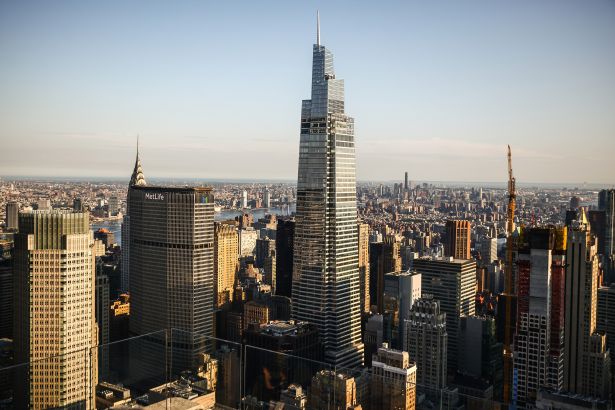
One Vanderbilt at 1 Vanderbilt Avenue in New York
During the decade-plus that SL Green Realty was assembling the site for what would become One Vanderbilt, the sheer vision was so enormous and groundbreaking that winding up with record office rents was not just a goal, but a mandatory step in allowing the project to pencil out.
“We knew that in order to justify the construction and development costs, we would need record-setting rents. We’ve exceeded our projections,” said Steven Durels, executive vice president and director of leasing and real property at SL Green. “As tenant demand accelerated for best-of-the-best product and as more inventory has come back to Midtown, where tenants clearly prefer to be, there’s more demand than supply. That’s driven up the rents.”
Durels cited recent rents in the building as ranging from between $250 to “well over $300” per square foot. Durels told Commercial Observer that the highest rent the ownership has secured so far has been $310 per square foot, although one lease that is out to a tenant right now exceeds that. He also noted that many of the building’s long-term leases were signed when it opened five years ago.
“The leases have to expire for us to re-run the space to bring it all up to market,” said Durels.
Built to be cutting edge, One Vanderbilt justifies its high prices in numerous ways, from its neighborly proximity to Grand Central Terminal to full-floor glass curtain walls — one floor, displayed in a photograph on the building’s website, stares directly into the spire of the Chrysler Building — and massive column-less floor plates with extra-tall ceiling heights and spectacular views of Manhattan. There are also a slew of worthy amenities from outdoor decks to two Michelin-starred restaurants on the premises: Daniel Boulud’s Le Pavillon and the omakase sushi restaurant Jo_ji NY.
Durels said that the building’s success — tenants include TD Bank, TD Securities, law firms Greenberg Traurig and McDermott Will & Schulte, and the global investment firm Carlyle — is especially impressive given that the corner of Vanderbilt Avenue and 42nd Street, next to Grand Central, was hardly regarded as a luxury site.
“One Vanderbilt was built with an eye toward being a Rolls-Royce building,” said Durels. “Once the building came out of the ground, people started to appreciate the design, and the fact that it had a large plaza fronting next to Grand Central Terminal. The vision started to be realized, and people started to understand it. It quickly became accepted as a luxury location.”
___
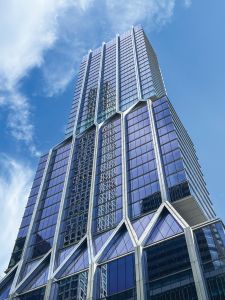
425 Park Avenue in New York
While it contains 25 percent of the horizontal steel from a previous structure on the site, 425 Park Avenue is, in all other aspects, a brand-new building that was completed in 2022.
David Levinson, chairman and CEO of the building’s developer, L&L Holding Company, confirms that the building was developed with the goal of achieving record office rents.
It was also heavily inspired by another building on this list.
“The original vision was to re-create the Seagram Building of the 21st century,” said Levinson, who points out that 425 Park Avenue was the first full-block building developed on Park Avenue since 1970. “The Seagram Building is a very significant building, architecturally and economically, because when that was built, it changed everything on Park Avenue. So our vision was to think about the impact the Seagram Building made on the marketplace, and that included the restaurant, because they had the Four Seasons. Now we have [the restaurant] Four Twenty Five, which has been very successful. So we really accomplished what we set out to do.”
Designed by Foster + Partners, 425 Park Avenue contains unique amenities and features that include a penthouse with 38-foot ceilings, meditation rooms, high-quality art throughout the building, the Jean-Georges Vongerichten-backed restaurant Four Twenty Five, and air quality that Levinson said is “proven to improve cognitive functioning.”
Levinson said Citadel is currently paying the building’s highest rent, $300 per square foot for the penthouse, in a lease that runs until around 2034. The highest rent being paid in the building for non-penthouse space is $260 per square foot escalated, according to Levinson. The building is 100 percent occupied, which means that any effort to raise rents even higher will have to wait until initial deals expire.
“No one had ever seen a building like this before,” said Levinson. “If you build something really great, people will pay for it.”
___
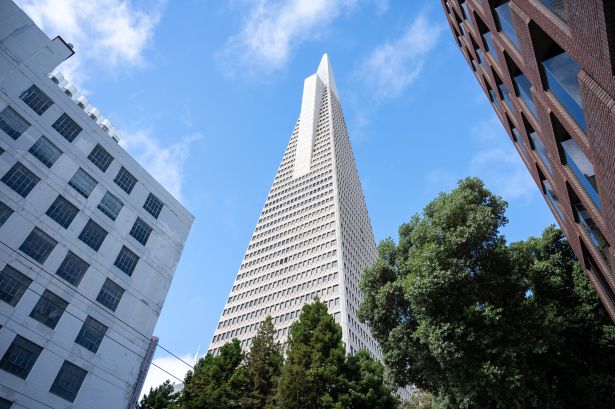
Transamerica Pyramid at 600 Montgomery Street in San Francisco
The developers of the pyramid-shaped, 48-story Transamerica Pyramid in San Francisco are so confident about the building’s strengths after a $400 million post-pandemic redevelopment that they’re marketing certain floors of the building at a virtually unheard-of $400 per square foot.
Development firm Shvo bought the building — along with two other nearby buildings and a park — with partner Deutsche Finance America in 2020 for $650 million. The new owners hired Foster + Partners for the redevelopment, and, shortly after that project’s 2024 completion, office rents in the building were topping out at around $115 per square foot, according to Chris Roeder, a vice chairman and head of the San Francisco commercial office brokerage team for JLL, the building’s leasing broker.
While achieving groundbreaking office rents wasn’t the primary goal of the redevelopment, Roeder said, the looming success in that area was apparent by the looks on potential tenants’ faces as they toured the redesigned property.
“The goal was to create a spectacularly designed building in the heart of Jackson Square with great views and unparalleled amenities, finishes and services,” said Roeder. “[Foster + Partners] created a full-block redevelopment that was just so appealing to people in its amenity floors, with fitness and the Sky Bar and conference facilities, each with finishes that were second to none. You could see it in people’s eyes and in their faces when they toured how appealing it was to a high-end crowd. The rents then followed.”
Roeder noted that once the redevelopment was completed, rents soared higher in a flash.
“There was a point in time where we were trying to achieve $200 per square foot, and we did that,” said Roeder. “That became the norm. A year later, we’ve achieved a rent at $300 per square foot.”
The building’s current tenants include global law firm Morgan Lewis, investment management firm Coatue, and Mizuho Financial Group.
Roeder noted that the $300 was not even achieved in the building’s penthouse, but rather within the building’s top 10 floors just below, signifying how special and groundbreaking companies consider the redevelopment.
“In San Francisco, wealth is created by the tech industry and the venture capital community,” said Roeder. “So we wanted to appeal to former founders, to foundations, to venture capital firms themselves, to private equity firms, and then to a mix of high-end law firms and banks. And that’s what we achieved.
___
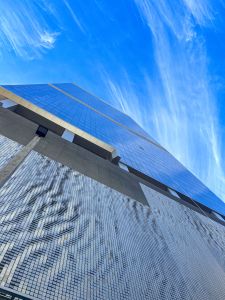
830 Brickell at 830 Brickell Plaza in Miami
Toward the beginning of 2021, when the team behind the under-construction office building 830 Brickell began leasing space, the top of the market for Class A office product in Miami was around $60 per square foot.
The developers, marketers and brokers working on 830 Brickell had hoped to get as much as $75 per square foot for the building’s higher floors.
“We thought that would be our high-water mark,” said Brian Gale, vice chairman of office brokerage services at Cushman & Wakefield. “That was 30 percent more than the market was getting at that time, so it was ambitious to think that we could get rents in the mid- to upper $70s. That had never been done before [in that market].”
But as they signed on tenants such as Microsoft, private equity firm Thoma Bravo, law firm Kirkland & Ellis, Santander bank, Citadel and law firm Sidley Austin before the building even opened, those rates rose quicker than anyone could have anticipated.
Gale noted that the building’s first deal was in the upper $60s per square foot, which, he said, felt like where the rent belonged. But, after showing leaders of a potential tenant firm the building’s unobstructed views of the ocean and beyond, they were able to jump to $80 per square foot.
By that point, a COVID-induced corporate influx into Miami had taken hold, and demand for Class A office space skyrocketed.
“We had this incredible demand of new-to-market tenants that we had never seen before, and not at this quality,” said Gale. “The biggest law firms in the world, the biggest private equity groups, the biggest tech companies and financial service groups. So, we said, ‘We have this incredible demand. Let’s start jacking up the rents.’”
In a short time, despite never having reached $80 per square foot in the market before the building’s recent opening, rents in 830 Brickell shot up through the $100s all the way to $225 per square foot, which is both the current high rent in the building and the highest office rent in Miami’s history, according to Gale.
The success of 830 Brickell, which Gale said has led to other Class A buildings in the market breaking the $150-per-square-foot barrier, can be attributed to the excellence of the product. The building’s architect, Adrian Smith + Gordon Gill Architecture, is also known for the world’s tallest building, the 2,717-foot-tall Burj Khalifa in Dubai, which was headed up by Smith when he was at Skidmore, Owings & Merrill. But Gale also credits 830 Brickell’s success to the desirability of the area itself.
“I think the demand that happened during that COVID period was specifically for Brickell Avenue,” said Gale. “That was ground zero for where tenants wanted to be. It wasn’t like we were some old submarket trying to mature, like Wynwood. Brickell was an established market, with all the retail from Brickell City Centre to Mary Brickell Village. It had all the condos and the office buildings. It was where everyone wanted to be, and we were the only brand-new building being constructed during a flight to quality we hadn’t seen before. It was the perfect storm.”
___
Seagram Building at 375 Park Avenue in New York
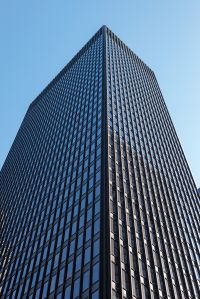
Given its history, it’s little surprise that RFR’s Seagram Building still makes the list.
The address often described as “the most beautiful curtain-wall building in America,” according to The New York Times, has seen numerous renovations and updates, keeping it in the upper echelon of desired Class A office properties.
And, all along the way, the building has commanded some of the country’s top office rents. AJ Camhi is head of leasing for building owner RFR Holding, and, in the 17 years he’s been there, Camhi has rarely seen a time when the Seagram Building wasn’t leading the charge in that area.
“Sixteen of the 17 years I’ve been here, we’ve achieved the most deals over $100 a square foot, before $200 became a thing,” said Camhi. “Then, over the last three years, we’ve had the most transactions over $200 a square foot. The Seagram Building has been setting the trend and outperforming its peers consistently year after year.”
In addition to indoor access to Major Food Group’s the Grill and the Lobster Club, constant upgrades are partially responsible for the building’s ongoing popularity. The Playground, a $25 million, 35,000-square-foot physical fitness compound completed in the summer of 2022, includes traditional gym equipment, basketball courts, pickleball courts, yoga and spin studios, and climbing walls.
Camhi noted that the building is currently 99 percent occupied, with 92 percent of tenants coming aboard within the past five years. The largest current tenant is Blue Owl Capital, an alternative investment firm with $157.8 billion in assets under management, which leased 137,660 square feet over five floors in 2022, and expanded to 168,597 square feet the following year and then to 238,673 square feet in October 2024.
Discussions with new tenants seeking to take space beginning around 2028 are hovering in the range of $285 to $300 per square foot.
“The building is made of bronze, which no developer today would ever build,” said Camhi. “It doesn’t make financial sense, but this building was built for an owner/occupier, so it’s a piece of art first before it’s a piece of real estate, and our tenants tend to be sophisticated and have an appreciation for architecture. It’s in the best location in New York City for the type of tenants that we’re looking for, steps from Grand Central. And, as it has reinvented itself, one of the world’s best buildings has become even better.”
Larry Getlen can be reached at lgetlen@commercialobserver.com.