

New York’s Real Estate Industry Would Like a Word With Lawmakers on 485x
The housing development incentive hasn't worked out like just about anyone wanted — and things are unlikely to change in an election year
By Aaron Short January 23, 2026 1:41 pm
reprints
When New York Gov. Kathy Hochul unveiled her $260 billion budget proposal on Jan. 20, the measure included new funding and initiatives to continue her push to build or preserve 800,000 homes over the next decade.
Hochul touted additional investments to help families move into more starter homes, protect properties from extreme weather and expand the supply of affordable units.
“New Yorkers deserve a high-quality education just as they deserve a safe and affordable place to call home,” the governor said in her remarks at her executive budget address in Albany. “While we’ve made real progress, my commitment to tackling New York’s housing crisis is stronger than ever.”
Yet, a key fiscal tool designed to create more mixed-income housing that hasn’t delivered on its promise was left unmentioned.
In April 2024, the governor and state lawmakers passed a property tax exemption that replaced the older 421a tax incentive that expired in 2022. Hochul had instructed real estate industry and labor leaders to negotiate its parameters, including specific minimum wage mandates for workers on projects in different parts of New York City, before legislators approved the budget.
Rather than something that spurred fresh multifamily projects, the negotiations produced an uneasy stalemate in the form of a long-term property tax exemption called 485x. Developers have stopped short of building projects larger than 100 units, claiming that their legally mandated labor costs on larger projects have become too expensive to pencil out. Labor leaders have been reluctant to renegotiate worker wages, and insist 485x is working as intended.
Now, lawmakers may be hesitant to take up any tax-related bills during an election year, which means little could be done to address the city’s housing shortfall.
Still, some real estate leaders are optimistic they can revisit the tax credit in the future and are beginning to float suggestions for revisions.
“The first thing we all have to admit is this is not working as originally planned,” said Carlo Scissura, president and CEO of the New York Building Congress, which promotes the construction industry. “It’s about what the numbers show and how we get people to build more. Just having the 99-unit buildings is not enough anymore.”
State officials and industry leaders had hoped 485x would galvanize the construction of new rentals and condos throughout New York City.
In the 18 months after its mid-2024 passage, however, developers filed applications for only 180 projects with 5,546 units of housing — and none of the new properties contained more than 100 units, an October 2025 Real Estate Board of New York (REBNY) report found. Some owners cited the law’s minimum wage rates — set at either $74.26 or 65 percent of the prevailing wage in Manhattan below 96th Street and the Williamsburg and Queens waterfronts and $64.58 or 60 percent of the prevailing wage in brownstone Brooklyn and Astoria for projects over 150 units — as a burden contributing to higher costs.
The pace of construction has also slowed. Since the beginning of 2024, 66,162 units of housing have been built in New York City, well short of the governor’s goals, while another 47,000 are stuck in pre-development. By the third quarter of 2025, only 3 percent of projects in the city’s pipeline were utilizing the 485x incentive, according to another REBNY report.
Construction is getting more expensive too. Costs to build a residential unit have risen nearly 50 percent, from $120,500 per unit in 2020 to $179,000 per unit in 2025, according to a New York Building Congress report.
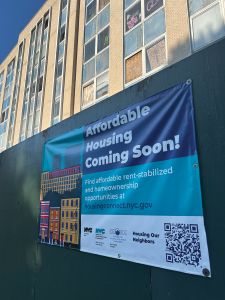
Labor leaders are urging patience. Gary LaBarbera, president of the Building and Construction Trades Council of Greater New York, said the law “needs no modifications and is working as intended.”
“This will become more evident over this next year, as New York City’s new building permits rate is trending on par with other major cities in the U.S. and continues to increase year-over-year,” LaBarbera said. “In 2026, we anticipate many more projects falling under 485x requirements to be added to the pipeline.”
But owners have filed only three applications in recent months to build large projects potentially taking advantage of the tax break, according to city comptroller records shared with Commercial Observer.
Ken Fisher, a real estate attorney with law firm Cozen O’Connor, believes another year of data would better inform tax discussions in Albany about how to adjust the tax credit.
“The demand for housing is there, but whether demand can support these extra costs is unclear, and the market is saying it can’t except in select circumstances,” Fisher said. “You’re not going to solve the affordability crisis without building new housing, and you’re not going to be able to build new housing unless a substantial part of it is privately financed, which doesn’t pencil out without an incentive program.”
Some real estate leaders are already suggesting revisions to the 485x incentive despite lawmakers’ reticence.
Brett Gottlieb, a partner in Herrick Feinstein’s real estate department, noted that some owners have skirted the requirements by constructing multiple 99-unit buildings next to each other that may share amenities and other features on some of their levels but are technically separate structures with separate certificate of occupancies. He proposed the state increase the minimum number of units that would trigger the construction wage requirements.
“The ones that are using the incentive in parts of Manhattan can absorb the higher market-rate rents that can in theory pay for higher construction costs, but a building with 125 units in the outer boroughs is just not going to support it,” he said.
Gottlieb also proposed creating exclusion zones where the 99-unit threshold would not apply, such as less wealthy areas outside much of Manhattan and along the Brooklyn and Queens waterfront.
“One would hope labor leaders would be interested in whatever job creation and wage growth they can get from the program,” he said. “By modifying these restrictions in part of the city, there would not necessarily be jobs of the same wage, but there would be significantly more jobs available.”
Others are targeting the law’s minimum wage levels. YuhTyng Patka, co-chair of Adler & Stachenfeld’s real estate tax and zoning incentives practice, wants construction wages to be set to an average wage for all workers on a project instead of a minimum that would apply to every trade regardless of skill. That change, which occurred under the previous 421a tax incentive program, would give developers more flexibility to pay higher-skilled workers a higher rate.
“It wasn’t popular at the time and there was bellyaching, but there wasn’t as much backlash,” Patka said. “There were folks that were able to make it pencil out, and there were 300-plus-unit rental projects built.”
In the meantime, a different tax incentive has become much more popular. Developers are beginning to apply for 467m, which offers up to a 90 percent tax exemption for 35 years for converting an existing commercial building into a residential one.
Patka hopes state lawmakers will extend the deadline to file for 467m beyond June 30 so that more owners can take advantage of it, particularly in Midtown South, which was rezoned last year.
“There has been a mad scramble for projects to get submitted to meet the June 30 deadline,” she said. “You don’t just have to file by June 30, you have to pull your permits by June 30. If you haven’t filed with the Department of Buildings by now, you’re in trouble.”
CORRECTION: This article was updated to reflect the correct deadline for 467m applications.


