Amancio Ortega’s Miami Buying Spree Highlights Region’s International Appeal
The Zara founder has been buying up office and residential properties — and, of course, retail
By Jeff Ostrowski November 26, 2025 10:00 am
reprints
Fast-fashion mogul Amancio Ortega built his fortune by selling bargain-priced shirts, jeans and dresses. Now, the Spanish billionaire is paying a premium for some of the Miami area’s most prominent properties.
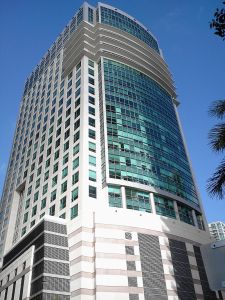
His latest big-ticket deal came this fall. Ortega’s family office, Pontegadea, paid $274.4 million in October for the 1111 Brickell tower in Miami. It is so far the city’s biggest office transaction of the year — and just the latest South Florida deal for Ortega, whose holdings include retail properties in Miami and Miami Beach, an iconic office building in Downtown Miami and a luxury apartment complex in Fort Lauderdale.
Ortega, 89, is best known for launching Zara, the global retailer that sells pieces inspired by high fashion for low prices. The U.S. version of Zara’s website lists a variety of T-shirts for $12.90 and jeans for as little as $49.90.
Fast fashion has been very good to Ortega. He founded Zara in 1975, and he helped pioneer the business model of quickly and cheaply producing knockoffs of luxury garments. Zara is now part of Inditex, Ortega’s global fashion empire. He was worth $122.4 billion as of Nov. 21, according to Forbes. That makes him the world’s 14th-richest person.
With tens of billions of dollars to put to work, Ortega has assembled an expansive real estate portfolio across the globe. Pontegadea’s acquisitions over the years have included the historic Almack House office building in London, M Plaza in central Seoul and the Tiffany Building in San Francisco.
Now, South Florida is squarely on the mogul’s shopping list. Over the past decade, Ortega has spent more than $1 billion acquiring properties in greater Miami and Fort Lauderdale.
Why the sudden interest in the region? Ortega declined Commercial Observer’s request for an interview, unsurprising given his reputation for keeping a low profile. The son of a railroad worker, Ortega reportedly eschewed corner offices, preferring to sit alongside his employees.
“In the street, I only want to be recognized by my family, my friends and people I work with,” Ortega once said.
Media shy or not, the sheer volume of Ortega’s activity is attracting attention. Commercial real estate insiders say Ortega’s shopping spree is just one more indication that Miami has fully emerged as a major market for international investors.
“For many years, we were an ancillary market,” Seth Mersky, an attorney in the private wealth group at law firm Gunster, told Commercial Observer. “Miami is really a hub now.”
The fashion mogul was relatively early to the party. In one of Ortega’s first acquisitions in South Florida, Pontegadea in 2009 paid $61.9 million for a 15-story office building at 2701 Le Jeune Road in Coral Gables, Fla., according to property records. Pontegadea still owns the 551,000-square-foot property — an indication that Ortega focuses on long-term holds rather than quick flips.
Ortega made a much bigger splash in Miami in 2016, when Pontegadea bought the 2 million-square-foot Southeast Financial Center office tower in Downtown Miami for $516.6 million, according to property records. Before the new generation of supertall buildings rose in Miami, the 55-story Southeast Financial Center was the high point of the city’s skyline.
His most recent office acquisition was the 1 million-square-foot tower at 1111 Brickell, also known as Sabadell Financial Center. It’s a prominent property on Brickell. Tenants include investment bank Morgan Stanley, law firm Baker & McKenzie and hedge fund Millennium Management.
Ortega’s pre-pandemic acquisitions look prescient: Miami’s office market has outperformed much of the rest of the nation. Amid an influx of new employers relocating from around the country, rents keep rising. The average rental rate for Class A office space in Miami-Dade County was $65.37 per square foot in the third quarter of 2025, up from $61.48 in the third quarter of 2024, according to Colliers.
In the Brickell submarket, meanwhile, Class A rents were flirting with $90 per square foot, Colliers said.
“We have one of the highest occupancy levels in the country,” office broker Tere Blanca, CEO of Blanca Commercial Real Estate, said. “While it’s not what it was in 2021 and 2022, there’s always a steady pace of companies arriving in Miami.”
Ortega isn’t buying only office space. In June, Pontegadea snapped up a new luxury multifamily complex in Downtown Fort Lauderdale for $165 million.
That deal was for Veneto Las Olas, a 46-story, 259-unit building at 201 South Federal Highway, a block north of Las Olas Boulevard. The project had been recently completed by Related Group, and the sale is among the priciest South Florida multifamily acquisitions in 2025.
That deal illustrates more of Ortega’s strategy in South Florida: Pontegadea has focused on buying ready-to-rent assets, rather than tackling development projects.
Considering Ortega’s roots in the rag trade, it’s not surprising that he’s also buying retail properties. In September, Ortega paid $110 million for a retail assemblage in the Miami Design District.
That property, Atlas Plaza, houses 20,000 square feet of retail at 135 and 137 Northeast 39th Street, and 114 and 126 Northeast 40th Street. The retail properties are fully leased to tenants that include Rolex, Oliver Peoples and the Michael’s Genuine restaurant.
Ortega’s fortune might have been built on frugal fashion, but he doesn’t shy away from a bidding war. In the Design District deal, Pontegadea beat out notable competitors, including Craig Robins.
Ortega also owns buildings along Lincoln Road, the pedestrian mall in Miami Beach that’s currently on an upswing.
While Miami’s real estate players have welcomed the arrival of a well-known investor willing to pay top dollar, Ortega hasn’t moved into Miami in quite the same way as other billionaires who have flocked to the region.
South Florida economic developers long have wooed billionaires, a strategy that paid off during the pandemic. In a noteworthy example, Ken Griffin, founder of the hedge fund Citadel, left Chicago for Miami, where he is developing a $2.5 billion office complex to house his companies.
A bit to the north, Palm Beach County now counts 69 billionaires as full- or part-time residents, according to the Business Development Board of Palm Beach County. The economic development agency has been targeting billionaires with the assumption that they’ll not only buy mansions but also invest in commercial real estate and drive job growth.
“A lot of these billionaires are asking if there are companies they can invest in,” Kelly Smallridge, the Business Development Board’s president and CEO, told Commercial Observer.
Ortega, for his part, doesn’t seem to be interested in living or working in Miami. In that way, his investments are similar to that of tech billionaire Michael Dell, whose family office in 2019 paid $875 million for the historic Boca Raton Resort and Club in Boca Raton, Fla.
Not everyone loves Ortega’s business model, of course. Zara’s success helped spur the rise of super cheap gear sold by H&M, Old Navy and others. The trend has been criticized as a bane of environmental sustainability and a bastion of low-wage, dead-end jobs.
“To be able to sell clothing that cheaply and still reap a sizable profit, production is outsourced to privately owned factories in developing nations, where there is little or no safety and labor oversight, and where wages are generally poverty level or lower,” wrote Dana Thomas in Fashionopolis, a book published in 2019.
An earlier takedown of the sector, Overdressed: The Shockingly High Cost of Cheap Fashion by Elizabeth Cline, reached a similar conclusion. “Buying so much clothing, and treating it as if it is disposable, is putting a huge added weight on the environment and is simply unsustainable,” Cline wrote.
Critiques aside, Miami’s commercial real estate players say Ortega is likely to keep investing in trophy properties in South Florida.
“European money is very comfortable in this region,” Blanca said. “It just feels like a good bet.”
Jeff Ostrowski can be reached at jostrowski@commercialobserver.com.