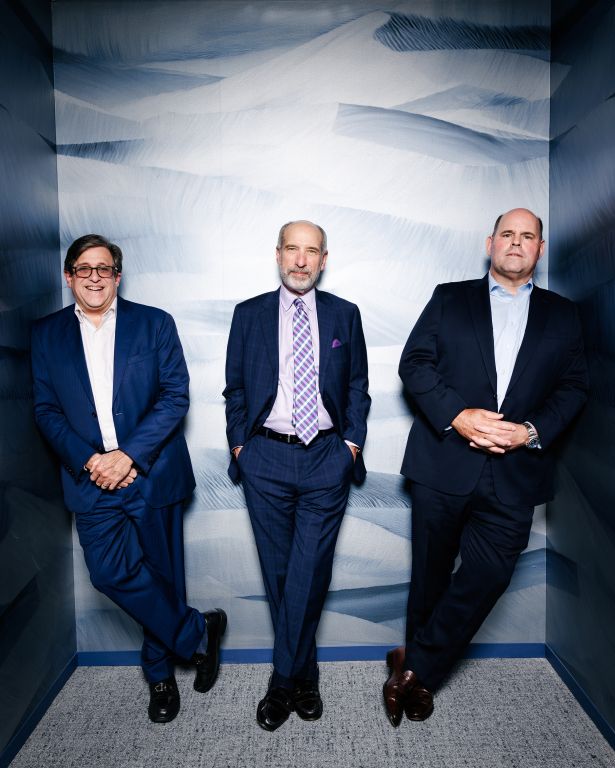
Williams Equities’ Michael T. Cohen, Robert Getreu and Andrew Roos Take Manhattan
The trio runs a now-century-old office ownership firm that uses lessons from the past for investment plans in the present and future
By Emily Davis October 20, 2026 12:00 pm
reprints
Williams Equities, a family-owned, New York City-focused commercial real estate firm run by Michael T. Cohen, Robert Getreu and Andrew Roos, marks its 100th anniversary this year.
Despite the company’s centenarian status, the trio of principals operates a portfolio largely in its prime, energized by a youthful wave of tech companies flooding Midtown South and an overall vigorous Manhattan office market.
Cohen, Getreu and Roos are second- or third-generation leaders of the company, originally established in 1926 by Victor Cohen as Williams & Company. The fledgling brokerage firm acquired its first property in 1953, and its portfolio grew to 2.1 million square feet by the end of the decade. Williams went on to establish strategic partnerships with Roos and Getreu’s predecessors, and their mounting acquisitions included 1700 Broadway, 1 Dag Hammarskjold Plaza and 28-40 West 23rd Street.
The 1990s saw then-Williams Real Estate Company transform into a leasing and brokerage operation, GVA Williams — a bid to stay competitive in an institutionalizing real estate world. The entity was sold in 2008 to what would become Colliers’ New York office.
“We wanted to manage assets, not people,” Roos told Commercial Observer.
Williams Equities now operates as a business within a business, and Cohen, Getreu and Roos all hold senior posts at Colliers. Williams Equities separately owns and manages its 14-property portfolio, made up of 12 directly owned and two affiliated buildings. Colliers afforded the family business a heightened platform and market insights, as well as fabulous Bryant Park views from 1114 Avenue of the Americas.
From that lofty perch, the principals oversee an office portfolio largely concentrated in Midtown South, a submarket that recently enjoyed its strongest first half-year of leasing since 2002, according to Colliers data, with tech-driven demand up 20 percent over the two quarters.
Williams recently added another Midtown South feather in its cap — the heavily discounted 470 Park Avenue South for $147.5 million — with redeployed capital from its $160 million sale of 655 Madison Avenue to developer Gary Barnett’s Extell. Williams Equities also joined a new partnership at the Flatiron District’s 888 Broadway with Global Holdings and Cannon Hill Partners.
Cohen, Getreu and Roos sat down with Commercial Observer in early September to discuss the 100-year history of Williams Equities, including the hard lessons and the strategic successes, and what’s in store for the company’s future.
This interview has been edited for length and clarity.
Commercial Observer: You’re all second- and third-generation principals at Williams. Were you always going to get into this business?
Michael T. Cohen: My grandfather was one of the founders of Williams, so I’m the third generation of my family. I started right out of college in 1981. I was pretty much brainwashed. The irony is I really didn’t appreciate what the business was going to be like until I was inducted with a desk and a phone, and told to call strangers and see if they wanted to do business with me.
So it was quite a comeuppance for a kid that grew up on the Upper East Side, private school, Ivy League. It hit me like a ton of bricks.
Robert Getreu: I’m theoretically second generation. My father-in-law and brother were partners with Michael and Andrew’s dads. I did some construction and building management before coming into the brokerage side of the business in 1993.
I eventually entered the ownership side of the business while carrying on with brokerage work and portfolio management at the same time. I’ve had a host of roles over the years, which have now morphed into the ownership role that we all sit in today.
Andrew Roos: Growing up, I planned to be a journalist. I worked for the Associated Press and took pictures for Rolling Stone. I thought I was going to be one of those “Almost Famous” guys. When I realized that I couldn’t make the kind of living I wanted, I decided to try real estate.
My father set up an interview for me at the Washington office of Julien Studley. I put on a denim suit, Frye boots with stacked heels and had hair down to my shoulders, and to this day I can’t understand why they didn’t offer me a job.
I joined Williams Real Estate Company in 1976, third generation. My grandfather was partners with Michael’s grandfather. So I’ve been here for roughly half the history of Williams, and my son, Mac Roos, works with us now. He would be the fourth generation.
Are there plans in place for the next generation at Williams Equities?
Cohen: Robert and I don’t have offspring in the business the way Andrew does, but we’re grooming the next generation. Like any 21st-century business, we’re going to find the right people for the job to keep the machinery running over time. It’s a chapter that hasn’t been written yet, and only time will tell.
Roos: Many of the companies that were around when we started don’t exist anymore, like Cross & Brown and Edward S. Gordon Company. I think the fact that we’re still here is rather extraordinary in and of itself.
Your portfolio has historically been concentrated in Midtown South. Do you think of that as your domain?
Getreu: We have other assets throughout the city, but we feel very comfortable in that area. We recently sold 655 Madison in the Plaza District and bought 470 Park Avenue South, a Midtown South building, because that’s what the market was reacting to. We’ve seen a total resurgence of that marketplace in the last 12 to 18 months, and we’re working to capture it.
Cohen: The irony is, I think that the institutional buyer, or the internal rate of return buyer, is driving down returns for the Midtown steel and glass buildings, and our stock and trade, the Midtown South terra cotta and cast-iron buildings, offer a better risk-
adjusted return.
After the pandemic, some in our industry started preaching this idea that there were Class A’s and Class B’s, and the Class B’s were doomed. I believe they completely missed the gradations within Class B. The top-ranked Class B’s have a different appeal from steel and glass but are very robust. We’re seeing that now expressed by the technology companies and the AI companies.
Roos: Midtown South is Williams’ sweet spot. People want to be between 14th and 23rd streets, like Google at 111 Eighth Avenue. The types of people that occupy those buildings — a lot of them are half my age — but they raise billions of dollars, and they want a building that enables them to brand and attract people that will help them succeed.
Cohen: We also have some blue-chip tenants in the portfolio. Netflix is our anchor tenant at 888 Broadway. We have Ramp at 28-40 West 23rd Street. We’re very happy to be predominantly, but not entirely, Midtown South.
You’ve added 470 Park Avenue South and 888 Broadway to your portfolio over the past year. Is Williams in a growth period?
Cohen: We have other buildings in our portfolio that, like 655 Madison, would be better suited for redevelopment. Our investor base is more risk averse, and we’re not developers, so the money from 655 Madison was recycled into 470 Park Avenue South. There will be other opportunities in the portfolio to do the same thing.
There is one office-to-residential conversion in our pipeline, but that’s several years out. There are other buildings that we are keeping an eye on, and saying, “What’s the highest and best use?” I think we will continue to be opportunistic.
When the three of you discuss a building’s highest and best use, is it always a clear choice?
Getreu: The idea of expanding or contracting is an asset-by-asset decision. Everything has to be opportunistic. 655 Madison was a somewhat obsolete office building, and we traded it for something that the market was looking for. So would we like to buy more? Absolutely. Would we like to retain what we have? Absolutely.
Cohen: We’re looking at acquisitions now because we feel that the environment is conducive to it. Our forefathers bought many of these buildings in the late `70s and early `80s and even the `60s, and we took a breather for a while.
We acquired the leasehold interest of the Argonaut at 224 West 57th Street with an offshore fund in 2007. In 2008, the world changed, and our investment was pretty much wiped out. We had a deep-pocketed partner, though, and we tripled down on that building. We bought the fee simple interest for $88 million in 2010. Once the building was 100 percent rented, we sold it for a modest profit.
We’d had this near wipeout experience and were chastened by it. We stayed on the sidelines during the market’s run-up in values between 2012 and 2019. When the pandemic occurred and interest rates doubled, we were able to survive.
So we’re not compelled to buy through the ups and downs. We try to pick our shots very carefully, and there’s a window that’s opened now. I fully expect it will shut again, and we’ll go back to the sidelines.
I imagine that after 100 years, you’ve accumulated a lot of lessons. You’ve seen the dot-com boom and bust, the Global Financial Crisis and the pandemic.
Roos: And that’s only this generation. There was the tax code change of the early `90s. It was “Stay alive till `95.” It’s a feast and famine business. You can make money in either market — it’s when it’s stagnant that it’s very difficult.
I love telling the story of when I met Harry Helmsley early in my career. I said, “What’s the secret?” and he said, “Simple. Just live.” What he meant was that you’ve got to live through the cycles.
The AI leasing boom in New York City has been compared to the dot-com days. How do you contrast those two eras?
Cohen: Same cycle, but different details. We’re seeing rental inflation coming out of the pandemic, which is typically the way the city recovers. For most of my career, the underlying variable of rents was the key determinant of real estate values, but, because rents are inflating at the same time that the interest rates on five- and 10-Year Treasurys have risen precipitously, we’ve had value destruction, even though our primary variable of rental income has increased.
This is an extraordinary juxtaposition, and it calls for a different strategy.
What’s the strategy?
Cohen: You have to plan around more expensive money. You need to have a larger percentage of equity, and you have to effectively overcapitalize based on the previous generation of investments. Less debt, more equity.
Does this strategy mean more partnerships, like at 888 Broadway?
Cohen: I think so, yes. When we look at redeploying capital now, we talk to others who have similar goals. Institutional equity is pretty much sidelined now, and most of the investment community today are cash buyers and 1031 buyers like ourselves.
A lot of your buildings are older than Williams itself. Is there an ebb and flow to how much capital you put into repositioning them?
Getreu: It’s market driven. The broker comes into the marketplace and has their checklist. When we add an amenity space or a new lobby, we get a positive reaction. We’re deploying that throughout our portfolio when possible.
Cohen: The lobby that appealed in 1985 or even 2000 is not the lobby that will appeal in 2026. The properties may be 50 or 100 years old, but the people occupying them are of the current generation, and the repositioning has to reflect what’s desired.
Roos: Our building at 28-40 West 23rd Street is a good example. It was a former ladies’ department store with an annex building. Michael’s father had a plan to re-create the Plaza Athenee in Paris. He installed a skylight, French-style windows and iron balustrades. That was fine for many years.
Now we’re spending $20 million to $30 million to renovate it. Could we have leased it the way it was? Yeah, we could have. But we’re in the business of trying to maximize the experience in our buildings. These buildings have floor plates of almost 70,000 feet, and these growing AI and tech tenants need to expand but don’t want to be vertically stacked.
79 Madison Avenue was placed on the market as a conversion in 2025, but it wasn’t picked up. Its lease with WeWork expired, too, and I understand the building is in a difficult limbo now. What’s going on there?
Getreu: We were assured of its viability as a residential conversion, and we have a number of offers to execute that deal. But the market changed, and it looks like the value creation may be greater if it goes back to the office market. We said, “Hold on, we could always convert it, right?” There’s always that safety valve.
It was successful as an office building for many years, but the problem really came about when you were getting $50 per square foot rents in that marketplace, and you had to put $150 or $200 per square foot into the building. Now we’re seeing rents of $70, 80, $90, and, all of a sudden, putting that kind of money in for an office tenant becomes possible.
We terminated leases with deals that we had structured many years ago, with the anticipation that maybe this was a conversion at some point. This is a long gestation period in order to get to a residential conversion. When you have an operating office building, it can take years to figure out emptying it out, restacking it, moving tenants and canceling leases. It’s an enormous undertaking.
Now we have a number of people interested in the building as an office building, so we’re working weekly to figure out what is the right answer here.
The building’s return to office use would be a pretty compelling story after all that office has been through. Speaking of which, do you have a favorite property?
Getreu: I don’t think I have a favorite, really. You’re passionate about something as you’re redeveloping it and leasing it successfully. That’s what you’re in love with. You really have to have a little bit of passion about this business, or else you’re not going to be successful in it.
Roos: It’s like picking your favorite child. I love them all uniquely.
Cohen: The food is best at 57 West 57th Street, where Quality Italian is.
Emily Davis can be reached at edavis@commercialobserver.com.