Amazon’s Same-Day Delivery Expansion Reignites Demand for Last-Mile Logistics
Ever more rapid dropoffs was already blurring the line between retail and industrial, especially in urban areas
By Patrick Sisson October 27, 2026 9:33 am
reprints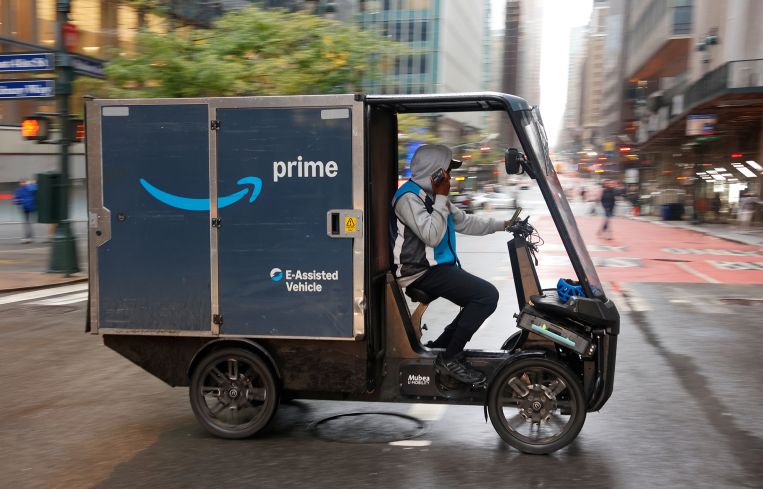
When Amazon makes moves in the delivery business, the entire retail industry tends to reorient itself around the e-commerce giant.
So, when a September report from Business Insider revealed preliminary plans for Amazon to embark on a “massive blitz in same-day delivery” with a proposed expansion of facilities code-named Project Mercury, industrial real estate took notice.
The plan called for expanding Amazon’s same-day delivery network to more than 1,000 locations, placing such facilities within 10 miles of 80 percent of U.S. Prime members, and making roughly 90,000 frequently purchased items, from cough medicine to paper towels, almost instantly available.
“This is going to have a pretty dramatic effect on certain markets,” Brandon Page, executive vice president at Blackstone-backed Link Logistics and head of portfolio leasing, told Commercial Observer. “It’s prompting others to try and catch up.”
Amazon said these preliminary planning documents are “subject to significant revision, and shouldn’t be treated as finalized plans.” But, according to a statement from spokesperson Steve Kelly, “It’s no secret that we’re focused on delivering faster for customers, and the expansion of our same-day delivery network is playing a big role in that.”
Amazon’s potential same-day surge would be a bold expansion, but also just the latest example of rapid delivery defining consumer shopping, and how the evolving customer expectations around fulfillment have sparked a decisive shift in retail and industrial real estate.
During the first quarter of 2026, e-commerce represented 18.9 percent of all U.S. retail sales, according to CompStak, above the previous 16.3 percent record set during the depth of the pandemic. During the second quarter, it was 17.1 percent. Roughly 20 percent of core retail sales were via e-commerce at the end of 2025. During Walmart’s second-quarter earnings call, executives stated delivery was up 24 percent between the first and second quarters of the year, and fast delivery in less than 30 minutes — now available in 38 markets — was up 48 percent.
Amazon’s ambitions parallel those of its main competitor, Walmart, as well as the entire retail industry, which is in the midst of reshaping retail real estate and driving up demand for last-mile, urban infill warehousing. Office has seen a flight to quality, and the goal to receive your goods faster than ever means urban industrial is currently seeing a flight to speed, creating incredible tailwinds for small-bay warehouses or industrial infill portfolios, which are posting significant rental rate growth.
“Final mile has the tightest vacancy of any part of industrial real estate,” said Jason Tolliver, president of logistics and industrial for the Americas at Cushman & Wakefield. “Everything that’s happening structurally in the market just continues to tighten the supply, and demand continues to grow.”
Retail’s imperative for speed hasn’t just reshaped how stores are designed, their dimensions, and what they can do, said Tolliver. It’s increasingly blurring the line between retail and industrial real estate.
Retailers have expanded store footprints to allow more delivery and pickup options, boosting last-mile logistics and using them as staging areas. Walmart has been especially aggressive in pushing its already formidable retail portfolio as a delivery advantage and experimenting with new ideas, including 3D-printing store additions, to accommodate new delivery space and testing new so-called Spark delivery depot locations, delivery and pick-up hubs in former retail spaces that no longer accommodate walk-in shoppers.
The entire retail ecosystem appears to have focused on the strategy of using stores as staging areas.
Home Depot announced Express Delivery in August, utilizing its more than 2,000 retail locations for delivery service that can provide goods in three hours or less. AutoZone is investing $1.6 billion this year in capital investment, with the majority devoted to opening new megahubs to help create distribution points for its customers. New Tractor Supply stores take nearly triple the footprint of traditional locations to accommodate online order and last-mile services.
Much of this shift is taking place amid Sun Belt growth and population expansion, with new store layouts springing up in emerging population centers, chasing areas with rapidly increasing delivery orders (though the shift in moving and mobility in the economy can be tracked by the drop in deliveries for the kind of large-ticket items that normally go into new homes).
Last-mile expansion might seem like an expensive proposition, but it’s not merely about meeting consumer demand. It’s also about taming skyrocketing transportation costs. Industry analysts estimate more than half of the ultimate cost of delivery comes from solving the last-mile problem, making optimization a key way to lower costs. Margins are tight, diesel fuel is up 75 percent since the start of the war in Iran, and immigration enforcement is cutting into the driver and delivery labor pool, said Zac Rogers, associate professor of operations and supply chain management at Colorado State University.
During COVID, the real estate world overbuilt e-commerce real estate, but that cushion is shrinking as the market catches up to that excess capacity, said Rogers. Now, he said, companies are getting back into hardware mode and building capacity, and that will include a focus on real estate for a smaller, more distributed network.
There are already premiums on rent for retail and grocery-anchored sites designed for delivery, with space for storage lockers, better delivery routing, and extra parking for trucks and pickup lanes, said Tolliver.
“Last-mile delivery should keep expanding, and I expect demand for functional infill distribution space to grow with it,” said Lukas Huberman, vice president and director of acquisitions for BLT, a firm focused on industrial real estate.
While the store strategy often means larger retail leases for brick-and-mortar retailers, the broader push for faster delivery still requires expanding into new warehouses and last-mile sites. It’s not store versus warehouse, or even industrial versus retail, explained Tolliver. It’s a relay.
Better networks, which include massive warehouses as well as neighborhood-level sites, make these feats of improved logistics possible. That’s why the brash attempts by companies like Gorillas and GoPuff to create 15-minute delivery hubs didn’t fully take off — they lacked the larger network to support their front-line delivery sites.
The need to build out this kind of logistics infrastructure has made it a great time to be an industrial landlord. Most of these infill buildings aren’t necessarily Class A, said Link Logistics’ Page, but they have a Class A-plus location, and proximity to the end customer, giving a lot of retailers and potential tenants a reason to overlook older, less modern sites. Those that are both well located and well equipped go for a premium. This summer, Amazon paid $195 million for a 1.2 million-square-foot warehouse in Chicago to facilitate last-mile deliveries.
“What stays constant is the supply side,” said Huberman. “Infill land is finite, and these buildings are very hard to replace. Municipalities are often wary of added truck traffic, which makes a well-located building with proper truck courts more valuable. As a lifetime landlord, we hold these assets for the long term and work closely with our tenants on how they use them.”
Ownership of these sites tends to be fragmented, and supply is low. New projects, such as a recent Amazon-backed project in Milwaukee to build out a new last-mile hub, are rare. CBRE found that roughly 80 percent of such small-bay industrial spaces were built before 2000. Firms like Bromley Industrial Partners are also expanding their last-mile portfolios, having recently picked up a $23.5 million warehouse in Tampa. Dalfen Industrial, which owns nearly 60 million square feet of industrial, has been busy this year buying infill properties in Texas and the Midwest.
“This isn’t a new thesis, but there’s definitely more of a tailwind,” Page said.
Another factor shaping the delivery landscape is technology. Fuel costs and drive time add to the case for proximity, said Huberman, so tenants are using AI mapping to find the gaps in their networks. The kind of automated sorting technology used in big-box warehouses hasn’t yet come to last-mile sites in any significant way — Page estimates fewer than 5 percent of facilities have that kind of tech — but it’s expanding.
As throughput of express delivery expands, he said, expect to see more robotics and sorting being implemented at smaller sites.
Plus, more and more retailers have made a push for electric delivery vehicles for the last mile, especially during today’s fuel crisis. Amazon is rolling out e-cargo bikes in more cities and is deploying tens of thousands of Rivian electric vans, while Walmart uses roughly 2,000 electric vans and has been testing drone delivery to single-family homes. That means power hookups and availability will become another deciding factor for last-mile spaces.
“The big factor now is power,” said Tolliver. “Labor used to always open the conversation about a site. Now, power opens the conversation, and labor solidifies it.”
That demand for power is just one more element that places last-mile tenants in competition with other potential industrial users. Advanced manufacturing growth has added more competition for smaller industrial sites, especially in areas with a booming high-tech sector like Southern California’s South Bay. Data center expansion and chip plants require storage space and room for suppliers, which is also adding to the waitlist for key sites. Even the expansion of autonomous vehicles is adding more demand for infill sites.
“Everyone tends to think industrial is kind of boring and slow,” Page said. “The reality is there’s a ton of different tailwinds coming from a lot of different markets and a lot of different industries. There’s just so much going on.”