Gaia CEO Danny Fishman Grew the Development Firm by Looking Way Ahead
That includes a partnership with Starwood on a Sun Belt multifamily portfolio at the tail end of the Global Financial Crisis
By Isabelle Durso July 14, 2026 7:00 am
reprints
Danny Fishman swims against the current.
Unlike most companies during the Global Financial Crisis (GFC) — which from 2007 to 2009 triggered a worldwide economic downturn — Fishman, co-founder and CEO of GAIA Real Estate, took the opportunity to be extremely active in deal-making.
Not only did he launch Gaia during the period, but he also hit his professional stride by acquiring distressed properties — properties no other company would dare buy during a financial crisis — for steep discounts, flipping them into desirable assets, and selling them for more than triple what they’re worth.
“Danny’s been very successful in not falling where a lot of other people fell,” said Doron Broman, founder and CEO of Moderno Development Group and a frequent business partner of Gaia. “His strategy is very smart, and he’s very disciplined.”
Fishman’s tactic of acquiring mispriced assets has turned Gaia, a private equity and property development firm focusing on acquiring, renovating and managing residential properties across the U.S., into a prominent institutional investor. All told, the firm — along with its privately held real estate investment trust Gaia REIT — has a portfolio encompassing more than 80 properties, 20,000 residential units and $4 billion in assets under management.
But all of that success came after Fishman grew the firm’s humble roots.
Fishman was born and raised in Jerusalem, launching an early career preparing large Israeli government-owned real estate companies for privatization. He then moved on to found Tamir Fishman, an Israeli investment bank and asset management firm that’s still growing today.
Fishman eventually met his business partner and Gaia co-founder, Ken Woolley, in Israel around 2008. From there, Gaia was born, taking its name from Greek mythology. (Gaia is the Earth.) The co-founders hit it off and both saw what they called a “rare opportunity” at the time, which was to invest in apartments during what was going to be an epic downturn during the financial crisis.
“We said, ‘Everything looks very expensive, very inflated, very overpriced. When there’s a correction in the market, whenever it happens, it will be a great opportunity to jump and start something together that buys distress,’” Fishman, 59, said.
That happened in 2009, when Fishman moved to New York City to launch the company alongside Woolley. They initially focused on buying up small residential properties in the city, specifically in Manhattan’s Lower East Side and in Williamsburg, Brooklyn.
“Back then, New York was the place,” Fishman said. “It was the capital of the financial market, financial world and also of real estate, so, for us, it was very natural to start over there.”
One of Gaia’s first major purchases in Gotham was a $147 million deal for 144 condominiums at the Corinthian, a 57-story, 817-unit residential building at 330 East 38th Street in Manhattan’s Murray Hill neighborhood. Gaia bought its share of the property’s units from the Spitzer family, which was led by Bernard Spitzer and later his son, former New York Gov. Eliot Spitzer.
Scott Aiese, a senior managing director at JLL Capital Markets, arranged roughly $115 million in financing for that deal. Aiese, who has worked with Fishman for more than 13 years now, said the Gaia CEO takes a different approach to deals than most investors he works with.
“The interesting thing about Danny is that he’s very conservative as an investor and doesn’t just take quick risks and buy the market,” Aiese said. “His strategy is obvious in hindsight. There’s not that many people that actually do look out 10 years and say, ‘Where should I be making bets now so that I can divest everything as everyone’s trying to buy?’ ”
Gaia also bought a few apartment complexes in New Jersey and Connecticut at the beginning, but after raising money from Fishman’s investor contacts in Israel, Gaia was able to do a much larger deal that capitalized on that strategy — a deal that set the firm on its trajectory, you might say.
In 2012, Gaia, in a partnership with Starwood Capital Group, acquired a 32-property, 9,500-unit multifamily portfolio — dubbed the PJ Portfolio due to previous owner PJ Finance — in the Sun Belt for roughly $446 million. The portfolio’s availability was tied to the 2008 bankruptcy of Lehman Brothers, a global financial services firm and investment bank whose collapse triggered arguably the worst of the GFC.
“We competed against four very big, established U.S. institutions for this portfolio. We were just a new company, so it was hard to convince everyone that we could do it,” Fishman said. “It was heavy lifting. It was fixing thousands of units in a few states and restructuring loans, and it was a very complicated transaction.”
But the complicated work seemed to come easy for Fishman, who Woolley said is “one of the most financially creative and sophisticated people” he’s ever met.
“For people to be good in real estate, they need to be multifaceted,” Woolley said. “They need to be good in management of the business itself, they need to understand engineering and architecture, they need to understand the sophisticated financial side. Danny is one of the best in that.”
That proved to be true in March 2022, when Gaia and Starwood announced they had exited the Sun Belt portfolio for more than 15 times what they spent on it. (The sellers never publicly disclosed the exact sale price.)
“There was an opportunity to buy, in relatively high cap rates, new product in markets that we already knew and were present in before, so we took advantage of the cycle,” Fishman said.
Gaia spent the next two years expanding to acquire two portfolios totaling 15 properties and 3,970 units across the Sun Belt, primarily in Texas. That included Gaia’s IVC Portfolio of four apartment complexes in Houston, which it acquired at a “deep discount” driven by the Lehman Brothers bankruptcy.
“That put us in a different category, because, suddenly, in the spring of 2012, we owned over 10,000 apartments, and that led to larger transactions during 2014 to 2016,” said Woolley, who is also the founder and chairman of Extra Space Storage.
The momentum hasn’t slowed down, even today, as Gaia purchased another multifamily property in Houston — Virage on Memorial, a 372-unit Class A project built in 2014 — in early 2025 for a reported purchase price of $83 million. Gaia acquired the property through its fully discretionary REIT, which had already previously bought similar assets in cities including Orlando and Nashville.
While it’s still making new purchases in the Sun Belt, Gaia’s established presence in the region goes back to that big portfolio deal that changed everything.
“Ten years before everyone was buying in the Sun Belt, he was buying in the Sun Belt,” Aiese said. “[Danny] has this ability to look out further and say, ‘I see where this is going in 10 years. Let’s make big investments now, but, when capital flows to this spot, we’ll own a lot and we’ll sell into that market.’ ”
And sell they did. Around 2019 through 2021, once things had settled down following the GFC, prices had made their way back up. That led Gaia to sell off a great deal of its portfolio, all while other companies bought up.
“When everyone was buying like crazy in 2020 and 2021, we sold everything,” Fishman said. “When COVID-19 happened and everyone ran away from New York, we bought in New York. In 2009, when everyone thought it was the end of the world and they were selling, we were buying. We keep disciplined.”
After Gaia liquidated much of its portfolio, Fishman and Woolley agreed the next step was to make their way back to New York City, where the firm started to aggressively purchase more properties in Brooklyn and Lower Manhattan. However, Woolley admitted that decision “did not prove to be a very good idea” for Gaia’s strategy, as the city’s expenses and cap rates both went up — and fast.
“New York has become a pariah place to invest,” Woolley said. “People don’t want to own apartments in New York.”
It is true that the city’s multifamily market is splitting as the buyer pool for more desirable “A” product — well-located, market-rate buildings in top neighborhoods — becomes largely divided from “B” and “C” product that’s struggling to attract consistent and competitive demand.
Fishman echoed that sentiment, saying that the divide in the market is widening as rents go up and affordability goes down.
“The first class that you learn in business or economics is supply/demand, that always works. No one can change that — not New York, and not a politician,” Fishman added. “New York has no supply, so the rents go up. New York is becoming less and less affordable, and places like Nashville or Miami are becoming more affordable.”
Fishman also pointed to a rather angry sentiment among New York City’s property owners following new policies under Mayor Zohran Mamdani.
“If the policies are to tax the rich and run after the business people, then they will not invest there,” he said.
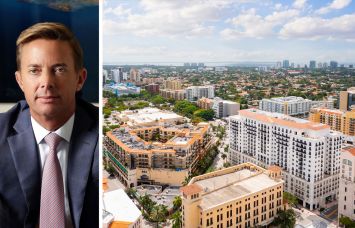
Fishman is one investor who took his business elsewhere following the political changes in New York City. In December 2025, Gaia announced it would move its headquarters out of New York City and into Miami as part of an investment strategy focused on South Florida’s multifamily market.
Gaia still maintains a New York City office, but Fishman said he sees more “opportunity” and a more “business-friendly environment” in South Florida. “I can give you a long list of reasons, but it’s almost, why not?” he said of the headquarters move.
Gaia’s Florida HQ has grown to around 35 people, and the firm has another 150 people in the field, the CEO said. Since moving, the firm has already done a few deals down in South Florida, where it’s in the process of a large development of single-family homes and townhouses in Miami.
That development is being launched through a $150 million fund called MILAS, which Gaia is working on with Broman’s Moderno Development Group. Gaia and Moderno, which focuses on small multifamily development projects, are set to acquire roughly 400 homes and townhouses near Miami’s city center, renovate or build anew on the properties, and then rent out the finished product for between $4,000 and $7,000 per month, Broman said last year. A second $150 million phase is planned for this year, and completion is roughly five to six years out, he added.
When asked why he and Fishman work easily together, Broman had a simple answer: They both enjoy walking a property.
“[Danny] likes to walk real estate,” he said. “We strongly believe in the fundamentals and basics of first walking and understanding the real estate. He takes the time to investigate the neighborhood and understand really what’s going on there. Everything is examined to the last inch.”
In addition to growing MILAS, Gaia REIT recently closed on three multifamily acquisitions in South Florida, with the most recent closing late last year, Fishman said.
That’s not to say Gaia is focusing only on South Florida.
In January, Gaia secured an $83.8 million refinancing loan for Winchester Park & Woods, a 66-acre, 478-unit multifamily community in East Providence, R.I., that Gaia acquired in 2013 from Equity Residential for about $55 million — a price that Fishman said was at least 25 to 30 percent what it was actually worth. After investing in a series of major upgrades, Fishman said the property is worth at least two times its initial purchase price today.
“When we bought it, institutions didn’t look at that market at all — they overlooked it,” Fishman said. “So we bought this property at a very, very cheap price, and we fixed whatever needed to be fixed. That was a home run property.”
While success has certainly been the norm lately for Gaia, Fishman said the last three years have been difficult due to rising interest rates. Many properties that were purchased at peak pricing with aggressive loans are now underwater or upside down, he said.
But credit and lending funds have stepped in and saved owners by refinancing or extending loans, effectively “kicking the can down the road” rather than resolving underlying issues, Fishman said. Everyone’s hoping rates come down and properties stabilize, but old problems might just resurface if not, he added.
Fishman will be there.
“I’ve done business in real estate now for 50 years, and I have met few people with the integrity of Danny Fishman,” Woolley said. “Real estate has a lot of shysters, a lot of people who take advantage of other people and screw over other people. Danny is a straight shooter all the way.”
Isabelle Durso can be reached at idurso@commercialobserver.com.