Changes in Retail Real Estate Nationwide Have Accelerated: Forum
The experts at a recent Commercial Observer forum talked of blurring lines between digital, experiential and brick-and-mortar, never mind the effects of Gen Z shoppers
By Larry Getlen June 22, 2026 4:35 pm
reprints
Kicking off a panel on the nature of experiential retail and the future of destination developments during Commercial Observer’s recent Retail & Hospitality Forum, Nima Fazeli, senior vice president of development for the H.wood Group, made a statement that should have seemed more shocking than it was.
“I don’t think you can really differentiate the different asset classes anymore,” Fazeli said of commercial real estate in general. “I think everybody in this room would agree that it’s all becoming blended into one homogeneous experience.”
This simple statement, a dismantling of sorts of CRE’s conventional sector and asset class divisions, was just one at the event — which took place on June 18 at the Paramount Club at 1301 Avenue of the Americas in Midtown — indicating the sweeping changes engulfing the retail sector in 2026.
After introductory remarks from Peter Brindley, head of real estate for building owner Elecor Properties (formerly Paramount Group), and the day’s emcee, Brian Pascus, a finance reporter for Commercial Observer, the event’s first panel included a discussion of curating leading retail corridors and the resurgence of Manhattan’s Upper East Side.
David Koeppel, a partner at law firm Koeppel Rosen, noted that since COVID the area has developed a new sense of cool.
“Post-COVID, there was somewhat of a void on the Upper East Side. People had left,” said Koeppel. “There were great values in residential real estate to be had, and those voids were filled by younger people starting families. Retailers like that. They love the foot traffic created by the residential tenants.”
Rachel Abeles, senior vice president for customer and revenue growth for Bloomingdale’s, said the Upper East Side fixture has spent the last few years seeking to bring more ambition into their platform with an emphasis on digital growth.
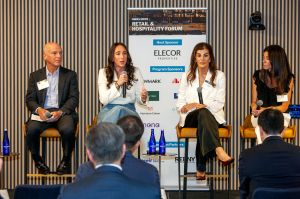
But Abeles noted that customers begin their journey with the brand digitally to better enhance the physical retail experience.
“Ultimately, what customers are looking for today is the tangibility of physical retail: to touch, feel, smell, try on and interact with other human beings,” said Abeles, who then said the company had embarked on a renovation costing “hundreds of millions of dollars” for its Upper East Side flagship, hoping to extend the strategy throughout the brand’s physical footprint.
“Customers are not just looking to transact, they’re looking to experience, but what they’re looking for is an experience that is vibrant and warm and original,” said Abeles. “If you go to the store and look at the fourth and fifth floors, you will see a reinvention of our [style]. We took Art Deco elements, but made them super modern by putting them in a brushed chrome. We added color, which we had never done in our stores. It sounds small, but if you go into a store that historically has been about black and white, it feels really different.”
The panel also included co-moderators Karen Bellantoni and Jackie Totolo, vice chairman and senior managing director, respectively, at Newmark.
The next panel focused on shopping centers. It included the good news that institutional investors are re-emerging into major positions in CRE, which is having a strong impact on retail.
“It’s a great time to invest in commercial real estate,” said Adria Savarese, managing director in real estate for the Americas for J.P. Morgan Asset Management. “The market is repriced and in the early stages of recovery. We look at what institutional investors are doing now, and they’re getting back in the game. We’re seeing larger transactions happening. Play that forward into retail, and what we’re seeing is really strong in that retail still offers superior spreads relative to industrial and multifamily.”
Savarese added that retail offers investors great stability, rent growth, net operating income growth, and the best performance, from an occupancy standpoint, that the industry has seen in 15 years.
Stephanie McGowan, managing director of real estate for Blackstone, noted that investors are showing the strongest appetite for open-air shopping centers, especially those anchored by grocery stores.
“It’s certainly where we’ve been the most active,” said McGowan. “From a macro picture, there’s been virtually no new supply of open-air retail — or really retail broadly in the U.S. — and we’re pairing that with really strong demand we’re seeing from retailers.”
The panel also included commentary from Kenneth F. Bernstein, president and CEO of Acadia Realty Trust; Mike O’Neill, executive vice chair at Cushman & Wakefield; and moderator Danielle Lesser, partner and chair of business litigation at law firm Morrison Cohen.
The panel on experiential retail — which also featured Jordan Bargas, executive vice president of development at Related Ross; Jeff Dvorett, president of Midwood Investment & Development; and moderator Hara Perkins, a director and administrative head of the New York City office for law firm Goulston & Storrs — emphasized that CRE was more likely to view the various sectors of a mixed-use property as a holistic whole than sector by sector.
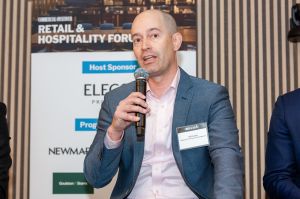
“The opportunity to create value by having an integrated strategy where there’s a symbiotic relationship between retail, office, or retail and multifamily, I think that’s what everyone, including ourselves, is focusing on,” said Dvorett.
Bargas added that it has never been more important to focus on the live-work-play aspects of mixed-use projects so that they reinforce each other to create places that function as full and satisfying communities.
“More important than anything else is to have everything blend together,” said Bargas. “When you’re leasing office space or renting apartments, or trying to get companies to move there, what do companies care about the most? It’s attracting and retaining talent. It’s not about just leasing an office building that checks all your boxes anymore. It’s about creating an entire environment that young professionals want to be at.”
Next came a fireside chat moderated by Nina Roket, co-managing partner and co-chair of the real estate law and commercial leasing practices at law firm Olshan Frome Wolosky. The session looked at high-profile retailers Tapestry and GGP, with representatives from both indicating that any reports of the death of retail at any point in the past decade were greatly exaggerated.
“Everybody says that retail’s back, but it never left,” said Kevin McCrain, CEO of GGP. “I thought it was dead. I thought the mall was dead. And then I looked and saw that sales never went down in our portfolio for 20 years. The consumer changed like the assets needed to change — the whole mindset was changing. But the consumer never left going to the store. The landlords needed to evolve.”
Megan Bates, vice president of business development and facilities for Tapestry, which includes the coach and Kate Spade New York brands, largely concurred.
“I would echo those sentiments. I think retail has been strong, and it’s stronger today,” said Bates. “One of the big things we’re focused on is Gen Z. There are 70 million of them in the U.S. and 2 billion globally, and it’s the most interconnected generation. A Gen Zer in New York City has more in common with a Gen Zer in Shanghai than they do with a 40-year-old in New York. That allows you, when you’re talking about your brand, to speak to a specific type of consumer that wants the interaction.”
Roket and McCrain also discussed the changing nature of lease agreements, especially around experiential retail deals.
“The traditional lease is really no more,” said Roket. “If you’re a savvy owner and a productive and robust operator, you really need to figure out the right way to structure these deals. I’m finding them to be structured in a more bespoke way.”
McCrain noted that for true experiential tenants, transactions are becoming much more structured.
“For a typical brand, there’s always the haggle around sales and the rent and occupancy costs and percentage rent, and a lot of the relationship goes into that,” said McCrain. “As you get into operator-led, experience-driven tenants, it becomes more of ‘Is it a management deal? Is it really low rent?’ They are generally low credit. Sometimes you do these things very speculatively because you really like the concept and it’s a bit of a loss leader, but it’s also, ‘Let’s make a bet.’ You do that generally when you have a much larger flagship asset, where you can make a little bit of a bet on a 20,000- or 30,000-square-foot, experience-driven tenant.”
Next came a panel on unlocking value in the hospitality sector.
Daniel H. Lesser, co-founder, president and CEO of LW Hospitality Advisors, was asked how the slowing of hospitality development around the U.S. and especially in New York was impacting hotel valuations.
He answered that given current supply constraints that show no signs of abating, the hospitality sector is currently a “very strong magnet” for investors.
“I don’t ever remember a period where hotels were perceived as more desirable commercial real estate assets than office buildings. It’s kind of mind-boggling when you think about it,” said Lesser.
The panel also featured Mark Keiser, president of development at Viceroy Hotels and Resorts; Scott Koster, executive vice president of asset management at GFI Hospitality; and moderator Paul “Tad” O’Connor III, a partner at the law firm Loeb & Loeb.
The day’s final panel focused on meeting consumer expectations within a changing retail landscape.
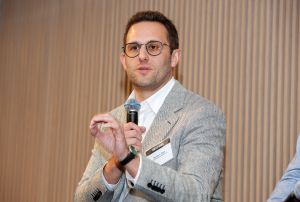
The panel, moderated by Commercial Observer’s Pascus, reinforced several themes of the day, including showing how strong retail currently is as it blends uses into different sectors.
“I have never seen a market like we’re in right now, and I’ve been a broker for almost 20 years,” said Brandon L. Singer, CEO and founder of MONA Retail Holdings. “You put a space on the market, you get two offers in a month, and you have a lease. We signed a lease yesterday on the Upper East Side where we had two offers before we even launched, and we signed the lease with one of the tenants. I’ve never seen that in my career.”
The panel also featured Adam Frazier, president and CEO at Columbia Property Trust, and Adam Schwegman, head of retail leasing at Jamestown, who reinforced this view.
“JLL just said there’s only a 4.4 percent vacancy rate across the nation. I don’t think it’s ever been that low,” said Schwegman. “When you start looking at more Class A spaces, it gets even tighter. There are projects where we can’t accommodate some of our retail partners where they want to be, and those are not easy conversations. It’s clearly an owner’s market.”
Larry Getlen can be reached at lgetlen@commercialobserver.com.