As City Considers Deficit Solutions, Fifth Avenue’s Businesses Tout Contributions
By Mark Hallum June 25, 2026 8:00 am
reprints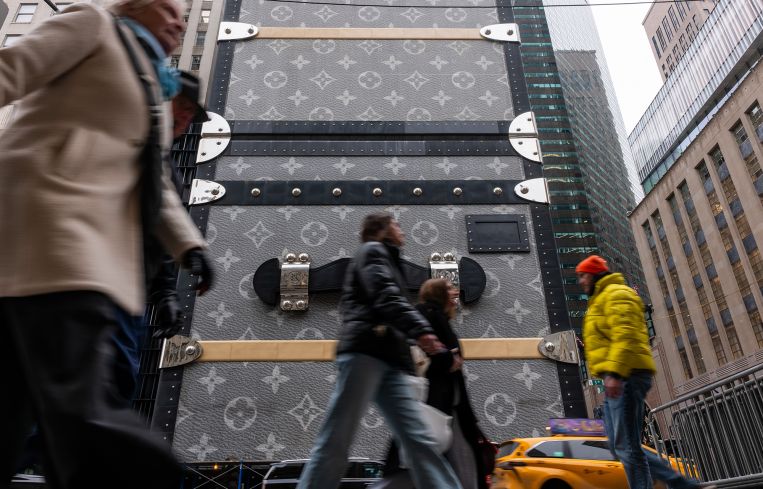
The Fifth Avenue Association business improvement district wanted to quantify how much the storied boulevard contributes in taxes to the city, so it hired BJH Advisors to find out.
The results? The Fifth Avenue corridor generated $1.53 billion in office and retail property taxes in 2024, the most recent year for which tax data is available.
That’s 11 percent of the total tax revenue for the city, despite the corridor between 40th and 61st streets representing only 6 percent of office and retail space in New York City overall. That finding is leading the Fifth Avenue Association to stress the importance of maintaining the corridor’s prominence as a global shopping — and working — destination.
The study conducted by BJH Advisors also found that the avenue is where retail workers are paid the most, with an average yearly wage of $98,000 compared to $70,000 across Manhattan overall and $58,000 in New York City overall.
Madelyn Wils, CEO of the Fifth Avenue Association, told Commercial Observer that if the city wants to keep its budget deficit closed, which it did in early May with an $8 billion cash infusion from the state, it will need to keep its eye on the ball — the ball being Fifth Avenue.
“This administration should be looking at not just finding new ways of raising taxes but protecting the tax base they already have, and that would mean taking an interest in growing business,” Wils said in an interview.
“When you look at Fifth Avenue, it has an outsized effect on the city in the amount of taxes it generates,” Wils added. “What we’re trying to convey here is that these are the kind of jobs I think that the administration would call working-class jobs that you don’t necessarily need a college degree for. These people have worked the way up in the stores through the stockroom into the sales area, so these jobs are important.”
Office and retail along Fifth Avenue have enjoyed a symbiotic relationship, with the tony shopping experience below offices driving higher rents above, according to Wils. Even the office properties that are not performing at top tier after COVID-related financial troubles are getting over $100 per square foot lately.
“Even if you have an office building that’s getting, let’s say, $125 per square foot right now, which is a very good rate, and you’re getting $2,500 per square foot for a store … that affects the building’s property taxes, which is why the the buildings on Fifth Avenue generally pay the most out of anywhere in the city,” Wils said. “The ecosystem between office, retail and residential works very well on the avenue.”
But global events have cast a shadow over Fifth Avenue’s expected returns, with the war in Iran and other geopolitical events having a negative impact on tourism, a major driver of foot traffic along the avenue.
“I think retailers are being very cautious right now,” Wils said.
But the overarching trend in how Fifth Avenue will perform can easily be based on major deals that occurred after the 2022 announcement of “Future of Fifth,” New York City’s plan spearheaded by the association to redesign the streetscape from Bryant Park to 61st Street. The plan calls for wider sidewalks, reduced traffic and more upscale streetlamps.
In late 2023, not long after the plan was announced, Wharton Properties’ Jeff Sutton sold three properties for $1.8 billion to Prada and Kering.
“I think what they want is the street to match the experience they’re giving to people inside,” Wils said. “These are the luxury global brands that know how their stores respond when cities make investments in their public realm. You can look at Bond Street in London or you can look at Calle Serrano in Madrid or the Ginza in Japan. They’re all spending a lot of money to make sure you walk in the store.”
And what is good for the goose is good for the gander, according to Wils.
“At a time when everyone’s questioning economic justice, and how that falls into economic development, we want to make sure that there’s room for all sorts of good jobs and all sorts of people who come and spend their money,” Wils concluded. “If they spend their money in New York, New York is making more taxes that support everybody.”
CO sat down with Fifth Avenue Association Board Chairman Ed Hogan in May to discuss how the redesign, set to launch in 2028 and wrap roughly seven years later, will take shape and what its vision has been as one of the old business improvement districts in New York City.
To Hogan, who recently left Vornado Realty Trust for JVP Management, the redesign was a necessity when he joined the association.
“It was kind of an ugly street,” Hogan told CO at the time. “The lampposts are old and they need painting. If I counted the trees that were thriving, there may have been 10 at the time. And I’m, like, this is not a beautiful streetscape. There was no street with more buses than Fifth Avenue, and up to 40 percent of those buses were empty. They’re just going back to the yard.”
Hogan used his eye for architecture on projects such as developing the retail experiences in Brookfield Place, Pennsylvania Station and Moynihan Train Hall, as well as reforming the Penn District overall.
Mark Hallum can be reached at mhallum@commercialobserver.com.