

One of NYC’s Largest Residential Co-Ops Repositions Its 50K-SF Retail Portfolio
Lee & Associates NYC has been tapped to lead the Seward Park Cooperative’s retail leasing and bring in new brands for the evolving Lower East Side
By Emily Davis May 27, 2026 8:00 am
reprints
Seward Park Cooperative’s board is looking to button up its extensive retail portfolio, Commercial Observer has learned.
The 65-year-old Lower East Side co-op has tapped Lee & Associates NYC to take over leasing strategy and retail representation for 25 of its retail properties. The Seward Park community is among the largest market-rate residential co-ops in New York City, encompassing four buildings across roughly 12 acres bounded by Grand, East Broadway, Essex and Pitt streets. Seward’s 50,000-square-foot portfolio of retail storefronts is a rarity among Manhattan’s large, legacy co-ops.
The Lee leasing team, made up of Peter Braus, Paul Popkin, Eric Levine, Morris Dweck and Annie Squier, also believes it’s a source of untapped potential.
The move to modernize the portfolio comes as Seward’s board seeks to capitalize on its neighborhood’s changing retail landscape while reducing its own operational costs.
“As the neighborhood continues to evolve, we recognized an opportunity to take a more cohesive and strategic approach to our retail portfolio,” Wei-Li Tjong, president of the co-op’s board of directors, said in a statement. “We were looking for a team that not only understood the market, but also appreciated the unique character and long-term needs of the Seward Park community. Lee & Associates NYC brings both the institutional leasing expertise and neighborhood understanding to help guide the next chapter of the portfolio.”
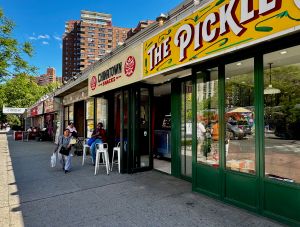
Seward’s more than 1,600 units contain over 5,500 residents, generations of whom have watched the Lower East Side’s retail market transform over the last six decades. That includes its most recent phase of development that yielded new commercial neighbors, including Essex Market, a Trader Joe’s, a Lidl and a Target.
Seward’s own commercial holdings stand largely independent from its towers, lining the community’s borders and offering a level of flexibility not available within most of the co-op’s ground-floor retail. Current tenants are a mix of food and beverage operators and local service providers, including Donut Plant, Kossar’s Bagels & Bialys, The Pickle Guys, Citibank and Apple Bank.
Such an array of retail held totally by co-op shareholders is rare, Levine said. Other legacy co-op buildings that once had comparable portfolios sold off their assets over the years. The 80/20 federal tax law long restricted the income co-ops could derive from non-shareholder sources, like storefronts and parking garages, to 20 percent. That law was changed in 2007 and became essentially obsolete, but co-ops across the city had already offloaded much of their retail to comply. Not Seward, however.
The Lee team is already marketing a restaurant space at 359 Grand Street, formerly occupied by neighborhood cafe Eva’s Kitchen on Grand, which closed last year. The space spans approximately 1,145 square feet on the ground floor, with an additional 1,019-square-foot lower level.
The recent decision to hire a commercial brokerage for the task of institutionalizing the fragmented retail portfolio may be a first for the decades-old co-op, according to Levine. Levine, who joins the Lee leasing team from his brokerage FIND Real Estate, is also a longtime Seward resident and shareholder.
“It was generally thought of that this is sort of the town center for the cooperative,” Levine said.” And patrons from around the Lower East Side shop here, but it was never really the focus as, day to day, the board and the management of the cooperative have largely been focused on the operations of the residential aspect of the property.”
One impetus for the change in strategy was the arrival of high-end, high-traffic retail developments into the neighborhood. Namely, Essex Crossing, the billion-dollar, 6-acre megaproject down the street from Seward, which opened a 30-vendor market in 2019.
The trendy, secondary high streets of the Lower East Side and the East Village have long attracted edgy bars, experimental restaurants and boutique storefronts, but brokers told the Wall Street Journal last year that retailers have upped the ante on their real estate aspirations in the two neighborhoods, where one listing can draw five to 10 offers in a matter of days. Citywide, New York’s retail market sustained strong leasing momentum in 2025, during which availability hit a 10-year low, according to Cushman & Wakefield data.
The Lower East Side and East Village remain in recovery mode, however. Storefront data published by the Manhattan Chamber of Commerce in December found that the Lower East Side and East Village had the second-highest vacancy rates among Manhattan’s community districts, with a 15.43 percent vacancy, second only to Lower Manhattan’s 22.11 percent.
Seward has a dense residential population to recommend itself, however, with nearby subway stops and high foot traffic to boot, and its retail strip already has cachet among local foodies. But, by repositioning the portfolio, the Lee team said it wants to give Seward a brand.
“We still want to service the community with what’s needed, but we also want to bring in larger brands and make it also a destination for other people to come visit,” Lee’s Popkin said.
The lack of an institutional owner can make a given cooperative’s retail a hard sell for well-established, would-be tenants, law firm HSF Kramer’s Josh Winefsky told CO.
“How do you get someone who is a neighborhood over in SoHo to come to the Lower East Side, right? That’s a big ask,” Winefsky said. “Presumably, the rent is going to be cheaper, but in any event, there has to be a strategy around showing the market that you’re operating at a level of sophistication that looks more like a business that owns, operates and manages retail, as opposed to a ground-floor space beneath thousands of residential apartments.”
Prior to this move to commercial management, Seward’s co-op board largely handled its retail leasing in-house, Levine said, or overlaid the job within residential management contracts. Bringing a commercial brokerage into the mix should boost the co-op’s status among potential retail tenants, and allows the voluntary board to dedicate more time to residential concerns, including rising costs in the form of property taxes, labor costs and insurance premiums.
Opportunities to replace Seward’s current retail tenants will come as leases expire or businesses close or exit. An estimated three to five opportunities are anticipated within the next 12 months. The broker team emphasized that the board wants to maintain the service-oriented retail that served the neighborhood, but invite in “proven operators” who want to tap into the Lower East Side market, Popkin said.
“The board members are volunteer leaders, fiduciaries of the co-op, but they live in the community, they’re going to be walking by those stores every single day,” Levine said. “I think there’s a heightened sense of responsibility on their part to make sure that if they’re walking by and it seems like a good fit, both financially and qualitatively, that it should also resonate with the community that they represent.”
Emily Davis can be reached at edavis@commercialobserver.com.


