There’s a New Proposition for Struggling U.S. Downtowns: Beautiful Data Centers
Legacy Investing has an idea of matching data centers with old and vacant real estate
By Emily Davis April 27, 2026 8:00 am
reprints
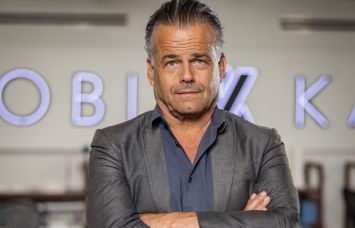
Daniel English and Jay Rappaport, the tech founders turned data center developers behind real estate platform Legacy Investing, had a great idea: America doesn’t have enough data centers. It also has too much obsolete real estate.
The number of data center facilities in the U.S. is expected to double by 2030, according to data from JLL. For its part in that equation, Legacy has zeroed on disused office buildings, rather than cornfields, as sites ripe for data center development.
“There’s just astronomical growth right now in compute, and it has to live somewhere,” English told Commercial Observer.
Persistent commercial office vacancies burdening midsize and large cities across America offer data center developers undervalued advantages, including proximity to fiber and existing infrastructure, tax base boosts and, as English argues, the opportunity to make data centers a thing of beauty.
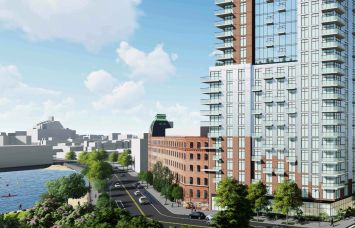
“We’re putting [data centers] inside a beautiful glass office tower that enhances the city. Most people have no idea there’s a data center there, and I don’t think that’s necessarily a bad thing,” English said. “There are ways to incorporate these into our lives.”
English’s Arlington, Va.-based firm made headlines in January when it off-loaded a glassy Downtown Minneapolis office building for $235 million, or roughly eight times its previously assessed value, after swooping in and upping the building’s capacity from 2 megawatts to 21 megawatts. Adam Duinick, president and CEO of Minneapolis Downtown Council, described the downtown community’s reaction simply as: “Wow.”
The deal offered a new way to deal with Minneapolis’ supply of vacant, financially distressed commercial real estate, he said.
“If we were in a slightly worse scenario as a city, we would have to have conversations about demolishing buildings,” Duinick said.
Legacy’s model of purchasing vacant offices has yielded significant returns for the company, which made a mint earlier this year on a sale of a reconfigured data center in Minneapolis.
Legacy is also undertaking the conversion of a more than 300,000-square-foot office building in Chicago’s South Loop without a single tenant signed on yet, confident in their urban adaptive reuse model and America’s insatiable appetite for artificial intelligence.
Legacy was founded in 2003, long before the Cloud, to build and manage homes for emerging technologies. Urban data centers became their specialty, and they catered to tenants like Amazon, Nvidia, Flexential and PNC. Today, Legacy has more than 30 investments across the U.S., with a few dozen data center projects completed in cities like Minneapolis, Chicago, Cleveland, Atlanta, Cincinnati, Pittsburgh, and Santa Clara, Calif. Projects in San Antonio, Los Angeles and Richmond, Va., are forthcoming.
English and Rappaport entered the real estate world by way of the early 2000s tech startup world. English counts six different tech startup companies in his early career, and he took his last one, Cricket Media, public alongside Rappaport. Rappaport’s own CV includes 15 years as a senior executive at early Internet companies, including America Online, where he negotiated AOL’s acquisitions of Time Warner, Netscape and CompuServe. His later company, AddThis, was sold to Oracle. Both men recognized that their field had a rapidly growing appetite for infrastructure.
Legacy reports over $3 billion in transactions with more than 20 million square feet under management across the U.S. And, thanks to market demand, they have $3 billion more in the pipeline right now, English said.
Legacy Investing’s busy pipeline is part of an industry-wide return to adaptive reuse, said Sean Farney, vice president of data center strategy at JLL. It’s driven by enormous pressure — data center vacancy rates across the U.S. are reportedly at roughly 1 percent.
“We are the envy of every other industry in the world, because we are 99 percent utilized,” Farney said.
The idea of saving older and underutilized properties by sticking a data center in them has been part of the data center story since the beginning. The first data centers were adaptive reuse projects, Farney said, built out of telecommunications hubs like 111 Eighth Avenue in Manhattan or former plants like the legendary 350 East Cermak data center in Chicago. The shift to ground-up construction in rural areas came later, as megadevelopments stamped out across the country on massive parcels that demanded extensive builds. Now, growing market demand is sending data center developers back to their adaptive reuse roots.
The vacant former headquarters of Cboe Global Markets in Chicago’s South Loop, at 400 South LaSalle Street, was acquired by Legacy and GI Partners in the fall of last year for $40 million. Just one year before that, it had traded for just $12 million. The new value of the brick and glass 1980s tower came from its suitability as a data center, in which Legacy plans to install 33 megawatts by the end of 2026.
The new demand for retrofitted data centers is boosted by the incentive to raise revenue, Farney said. Increased Wall Street scrutiny in the last several years has pressured operators to generate income faster. Adaptive reuse, in sites ranging from empty rural factories to cobweb-filled office buildings, can offer a data center’s structural, permitting and infrastructure needs on a silver platter.
Data centers are a unique asset class — whereas most building demand is driven by people, this one is driven by robots. Those robots don’t need neighbors, fancy amenities, easy commutes, or even windows. What they do need is heavy floor plates and power.
“I don’t think that that has to be ugly,” English said. “I think that those can be things that we accept, embrace, and are even happy to have in our community.”
Giant 500 megawatt centers and gigawest data center campuses are still a needed niche for AI training, but English said there’s still plenty of demand for buildings that are under 100 megawatts. For Legacy’s prospective tenants, English offers urban locations that promote fiber density and cut down on latency, an advantage to companies offering similar perks to that of Amazon’s same-day delivery service. For the local communities, he argues that vacant pieces of their downtown’s history, like the Cboe building in Chicago, can be put to good use, bring in construction and maintenance jobs, and generate new tax revenue.
“It already has a shell. It already has power infrastructure and water infrastructure and fiber infrastructure that we can tap into that is a net benefit for the city,” English said.
All data centers require water to keep their facilities cool, but their consumption can vary widely based on climate, size and use. Every substantial data center will have profound power and cooling requirements, but industry experts vary in their interpretations of the impacts of those demands, or how to address them.
And then there’s the payoff for Legacy.
Just a decade ago, Legacy’s typical data center project clocked in at around $50 million, English said. Today, each is worth at least half a billion dollars, he said.
Legacy acquired a mixed-use, six-story building in Minneapolis in 2019 with a 2 megawatt data center. The building, which spans approximately half a million square feet, hosted the Sleep Number Corporation headquarters on its lower floors, but was otherwise vacant. Legacy spent more than $70 million on improvements and redeveloped the data center to house 21 megawatts.
Most of that new data center was leased to an unnamed AI and cloud-inferencing provider, and a joint venture acquired the building in January for $235 million. It was the highest price for a Minneapolis office building since 2019.
“My hope is that it sends a signal that there’s an economically dynamic community here that cares about business, and it says we’re open for business,” Downtown Council’s Duinick said.
Legacy continues to operate the Sleep Number HQ data center and is working to expand the capacity to 40 megawatts.
But the sale came at a tricky time for data center developers in Minnesota. Rural and suburban communities were packing council meetings in fights against massive developments, including a Google data center and a 338-acre hyperscale campus. But the Downtown Minneapolis sale, Duinick said, quickly shifted the conversation in Minneapolis. At least two other vacant office buildings up for sale in Minneapolis have been rumored to have received interest from data center developers since the Sleep Number HQ sale, Duinick said.
Many of those 1980s structures’ deep floor plates and poor exposures don’t invite residential conversions, because, as English likes to point out, “servers don’t care.”
The city isn’t looking to fill its skyscrapers with data centers, but rather with a mixed-use approach like the Sleep Number HQ, which offers a happy medium of reliable rental income, job creation and strengthening of the city’s property tax base.
The continued scalability of Legacy’s urban, adaptive reuse model, and the scalability of the rest of the data center industry, is filled with uncertainties.
Growing public opposition to the entire asset class is driving Maine and at least 10 other states to bring the hammer down on the gold rush, either through outright bans on developments over a certain megawattage or new policies requiring massive data centers to foot the bill for grid upgrades. The resulting pushback is making on-site power generation a must-have for the larger, ground-up data centers, according to Michael Vardaro, managing partner at construction law firm Zetlin & De Chiara. On top of that, power-generating equipment is bogged down in years of manufacturer backlog.
Financing risks around the costly, gangbusters sector loom large as well, and the nation’s aging electrical grid looks more and more like it’s headed towards a nasty bottleneck.
English and Farney both acknowledged that there’s a shift in where data centers are going based on which states are more business friendly, with Texas poised to usurp Virginia as America’s data center capital.
“It’s going to happen. It’s just a matter of where,” Vardaro said.
But, English argues, political pressure encourages better design –– the kind Legacy is staking its brand on.
“This is still the first inning of data centers, and there’s still an opportunity to define how data centers exist in our built environment in our cities and in our communities,” English said. “That’s exciting to me because it means there’s still room for creativity.”
Emily Davis can be reached at edavis@commercialobserver.com.