Running the Numbers: JP Morgan’s Kurt Stuart Takes CO on a Property Running Tour
By Cathy Cunningham March 24, 2026 1:18 pm
reprints
J.P. Morgan’s commercial real estate teams cover every asset, but a big focus on the multi-family side is workforce housing, and a lot of that workforce housing is in coastal markets.
The locations all share some commonalities: They’re supply constrained, their cash flows are strongly durable, and they’re desirable places to live, so vacancy rates and rent levels are very stable over long periods. The clients that the firm banks are investors that are focused on the long term.
When Kurt Stuart moved to New York City from Manhattan Beach in California, he learned the neighborhoods J.P. Morgan was lending in by putting on his sneakers and running around them, absorbing them with his own eyes. And, so, what better way for Commercial Observer to see some of the bank’s Huntington Beach portfolio (while at the bank’s National Sales Meeting) than joining Stuart on a four-mile run around 16 assets?
“This neighborhood is filled with folks that work around the Huntington Beach area. It’s a really diverse economy,” Stuart said before we hit the street. “You’ve got Disneyland three miles that way, you’ve got the University of California-Irvine in Newport Beach and, obviously, there’s the beach right here. There are a lot of reasons to live here.”
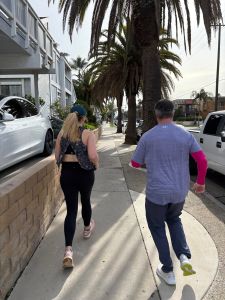
While keeping a property’s fundamentals — viewed on a piece of paper — in mind, Stuart is looking out for signs of activity and safety in the neighborhoods. “Are there people walking around, are there cars parked, is it a place people leave during the day?” he said. “Safety is incredibly important, because it affirms the desirability of a place to live.”
At a time when AI is omnipresent, Stuart said he really values the opportunity to visit assets himself. “So much information is digitally conveyed, without a tangible element,” he said. “To me, this provides a tangible confirmation in a digital world.”
Most of the sunlit buildings we ran past were built in the 1970s and 1980s, each with its own character, and had been carefully preserved by their owners over the years. Ownership varies from locally based, privately held investment firms to small family offices, Stuart said.
“If you were to do a cross section on the multifamily sector, you’d find that by far the most highly fragmented ownership is under 100 units, and it all exists on the coast,” Stuart said.
“Some of these tenants have been here for decades,” he added. “There’s a lot of long-term tenancy, and much less transient than you’d see in Class A assets. These are folks who want to be three blocks from the water, they work somewhere around here, and pay around $1,800 for a one-bedroom.”
It hasn’t always been smooth trails for Stuart. When running with his triplets in a stroller when they were babies, he often underestimated the number of people who’d suddenly pop out in front of him to compliment the children or pinch their cheeks, causing narrowly missed collisions.

“I’ve also run in some tougher neighborhoods where I had to run … a little bit faster … because people are wondering, ‘Hey, who is this guy running around our houses?!’ ” he laughed.
As we hustled along that Sunday morning, we were accompanied at various points by people on rollerblades, a bike carting a surfboard, and a garage band belting out “Hey Jude.”
Stuart’s middle name is Lennon (“My parents were huge hippies and huge Beatles fans,” he said). His dad lived on the beach of Manhattan beach in the 60’s, during the hippy movement, and coincidentally “Hey Jude” is Stuart’s favorite song in the Beatles’ repertoire, as his mom’s name is Judy.
“Here is a bonus,” Stuart said. “John Lennon was a huge advocate for community and connection, which coincidentally sits right at the center of what housing is all about!”
Naaa naa na nana-na-naaa, nana-na-naaa…