For King & Spalding’s John Wilson, the More Complicated, the Better
The longtime commercial real estate lawyer is known as a go-to on complicated fundraising deals and structures
By Amanda Schiavo March 2, 2026 6:00 am
reprints
For many lawyers, the goal is to outshine, outboast and otherwise grandiosely beat the other guy. It’s how they are trained, and, after all, it’s how most of them make their living.
Need proof? Just look at social media. It is filled with attorneys telling stories of the bonkers things they’ve done in court to win a case — like that divorce lawyer who once dropped down onto the floor of a courtroom to prove a point.
But you won’t get any of that bravado, chest-beating or showboating with King & Spalding’s John Wilson. That’s not what he’s about.
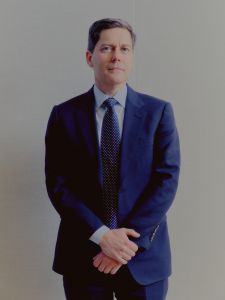
Wilson, a 29-year legal veteran initially drawn to the law by its intellectual underpinnings, has spent his entire career with King & Spalding, where he focuses on fundraising. That leans heavily into advising fund sponsors and management teams through transactions that include mergers and acquisitions, management lift-outs, investments and recapitalizations. These are the types of deals that require meticulous thought and careful consideration.
“The fundraising world is not a zero-sum,” Wilson, 52, said. “Your goal is not to win — your goal is to successfully close the vehicle. At the end of a fundraise — unlike M&A, where the buyer and seller may never interact again — you’re not at the end of your transaction. You’re at the beginning of a new relationship between that investor and manager. And that requires a different mindset: not to win every point against the other guy, but to develop a successful working relationship.”
This is a mindset and a strategy that has defined Wilson’s career over the last two decades. He’s seen how the real estate industry has evolved from a financial perspective, and he’s seen the change in what investment managers are doing, and how they are investing.
“From the outset, it was clear he understood not only the legal issues, but also the strategic and human elements of building a successful investment platform,” Jason Tompkins, managing partner at Asana Partners, said of the first time he worked with Wilson 20 years ago. “Roughly 10 years ago, when my partners and I founded Asana Partners, John was instrumental in helping us launch the firm. Since then, he has advised us across virtually every aspect of our platform, from fund formation to governance to compensation and ownership structure.”
In late 2021, Asana decided to modernize its corporate governance structure, expand ownership, and add three senior leaders as partners. The firm committed to completing this by Jan. 1, 2022, a somewhat aggressive timeline considering how complex and sensitive of a task they were pursuing.
“John and his team immediately rolled up their sleeves, and treated the project with the urgency and care it deserved,” Tompkins said. “He navigated complicated ownership, tax, governance and compensation considerations while keeping the process constructive and focused on the broader goal of alignment and retention. Despite the compressed timeline and multiple stakeholders, John delivered exactly what we had promised, on time. It was a clear example of his ability to execute under pressure while maintaining trust on all sides.”
Wilson, a native of Saint Petersburg, Fla., and a graduate of the University of Florida law school, has worked on a number of other deals and arrangements. That includes advising Clarion Partners on the formation of an open-ended multifamily fund that acquired $700 million in seed assets at its initial closing in 2018. He also advised Cortland Partners on the formation of a $1.6 billion closed-end, value-add multifamily fund that had a final closing in 2024.
“Cortland acquired 19 of Elme’s 28 properties in a $1.6 billion transaction that closed in November 2025,” Wilson said, referring to multifamily real estate investment trust (REIT) Elme Communities. “I would describe this as a highlight of 2025, as it was a larger transaction in a year with relatively low transactional volume. This transaction brought to bear the firm’s broad range of lawyers across funds, M&A, real estate transactional and real estate finance.”
He was also part of the team that advised Greystar Real Estate Partners on the formation of a $4.6 billion open-end student housing fund so it could acquire the REIT EdR (formerly Education Realty Trust) in 2018.
Looking back on 2025, Wilson said that most people in the commercial real estate industry had high expectations for what the fundraising environment would look like, but things didn’t turn out exactly as they had anticipated.
“Most people came into 2025 thinking it was going to be a very robust fundraising year, and that maybe we were back to something that was going to look more like 2021, but that didn’t happen initially,” he said. “The first quarter was very significant, and then post-Liberation Day, that uncertainty, combined with other macroeconomic concerns, really slowed things down for a while. But then it became really strong in the fourth quarter. It ended up being an up year, but in a pretty uneven way.” (Liberation Day was President Donald Trump’s nickname for his big April hike in tariffs.)
Challenges abound within the fundraising environment, particularly from a macro perspective, which takes into account high interest rates, those steeper tariffs, geopolitical concerns and inflation.
“The potential headwinds in 2026, to some degree those will continue,” Wilson said. “We have other geopolitical concerns, whether that’s Iran or more tariff uncertainty. Those could create headwinds if there’s not continued transactional volume.”
But, just because there are challenges in the space doesn’t mean there’s zero opportunity, and right now there is an abundance of opportunity in — say it all together now — data centers.
“The data center opportunity is clear and enduring for the foreseeable future,” Wilson said. “I don’t think that’s a flash in the pan. The most significant opportunities seem to be in housing, industrial and retail.”
Notably absent from that list of opportunities is office, where Wilson says there aren’t enough people with clear-cut plans for that asset.
“It’s not clear that there’s an opportunity in office right now,” he said. “There’s lots of office buildings that are troubled and where owners are trying to figure out what to do with it. There doesn’t yet seem to be a broad view of what to do. There are instances here and there of somebody converting a particular building to residential use, but not enough.”
The issue with office opportunity just goes back to the COVID-19 pandemic and the fact that not everyone is back in the office full time, and those who have returned to the office generally want to be in Class A spaces with premium amenity offerings.
“You’ve got a small number of true Class A buildings and they’re doing just fine,” Wilson said. “I’m talking about all the Class B and C buildings that are under-occupied, and there are more of them than could possibly all be converted into housing. And, often, structurally, it’s not easy to convert them into a different type of office. And, even if you do, is there the demand for the tenants at that price point in the amounts you’re going to need to fill those buildings up?”
He’s not seeing a ton of activity in the office space, then. Still, that’s not to say nobody is doing anything with any of these buildings. But, at the end of the day, Wilson says investors are going to go with the opportunities they are most comfortable with and in which they see the most value, and he’ll be there to guide them through the challenges and to celebrate the successes.
“John’s professional legacy will be defined by loyalty, trust and long-term impact,” Tompkins said. “Across countless real estate and private equity firms — including Asana Partners — John has played a foundational role in shaping governance, ownership and culture in ways that may not always be visible from the outside, but are immeasurably important. His clients trust him implicitly, and that trust is earned through decades of integrity, care and exceptional judgment.”
Amanda Schiavo can be reached at aschiavo@commercialobserver.com.