Health Care Property Pros Triage Ways to Stretch Space and Dollars
Commercial Observer’s National Healthcare Forum drew top architects, builders, health care executives and facilities managers.
By Andrew Coen March 26, 2026 2:50 pm
reprints
Leaders across the health care industry assembled at the City University of New York Graduate Center’s Proshansky Auditorium in Midtown Manhattan on March 25 to tackle ways the commercial real estate industry can tackle rising financial challenges in the often fast-changing sector.
Commercial Observer’s spring National Healthcare Forum featured leading architects, developers, health care executives and facilities managers who explored how enhancements to the built environment and to operations meet these fiscal demands.
Brad Taylor, vice president of capital projects at Northwell Health, said planning for new facilities or renovation projects begins early at “the hospital level” with the goal of addressing patient demand, market growth and infrastructure needs.
“Any time we see an area that’s being underserved, where it’s taking too long to get in for services and patients can’t get the care they need, we generally are very quick to move with the capital project,” said Taylor during the forums’ opening session moderated by Jordan Miller, principal and national health care lead a consultancy Rider Levett Bucknall.
When approaching capital projects, Taylor said extreme needs and regulatory requirements take first priority followed by addressing the life cycle needs of devices such as imaging equipment that might need technological updates. Northwell will then examine new opportunities for enhancements that can generate profits for the health care system.
Taylor stressed that delivering projects in a timely manner is top of mind when deciding who to select for any capital or equipment enhancements.
“I’m really looking for a team that can deliver projects on a schedule because, generally, if you’re delivering a project on a schedule it says a lot about the overall health of the project,” Taylor said. “I’m looking for people that will relentlessly pursue speed to market on these projects.”
Jonathan Cogswell, Northwell’s vice president for Manhattan development for design and construction, also emphasized how critical speed to market is with projects when managing a capital plan. Cogswell spoke during the forum’s second panel, “Flex & Modular Care Environments: Designing for Surge, Shift and Scalability.”
Cogswell said advancing infrastructure projects quickly is especially important for Northwell’s Manhattan facilities given their age — its Lenox Hill Hospital campus has one building that is 117 years old. He noted that Northwell’s strategy to build a 15-story, 200,000-square-foot ambulatory care center at 1345 Third Avenue was centered around providing Lenox Hill with more flexibility to adapt depending on evolving health care needs.
David Kontra, assistant vice president for real estate at Children’s Hospital of Philadelphia, said generating larger specialty care centers as hubs has been a success but can also create challenges with staffing needs at times when a second location is needed.
“The problem with that is as you have these larger hubs, logic says that you would have less of them, but you’re always going to have a need for that one specialty care or another that really needs to be not in a hub,” Kontra said. “All of a sudden, you’re having the triage of where you want to focus on these hubs, but then you’re really looking for that outer location because that cardiology team needs to be in that physical location.”
The second session — moderated by Jeffrey Berman, principal at Jeffrey Berman Architect — also featured John Haught, senior vice president at construction manager LF Driscoll.
As health care companies seek more adaptability with their use of space, ironing out key details during lease negotiations takes on greater importance, according to Ira Rovitz, executive managing director at Newmark.
Adequately planning for “ancillary costs” like having sufficient power and water in a hospital system is often more important than the actual rental agreement, Rovitz said in the forum’s third session, “Real Estate as a Clinical Strategy: How Health Systems Use Deals, Leases and Portfolio Optimization to Shape the Future of Care.”
Jeffrey Lynn, senior director for real estate at Memorial Sloan Kettering Cancer Center, said owning properties generally provides more flexibility to a health care system compared to leasing when mapping out spacing needs. He noted, though, that sometimes leasing makes more sense to provide options down the road.
“If you have access to capital and you have access to opportunity, ownership provides you the lowest long-term operating basis and provides you the highest level of control,” said Lynn during the panel moderated by Adam Taubman, counsel at law firm HSF Kramer. “Capital constraints are ever increasing, and there continues to be disconnects in gaps in value in the marketplace that can also constrain opportunity, so that makes leasing attractive if not necessary in certain situations.”
Following a networking break, the forum’s fourth session — “Navigating Change Orders: Decisions, Dollars and Delivery” — focused on how to best respond when plans don’t go according to plan.
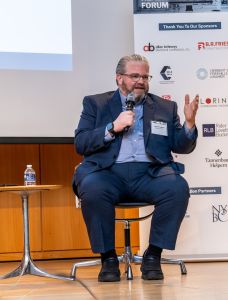
Conrad Belluomo, senior design and construction project manager at Northwell Health, said “unforeseen” events often pop up during the construction process, usually due to changes in design. That makes it vital to have contingency plans mapped out in advance. Belluomo said in one instance while building outdoor space at a health care facility an issue arose with the property’s waterproofing system due to air intakes. That prompted a switch in how the development team approached the project.
Barna Tokay, director of operations at construction manager B.R. Fries & Associates, stressed that change orders need to be crafted so that anyone added to a project can identify why the adjustment occurred and be ready to implement it. He said that sketches and other visuals are also helpful, and that all the necessary details should be effectively laid out so no further notices are needed about the changes.
“Everybody comes out a winner with a properly prepared change order,” said Tokay during the panel moderated by Brandon Reiner, partner in construction and design at law firm Tannenbaum Helpern. “There’s actually no winners in change order, because ultimately it costs somebody money at the end of the day that they haven’t budgeted. However, a properly prepared change order with all that backup will mitigate that.”
Hospital institutions in New York City also need to prepare now for new requirements under Local Law 97, which mandates lower emission levels for most buildings over 25,000 square feet. Dan Mastin, energy and commissioning program manager for New York Presbyterian Hospitals, said Local Law 97 is a “big gorilla in the room in New York City health care” with all major hospitals facing potential multimillion-dollar fines in the 2030s if they fail to comply with the regulations.
“We’re trying to find any way that we can take those Tier 1 and 2 projects and incorporate energy emissions reductions,” said Mastin during the forum’s final panel, “Design, Construction and Financing Solutions to Infrastructure Challenges for Capital-Constrained Healthcare Organizations.” (Tier 1e and Tier 2 refer to federal emissions standards.)
Climate risk measures that health systems are grappling with can often serve as an opportunity for public-private partnerships, according to Annabel Cryan, director of innovative finance strategies at infrastructure advisory STV. Cryan noted that when the Charleston Medical District encountered flooding issues around its facilities, she helped facilitate tens of millions of dollars in funding from the State of South Carolina for infrastructure improvements as an example of how hospital systems can leverage public funding when needed.
The final panel — moderated by Raffaela Dunne, market director of health care at Consigli Construction — also featured Rahul Tikekar, senior vice president at Loring Consulting Engineers; Ed Borman, vice president of the health care division at electricity contractor Allan Briteway; and Colin Barrett, vice president of infrastructure and special projects at Mount Sinai Health System.
While there are digital tools that can produce meaningful savings and better efficiencies, such as fault-detection diagnostic systems, there is no substitute for the human element, according to Tikekar.
“You have to have that human angle to really understand what is being implemented in the field,” Tikekar said. “My word of caution would be to use technology to your advantage, but don’t think that it’s going to just function as an autopilot.”
Andrew Coen can be reached at acoen@commercialobserver.com.