New York City’s Post-Pandemic Development Is Turning Up Reminders of the Past
Railroad tracks, stone floors, a bust of Shakespeare — 'we just stood there in awe'
By Amanda Schiavo December 9, 2025 10:00 am
reprints
Looking for some marvelous historical finds? There’s no reason to raid a lost ark when you can just start developing an office or residential property in New York City.
Developers post-pandemic have been finding and incorporating elements of the city’s past while building for its future, salvaging historical artifacts uncovered during construction and weaving them into their new and upgraded buildings.
Incorporating elements of a building’s past life into its new era goes beyond just nostalgia.
“Archaeological recovery is extraordinarily important because it connects the past with the present and contributes to preserving the city’s history,” said Maria Iacullo-Bird, a clinical professor of history at Pace University. “There is civic responsibility and engagement in acting on the opportunity to recover and incorporate artifacts into new buildings that can educate us about our past and help us better understand the present.”
And, for the building owners and developers, harkening to the past is also about cultivating an identity for a place that will in turn help it to become a more recognizable property that draws in buyers and renters.
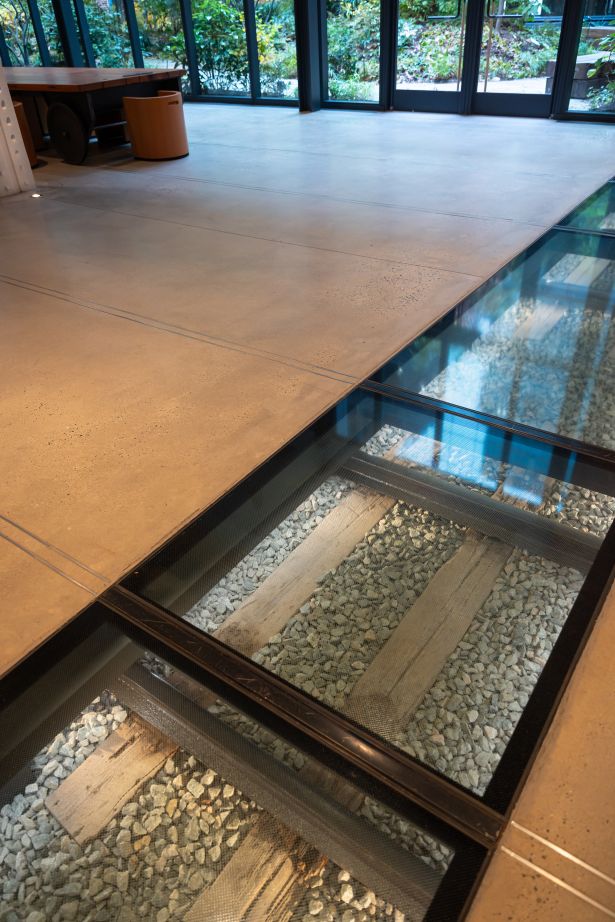
At Terminal Warehouse, a 130-year-old landmarked building at 11th Avenue and West 28th Street, the property’s history quite literally shines through the floor. In its former life, Terminal Warehouse was a bustling industrial hub, where freight trains would come through its arched tunnel directly into the core of the building, making it easier to load and unload goods. The tracks for those freight trains are now part of the building’s new era as a luxury office, events and retail space.
“When we first purchased the building, the train tracks were all covered up. There was just a little access hatch that gave you a view down into it,” said Vincent Rende, vice president of development and construction for Columbia Property Trust, which owns Terminal Warehouse alongside L&L Holding Company. “As we started construction and started to peel back the building, and really put it back into its original form, we had this amazing moment where the raised floor of the tunnel was removed and you saw the full length of the track.”
That was an “aha” moment for the team at Terminal Warehouse as they came to the realization that preserving an important part of the building’s history would be key to its future success.
“We just stood there in awe and had that feeling of wow, what this place used to be and how it used to function,” Rende said. “And then you start to go down the rabbit hole in your brain and start to think about all the workforce that put this building together, and how it functioned at its inception. … You marveled at how they built this building in a way that was so technologically advanced for its time.”
Now, when you enter through the tunnel at Terminal Warehouse, the tracks are illuminated with bright lights and protected with a transparent covering, providing a literal window into the past.
“These rails are amazing, and we needed to somehow connect people to the original history of this building,” Rende said. “We needed to incorporate it into our new design, so we inlay the existing track on top of the new flooring. As soon as you walk in you see this path leading you down the tunnel.”
Another office space where past meets present is the 110-year-old 120 Broadway, specifically the top three floors — originally the home of a bankers’ club — which were redesigned for the employees of global financial services company Tower Research Capital.
The three floors Tower now occupies required extensive renovations and restorations to accommodate the company’s needs. During this process, which began in March 2024, crews uncovered the original ornate ceilings, the original floors hidden beneath carpets, and an antique clock hidden behind a drop ceiling. The clock is now fully restored and working again for the first time since the 1970s.
“It was kind of amazing because we felt like we were [excavating] in Egypt, or digging up dinosaur bones in North Dakota,” Joseph Artusa, senior vice president of leasing for Silverstein Properties — which owns the building — said of the historical discoveries made during the renovation. “Every room that we opened up, whether it was big or small, has some detail from 1915. It was remarkable, and we were so proud to be the ones to restore it.”
Silverstein acquired 120 Broadway in 1980 and began a more extensive renovation of the entire building in 2017, Artusa said. At one point, while renovating about 10 common corridors of the building, they discovered the original stone floors, which had been carpeted at some point prior to Silverstein’s ownership.
“We preserved all of the stone floors from 1915 in the building,” he said. “Because at some point, somebody thought it was a good idea to encapsulate those underneath the carpeting. But now it’s all ripped up, and the corridors look absolutely beautiful.”
120 Broadway was a treasure trove of historical goodies. During the lobby renovation in 2018, marble was removed from a portion of the south wall for access into the Capital Grill restaurant. Behind that wall, workers found one of the original building elevators. Now, the old elevator doors, which still have their original paint, are on display and can be seen by anyone walking through the public lobby.
“At some point, probably the 1960s, `70s, or even the early `80s, somebody probably thought it was a good idea to make the building look more like a modern office building,” Artusa said. “But, today, people like preservation. One of the things we found important when we started the repositioning of this building in 2017 was to highlight the history of the property. Part of the allure of coming to this building is the history of it.”
It’s not just offices that are offering tenants a look back in time, and making history part of the aesthetic.
“When it comes to these older, historic buildings there’s always a jewel box to be found,” said Carlos Cardoso, a partner with architecture firm Beyer Blinder Belle (BBB). “Sometimes we get a sense of what was there, but 90 percent of the time we come upon it merely by accident.”
BBB is part of the team working to convert Manhattan’s iconic Flatiron Building into a condo building. Demolition work uncovered a hidden balcony that will now be incorporated into someone’s home.
“There’s an opportunity there,” Cardoso said. “That’s somebody’s apartment, and that’s really cool.”
At TF Cornerstone’s residence called Malt Drive in Long Island City, Queens, the firm found relics including a mooring post, star anchor plates, a large propeller and roof vents, which have all been incorporated into different areas of the property.
Naftali Group found a large mermaid medallion while developing its condominium property, the Willow in Gramercy, which has now been embedded into the floor of the Manhattan building’s speakeasy-style amenity space, called the Mermaid Room. The medallion was salvaged from the building that had previously stood on the site and has now been permanently incorporated into its new design.
At the Caroline, a rental building on West 23rd Street, developers found a bust of Shakespeare that belonged to the former Booth’s Theatre, which famed Shakespearean actor (and estranged older brother of Lincoln’s assassin) Edwin Booth founded, and which once stood on the site of the apartment building. That bust has been woven into the building’s facade.
“To take a piece of architecture or a piece of sculpture found during excavation or saved from demolition and then incorporate it into a new building is tremendously exciting because it’s making people aware of that location’s history,” Pace’s Iacullo-Bird said. “It’s important because it gives us a window into the past and an awareness of the layered history of the site.”
Amanda Schiavo can be reached at aschiavo@commercialobserver.com.