Fed Enacts Third Straight Rate Cut, Leaves 2026 in Limbo
By Andrew Coen December 10, 2025 2:55 pm
reprints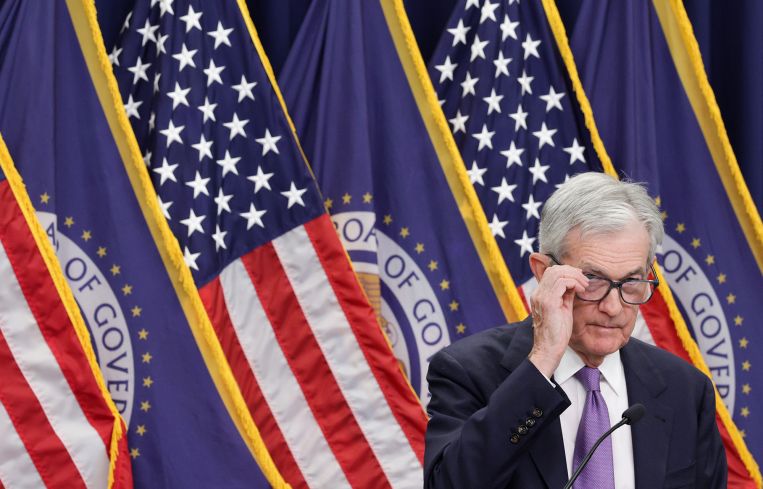
The Federal Reserve closed 2025 similar to the way it rounded out 2024, with three straight interest rate cuts. Also giving a sense of deja vu, commercial real estate will enter the new year with lingering uncertainty about future borrowing conditions.
In a 9-3 vote, the Fed lowered its benchmark interest rate by 25 basis points to between 3.5 percent and 3.75 percent Wednesday with signals of a slowdown of cuts in early 2026. The central bank’s quarterly “dot plot” matrix of individual committee members projected just one rate cut in 2026 and another in 2026 to leave the federal funds rate at 3.1 percent in two years.
“Having reduced our policy rate by 75 basis points since September and 175 basis points since last September the Fed funds rate is now within a broad range of estimates of its neutral value and we are well positioned to wait to see how the economy evolves,” Fed Chair Jerome Powell said in post-meeting press conference. “Monetary policy is not on a preset course and we will make our decisions on a meeting by meeting basis.”
Wednesday’s meeting was likely one of the last to be led by Powell before his second term expires in May 2026, with President Donald Trump calling over the past year for a replacement who will lower borrowing costs. Trump has also sought more political control of the central bank by attempting to fire Fed Governor Lisa Cook over alleged mortgaged fraud in case the U.S. Supreme Court will decide next year.
The trio of Federal Open Market Committee cuts to close 2025 came after five straight pauses to open the year on the heels of last year’s late shift where the Fed slashed interest rates 100 basis points from September to December. Short-term interest rates previously hovered between 5.25 percent and 5.5 percent from July 2023 to September 2024.
Jay Neveloff, partner and chair of U.S. real estate at global law firm HSF Kramer, said deal activity has been robust in late 2025, and he expects this trend to continue into 2026 no matter what action the Fed takes because of the buying opportunities many investors are seeing.
“I think that the activity is going to continue whether there are additional rate cuts or not next year,” Neveloff said. “Some of the visionaries that I respect are saying: If this is a buying opportunity, how long is that window going to last?”
Neveloff added that as more deals get traded, lenders are also getting more “aggressive” and increasing loan sales activity. He also noted that there is a far bigger abundance of capital toward real estate than in past economic cycles.
Ryan Severino, chief economist at BGO, noted that cuts to interest rates do not always assure positive CRE fundamentals with cap rates and valuations. He said CRE returns have historically fared well in high interest rate environments with the 10-Year Treasury “notably higher” in the 1980s and `90s than the 2000s and 2010s.
Mark Silverman, partner at Troutman Pepper Locke, said regardless of what action the Fed takes in the ensuing months, refinancing existing loans issued in the commercial mortgage-backed securities (CMBS) market prior to rates spiking in 2022 will remain a challenge due to widened spreads. Silverman added there is also less desire from lenders to extend CMBS debt at or near maturity unless property owners step up their proposals.
“It needs to be done intentionally so borrowers are bringing real cash to the table,” Silverman said. “They’re coming up with real restructuring proposals, and it’s not merely keep doing what you’re doing and we’ll give you another six months.”
Jamison Manwaring, CEO of Neighborhood Ventures, an Arizona-based multifamily operator and online investment platform, said long-term interest rates dictated by the 10-Year Treasury bond yield will be more critical for penciling deals than short-term borrowing levels.
While rising government debt is likely to keep long-term rates higher in the near term, Manwaring is hopeful that a new Fed chair will spur more aggressive rate cutting on the front end of the curve to eventually bring the 10-Year from 4 percent to around 3.5 percent,
“There’s optimism in the next year, because no matter what happens in the first couple of months we’ll likely get a new Fed chair that’s more aligned with the administration,” Manwaring said. “If the fundamentals hold as the Fed lowers the short-term rates, it should bring rates down on the 30-Year and 10-Year. That’s all we can control, and that’s what the administration wants and the type of chair they’re going to put in there.
Mike Tepedino, managing partner at Blue Light Capital, said declines in the Secured Overnight Financing Rate over the last year and a half have helped give a spark to transaction volume.
“A continued trend toward lower short-term rates offers a psychological boost for the market and has a real effect on borrowing costs and the ability to finance deals,” Tepedino said. “Lower borrowing costs can also help support tighter cap rates over time, which has the potential to lift valuations as confidence and liquidity improve.”
Andrew Coen can be reached at acoen@commercialobserver.com.