

CMBS Distress Rises in 17 of the 25 Largest U.S. Markets
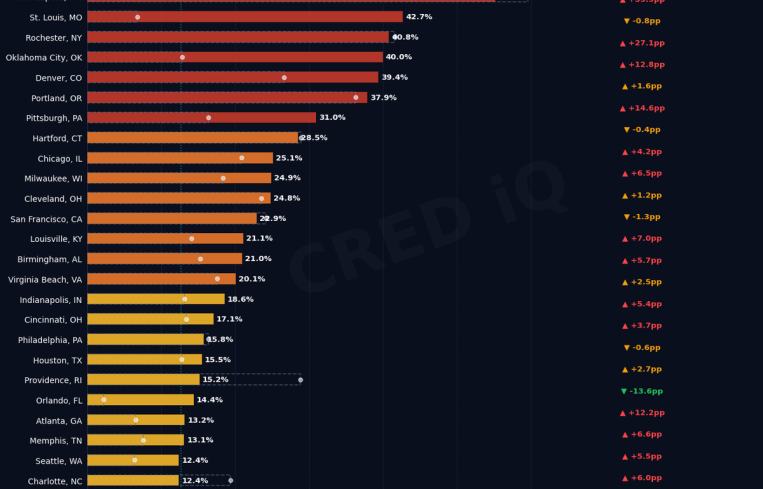
CRED iQ’s May 2026 commercial mortgage-backed securities (CMBS) distress analysis reveals widening stress across the nation’s largest metropolitan markets — with the overall distress rate among the top 25 most populous U.S. metropolitan statistical areas climbing to 12.7 percent, up from 12.2 percent in June 2025. Seventeen of the 25 markets posted year-over-year increases, led by explosive moves in Midwest and mid-major markets.
Minneapolis (showing a distress rate of 55.2 percent), Denver (43 percent), and Rochester, N.Y. (40.1 percent), lead the top 25 largest markets in overall CMBS distress as of May 2026, according to CRED iQ’s proprietary loan analytics platform covering conduit and single-borrower large loan (SBLL) pools. These figures capture all loans classified as delinquent, in special servicing, or in real estate owned status — giving the most complete picture of loan-level stress available in the market.
Minneapolis and Denver’s elevated readings reflect deep office loan impairment in their central business districts, with several large SBLL loans remaining in extended special servicing. Rochester’s distress is concentrated in a narrow but deeply stressed loan pool, amplifying its percentage reading.
At the other end of the spectrum, New York (12 percent), San Antonio (14.7 percent) and Houston (14.7 percent) post the lowest distress readings among the top 25 — a reflection of deeper, more diversified loan pools that absorb individual loan failures without dramatically moving the overall rate.
The most dramatic year-over-year escalation belongs to St. Louis (plus 29.9 percentage points), Oklahoma City (plus 28.5 percentage points), and Pittsburgh (plus 16 percentage points) — markets where concentrated office and mixed-use loan exposure has rapidly deteriorated. The distress rate in St. Louis climbed from just 8.2 percent in June 2025 to 38.1 percent in May 2026, the largest single-year surge in the cohort and a clear signal of accelerating loan impairment in a market facing structural office demand headwinds. Oklahoma City similarly jumped from 11.5 percent to 40 percent, driven by a wave of newly transferred special servicing designations.
Denver (plus 15.8 percentage points) and Louisville (plus 25.4 percentage points) also logged significant deterioration, reinforcing a broader pattern: mid-major metros with high legacy office concentrations and maturing floating-rate debt vintage 2021–2022 are experiencing the sharpest stress acceleration.
Not all movement is negative. Providence, R.I., posted the sharpest improvement in the cohort, falling 14.7 percentage points to 15.2 percent as previously troubled loans resolved through modification, payoff or disposition. Charlotte, N.C., (minus 9.9 percentage points) and Austin, Texas, (minus 9.4 percentage points) also improved materially, consistent with stronger Sun Belt absorption dynamics and active loan workout activity in those markets. These declines highlight an important nuance in CMBS distress analysis as improvement in the rate does not always mean underlying credit quality has recovered, and it can reflect successful loan resolutions at a discount rather than stabilized property performance.
Office distress nationally across these 25 markets stands at 17.1 percent — nearly unchanged from 17.2 percent in June 2025 — while multifamily continues to creep higher, reaching 11 percent compared to 10.3 percent a year prior.
Mike Haas is the founder and CEO of CRED iQ.


