New York City’s Higher-End Retail Deserts, and How to Fill Them
You’ll need developers committed to placemaking or at least a plucky entrepreneur or two
By Larry Getlen May 19, 2026 6:30 am
reprints
Walking through the area near Brooklyn’s Windsor Terrace/Kensington border, one is confronted by blocks filled with high-rise residential buildings, many built before World War II, some constructed just after.
Throughout the main Ocean Parkway thoroughfare and onto many of the connecting cross streets, retail is either scarce or, like some of the apartment buildings themselves, showing clear signs of age and wear.
According to the U.S. Census Bureau via Point2Homes, as of 2023 the median household income in Windsor Terrace was $141,616; in Kensington, it was $83,696. For households led by people ages 25 to 44, that number rises in Kensington to $102,720.
And, while exact figures aren’t available, over the past decade or so the area has become home to many people priced out of nearby neighborhoods such as Park Slope, Boerum Hill and Cobble Hill, areas where one-bedroom apartments rent for $3,500 to $5,000 per month.
The area, then, might not be the height of luxury — although new developments with rooftop social spaces, fitness centers and prices to match are beginning to spring up — yet the Windsor Terrace/Kensington border is clearly an area whose residents possess enough disposable income to support worthwhile local gathering places.
And, yet, announcements of exciting new bars, eateries, social hot spots or other leisure-based shopping experiences are virtually nonexistent.
An undated report from the City University of New York’s School of Professional Studies titled Gentrification and Social Shift in Kensington, Brooklyn spells out what seems a perpetual observation about the area of late.
The paper notes that Church Avenue was considered “one-stop shopping” for much of the 20th century, driven by family-owned businesses that included “bakeries, restaurants, hardware stores and a movie theater.”
But the report then focuses on the area’s more recent inability to respond to changing times with retail that meets the moment.
“Newer residents often complain about the lack of amenities in the neighborhood,” reads the report. “There are a few chain stores (e.g. Rite Aid, Walgreens, ShopRite, etc.), but everything is mostly independently owned. There have been a slew of shops that have opened and closed within months because they could not garner enough business to stay open. The high rents for commercial space often are the culprit. The other problem is the lack of patronage of said shops. While there are a few restaurants, many people often complain of ‘nicer’ restaurants not being open here, along with coffee shops and bookstores.” (The Rite Aid has since closed due to the corporation’s bankruptcy.)
All of which leads to the question: What exactly does it take to get a neighborhood filled with residents with disposable income the types of retail that are worth their time and money?
Richard Skulnik, vice chairman and partner at brokerage Ripco Real Estate, noted that the area’s proximity to upscale Park Slope — which has a median household income of $174,364 — might be a disadvantage in attracting new retail.
“Powerhouse neighborhoods that are adjacent can suck all the oxygen out of the room, because that’s where all the retailers look,” said Skulnik. “Nobody wants to venture outside of those neighborhoods.”
Skulnik noted that areas with strong retail corridors, like Park Slope’s Fifth and Seventh avenues, can dominate retail demand, leaving nearby areas in a sort of middle-income bubble.
“In Manhattan, the Upper East Side is a fabulous residential market,” said Skulnik. “The further you go north and east, the less likely you are to have national tenants looking in those markets.”
Part of the issue for areas starved for worthy retail is that this absence is self-perpetuating, as retailers seek to be clustered amid similar retailers.
“In an urban setting or even in malls or shopping centers, the most important word for retailers is ‘co-tenancy,’ meaning that retailers want to be where their friends are,” said Brandon Singer, CEO of brokerage Retail by MONA. “When I first got into the business 20 years ago, I didn’t understand why Gucci wanted to open up next to Louis Vuitton — like, why would you want to be next to your competition? What you wind up realizing is that [they’re appealing to] the same customer. Because of that, when you apply that same logic to other categories of retail, the same thing holds true. Brands want to be near their competitors.”
Ariel Schuster, vice chairman at Newmark, sees co-tenancy as the No. 1 factor for New York retailers in deciding on a location.
“Apparel tenants are not pioneers, and they often say that to us out loud,” said Schuster. “They’re looking to see where there’s a density of similar-type brands. That’s how neighborhoods get developed.”
Part of the equation for new retail also has to do with zoning, with some residential high-rise buildings required to include ground-floor retail while others are not.
In Kensington and Windsor Terrace, for example, few residential buildings have retail on the ground floor. In Gowanus, where new residential product is going up en masse, that requirement exists, according to Justin Pelsinger, partner and chief operating officer at Charney Companies. Charney has developed, or is currently developing, mixed-use buildings in the area such as 175 Third Street, Nevins Landing North and South, Douglass Port and Union Channel.
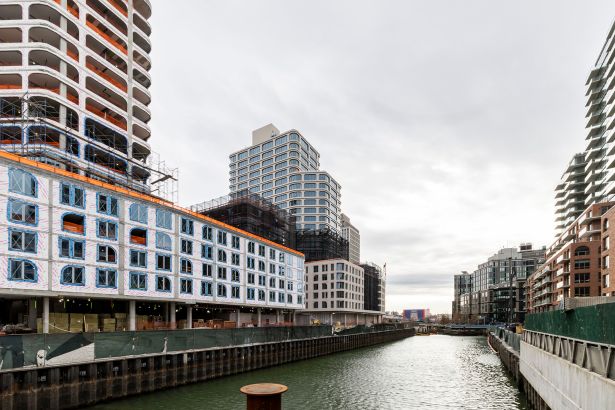
“In Gowanus, the zoning requires retail on the ground floor of all these new buildings,” said Pelsinger. “That was a very specific mandate made when they were passing the rezoning because they understood the need for activation on the streetscape, and they didn’t want to leave it to the private sector to determine how much they wanted to do or not.”
Sam Sparks is a partner at Tavros, which is partnered with Charney on its Gowanus developments and others. Sparks said that the enormity of these new developments and others, which are bringing around 9,000 residential units to the area over a relatively short period of time, helped compensate for any shortage of current co-tenants in the eyes of new potential retailers.
“The addition of all these new homes creates a lot of new need,” said Sparks. “We’re seeing a lot of lifestyle, service, and food and beverage, particularly from local users. It’s a lot of people who are already in business in Park Slope or Carroll Gardens nearby. They were some of the first to recognize what was happening in Gowanus, what the opportunity was, and ultimately what the neighborhood’s going to be.”
TF Cornerstone has spent 20 years developing much of Long Island City in Queens. While the company’s reputation precedes them at this point, meaning lots of retailers have faith that its residential towers will fully lease up, that faith has its limits, leaving the company with the greatest success from retailers that already have experience with, or at least a deep understanding of, the Queens neighborhood
“We did speak to a couple of Manhattan-based restaurateurs and tried to lure them out,” said Steve Gonzalez, vice president in charge of retail leasing for TF Cornerstone. “Sometimes, people from Manhattan are just focused on Manhattan, and it’s a little bit hard to pull them over the bridge. The folks who really get Long Island City are either Long Island City residents, or just people who have been familiar with the area for a long time. We have managed to get a few retailers to open their first locations in Queens — at our Malt Drive developments, for example, Sundays nail salon made the jump — but a lot of the other retail base is either from here or just very, very familiar with the waterfront.”
To get a deeper glimpse of the perceived ups and downs of a middle-income neighborhood in the eyes of retailers, let’s look at one rare leisure-associated retailer that has opened in the Kensington area over the past five years or so.
Lofty Pigeon Books is located in a 1,200-square-foot space at 743 Church Avenue, on the corner of Church Avenue and East Eighth Street, between main thoroughfares Ocean Parkway and Coney Island Avenue. The only bookstore for over half a mile at least, according to Google Maps, it was launched in August 2023 by husband and wife booksellers Briana Parker and Davi Marra.
Directly across the street is a 24-hour car wash and oil change spot. The block it’s on is an interesting collection of mom-and-pop athletic gear and apparel shops, closed storefronts, municipal-looking offices without signs, delis and community centers catering to Spanish-speaking and Islamic populations, and one bar and one cafe-bakery right next to each other, each barely over 1,000 square feet, including back kitchen and office areas, according to data site Property Shark.
Parker and Marra met while working at the Upper East Side’s Corner Bookstore, and discussed opening their own store for a time as a distant possibility.
When the COVID pandemic had many predicting the city’s downfall, Parker felt the opposite.
“Everyone was like, ‘New York’s over, and cities are over’ because of the pandemic,” said Parker, who grew up in Brooklyn’s Sheepshead Bay. “And I was like, ‘I’m from here. I feel the opposite. I want to dig my heels in. I want to be part of a community, and I want to contribute directly to the creation and sustaining of that community.’ ”
From the outset, the couple saw possibilities in Kensington beyond what most retailers perceived, although they considered a possible Ditmas Park, Brooklyn, location as well.
“This is an area with a lot of families, which can really sustain a store,” said Parker. “It’s also a neighborhood that really prizes community and local business. We just knew that there are not a lot of chains there — people really want mom-and-pop shops out here, and they will support them. There’s also a high-income base of people here, but it’s still pretty diverse economically.”
Parker may have had a keener eye for the opportunity than most based on what she saw growing up in Sheepshead Bay.
“I lived off the Q train, and I watched Cortelyou Road grow into a much more commercial area,” said Parker. “So [the area] was sort of in our gut. There really wasn’t a bookstore here or even a ton of retail, but it was ripe for it.”
The couple was emboldened by census data showing the area had a high percentage of college graduates and post-graduates, and that the total number of people in the area eclipsed that of much smaller towns that supported their own bookstores. Parker said that they homed in on their current block before there was even space available.
They also did a foot traffic study showing that foot traffic on the block was higher than one might expect, due to factors that included its location between Ocean Parkway and Coney Island Avenue, and the presence of the cafe-bakery, the bar and a liquor store that has since closed, among other factors.
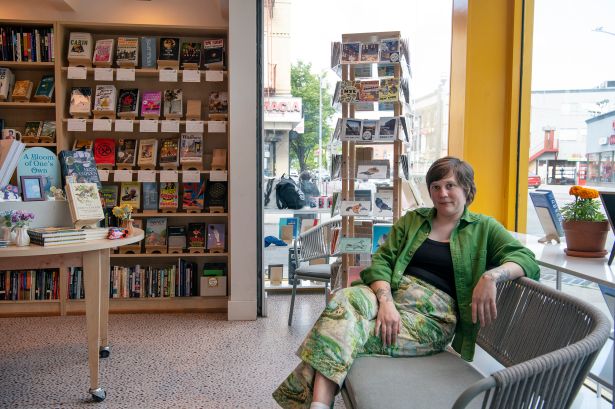
“This little commercial pocket gets a good amount of foot traffic, plus it’s on a corner,” said Parker. “Other businesses fed into it, along with foot traffic patterns for people coming to and from nearby subway stops and schools, and even people who go birding in Green-Wood [Cemetery] who pass by.”
Parker also noted that having the cafe-bakery on the block gave them an advantage.
“Der Pioneer [the cafe-bakery at 737 Church Avenue] is super popular and brings a lot of people to the block,” said Parker. “A lot of bookstores open with cafes in them. We didn’t necessarily want to do that, but it is really helpful to have that nearby, because bookstores don’t necessarily drive foot traffic themselves. Having a cafe where people go every day for coffee is kind of a nice pairing.”
Parker said that after deciding on their current spot following a three-year search that included a better-than-expected deal from their landlord, Lofty Pigeon has done solid business, including meeting its third-year revenue projections in the store’s first year.
But the opening and subsequent success of Lofty Pigeon, which has expanded beyond just books to sell gifts and cards and host events such as readings and open mic nights, feels like it was blessed by a touch of kismet, even down to becoming a destination for people waiting for their cars to be washed.
“It’s sort of in this perfect intersection that’s hard to replicate,” said Parker. “It’s hard to be the first as a bookstore. It’s hard to be the first business of your type in any area. I think there is a perfect mix of compatible businesses, but, also, there isn’t a ton of retail. So we don’t just get book traffic. Greeting cards and other things have been a bigger part of what we do than we expected.”
The challenges in finding the ideal site for a business like Lofty Pigeon, or in attracting businesses of this sort, would be familiar to developers creating new sites in less-than-ultra-wealthy areas, but the specifics change with the circumstance.
BFC Partners is currently developing a three-building, 1,250-unit residential site on Coney Island’s Surf Avenue, an area of Brooklyn that has generally been known for warm weather attractions — and a shuttered vibe burdened by high crime much of the rest of the time.
“Coney Island, historically, in the past, has been a ghost town in the wintertime,” said Joseph Ferrara, a principal at BFC Partners. “Because the amusement parks are closed, you’ve got these tenants across the street that shut down for the winter. ‘Emerging neighborhood’ is a very loose term when you’re talking about Coney Island, because it’s been around for over a century. But with regards to residential, it’s emerging.”
Ferrara notes that in a situation like BFC’s, recruiting the basics for living has taken priority.
“It’s really important that the tenants moving into these projects have the basic social services and retail support, like a pharmacy, a laundromat, a supermarket, a medical group, that type of stuff,” said Ferrara, whose earliest tenants included a Shop Fair Supermarket, a “treat and release” patient center from public agency NYC Health + Hospitals, an optometrist and a pharmacy. “We knew out of the gate that these would be the first retailers interested when those services are lacking in an existing community.”
While Ferrara has been assisted by the brand recognition that Coney Island brings, he’s had less luck in less notable areas.
In November 2024, BFC opened a $151 million, 270-unit affordable community in Staten Island called the Pearl, which was the largest affordable housing project in the borough. Half the project’s units were earmarked for formerly homeless seniors earning no more than 30 percent of area median income (AMI), with the remaining units available for those earning up to 80 percent of AMI.
Here, Ferrara said, finding retail tenants has been a challenge.
“I’ve had a 10,000-square-foot retail space, I’ve gone to three brokers already, and I still have gotten minimal interest in a beautiful, brand-new building with 270 apartments,” said Ferrara, who is in late-stage discussions with several health-
related retailers but has yet to sign any leases. “But you know what’s lacking? I’ve got 270 new apartments right there, but there’s nothing new [in retail] anywhere down this corridor. And, you’ve got a transitioning neighborhood that was recently rezoned for residential, so you’ve got these really small-scale one- and two-family homes, and then you’ve got mechanic shops and body shops because, historically, that’s what it was zoned for. That retail space has been a struggle.”
In Ferrara’s case, the low incomes of the residents, the lack of public transportation connecting the area to the rest of the city, and the more inhibitive zoning until recently have all served as barriers for bringing in quality retail.
But even in a much more promising high-income area, ingenuity is sometimes required to attract higher-quality retailers.
Jessica Lappin is president of the Alliance For Downtown New York, a business improvement district that has spearheaded efforts to greatly improve that area’s retail situation over the past decade.
“When I started over a decade ago, downtown was very under-retailed,” said Lappin. “Now we have over 1,000 retailers. We’ve gone from zero to 60 over a period of time.”
Even with this success, the area has been burdened by more empty storefronts than desired since the pandemic, meaning that Lappin has had to get creative to continue attracting new retailers.
Right now, the Alliance is running a promotion called RE:Store, which works with building owners to offer free temporary pop-up space for three months plus up to $15,000 to cover expenses for retail concepts that can activate the space while generating revenue. (Concepts that require on-site food and beverage preparation or consumption of cannabis, tobacco or alcohol are all prohibited from RE:Store.)
“We had over 360 applications from across the city,” said Lappin. “We had a jury, including retail brokers, other retail experts and an owner, and we selected six winners. What we were looking for was, ‘Will they fill a need that doesn’t exist in the area? Will they generate some activity? Will they create a buzz? And do they have the capacity to do it?’ ”
Winners included a food-focused bookstore called Kitchen Arts and Letters, archival record label Numero Group, and several shops dedicated to home goods and vintage clothing, all of which are scheduled to open in June.
Even though some of these stores will be opening on Broadway, they will be filling vacancies, and Lappin hopes they succeed well enough to become permanent, or at least to showcase how well the spaces adapt to their type of retail.
For areas seeking to attract new retail, Lappin suggests surveying local residents to establish a clear understanding of what sorts of establishments are more desired in the area.
“I would start with data and really try to survey the people who live there,” said Lappin. “If it’s a residential community and you ask them, ‘What are you looking for?’ that enables you to go out and say that people are really looking for a coffee shop, or a place to have brunch, or a bar to go to after work. If you have some of that information, that can be encouraging to an entrepreneur.”
That said, this being New York City, there is little substitute when creating a retail environment from scratch or scarcity for a concentration of high-income residents and close proximity to the subway. And, of course, having a developer that goes all in on placemaking doesn’t hurt.
Retail placement in Williamsburg seems like a no-brainer for high-end brands in 2026. And yet, Bonnie Campbell, a principal at Two Trees, noted that the area was far less desirable when the company began the process of redeveloping the Domino Sugar Factory there over a decade ago.
What worked in the company’s favor was the enormity of its intentions, including a 15-story, 460,000-square-foot, all-electric Class A office building with high-end amenities to match. Two Trees also developed a 5-acre public park and a 4-acre waterfront park, plus around 2,800 residential units.
But Campbell believes that, in order for retail to flourish in developments and neighborhoods catering to all income levels, even the developers of considerably smaller projects should approach their residential projects with retail top of mind, baked in from the earliest stages of a project’s planning.
“Placemaking is foundational to our whole development thesis — how do we attract people to these neighborhoods? It’s not through fancy architecture and luxury condos. It’s through the ground floor, through the retailers. That’s the key to success,” said Campbell. “When we look at a building, we look at the ground floor. It’s not about squeezing the last dollar out of the rent, because what you do on the ground floor is going to make your space upstairs more desirable — if you create a community hub, everyone’s going to want to be there. People are going to want to live in that building. And, if you’re getting 25 cents more per square foot on those rental apartments, that pays for the retail.”
Larry Getlen can be reached at lgetlen@commercialobserver.com.
This article has been updated to reflect the full scope of the Charney/Tavros partnership.