Industrial Sector Finds Footing in Unpredictable Political Environment: Panelists
By Mark Hallum April 16, 2026 2:00 pm
reprints
Industrial real estate is making a cautious return from the high highs and relatively lower lows it has experienced since the pandemic, industry leaders say.
Executives discussed some of the newer frontiers and constraints in terms of building and financing various industrial projects at Commercial Observer’s Industrial, Data Centers & Logistics Forum event at etc.venues at 601 Lexington Avenue earlier this week. Topics of concern included the matter of growing NIMBYism and power scarcity.
Tuesday morning started off with a keynote session with Jeremy Hellinger of J.P. Morgan Chase, Matthew Ostrower of Link Logistics and Andrew Warin of Newmark, who spoke to shifts in some of the national market fundamentals taking place across the industrial sector. Changes include declining asking rents on the West Coast, and a U-shaped recovery following the pandemic as e-commerce took off and the sector became overbuilt.
That momentum from 2021 to 2023 was mainly driven by Amazon’s logistics growth, which punished traditional retail and drove a building spree that overcorrected to anticipated demand, according to Hellinger.
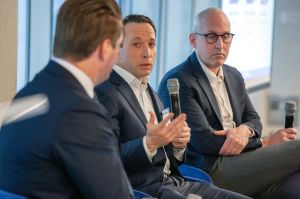
“It’s remarkable how much industrial flew under the radar in terms of how challenging it was to lend on for a long time,” Hellinger said. “Industrial was one of the more challenging assets to underwrite, and it actually still is very challenging to underwrite. It’s still very early in the recovery of industrial, and we’ve all seen the signs in leasing traction. … It was probably the most overbuilt sector in commercial real estate, even more so in office.”
The latest trend now seems to be that tenants are optimizing warehouse space by using robotics, and storing inventory from floor to ceiling where it can more safely and efficiently be retrieved and shipped using machines, according to the speakers.
The first panel of the morning — titled State of the Market: Macroeconomic Trends & Emerging Opportunities Fueling Growth for this Critical Sector — was moderated by Jonathan Adelsberg of law firm Herrick, with speakers Mark Levy of FRP Development, Richard Prokup of Mapletree, Alex Redfearn of Redfearn Capital and Peter Zuk of Oxford Property Group.
The discussion revolved around global events such as tariffs — which for more than a year have undergone shifting policies from the White House — and uncertainty from the ongoing war in Iran as it impacts trade through the Strait of Hormuz.
Essentially, tenants of industrial space are looking only at what they can control: their domestic supply chains.
“[Occupiers] can’t really plan their businesses around these various events, and they certainly can’t predict any level of normalcy, so I think most boardrooms today are talking about how they have to focus on the fundamentals, which are that the American consumer is fairly healthy,” Levy said. “So I think there is a continuation of, ‘How can we build out a supply chain network that can reach our customers more consistently, more quickly?’”
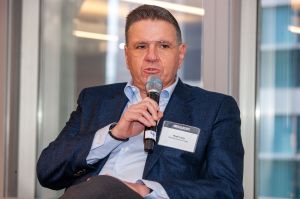
The next panel was Funding the Industrial Boom: Capital Sources Driving Today’s Largest Deals & Developments, moderated by John Vavas of Polsinelli. Panelists were Chris Allman from CIM Group, Mark Finan of CBRE, Yi-Shan Huang of BGO and Stefan Sansone of Kurv Industrial (formerly known as Bridge Industrial).
The panelists went back and forth about data centers and the biggest constraints their firms face when deciding whether to finance them: electricity.
Huang said NIMBYism is making life harder for developers — but understandably so, she admitted, talking about her own power bill skyrocketing because of data centers increasing demand for power across the board.
CIM Group’s rep said it takes matters into its own hands to sidestep those problems in Utah.
“Power is such a thing that we have a data center site in Salt Lake City where we literally had to build our own power plant,” Allman said. “Not only are we building a data center where we have services agreements and the lease as an entirely different conversation, but we had to build the power ourselves because Salt Lake City was seven years backed up, there’s no way we were going to see power.”
The final panel, called Spotlighting Niche Subsectors: Data Centers, IOS, Powered-Land, Manufacturing & the Areas Attracting Investor Attention, was moderated by Nicole Fenton of HSF Kramer. It featured Justin Horowitz of Cooper Horowitz, EJ Wislar of PRP Real Assets, Dan Haroun of Catalyst Investment Partners and Chris Graham of Blue Owl Capital.
For Blue Owl, funding any data center development that doesn’t already have a guaranteed power supply is a hard no.
“As a lender, we don’t take power entitlement risk, so we’re not going to lend if they don’t already have the power as of right,” Graham said. “On the equity side of our business, when people talk about data centers, they think of the huge gigawatt AI training centers, but there’s plenty of other types of data centers like cloud, you can go down the list. The power needs range on the data center side from like 3 megawatts to a gigawatt of power, so it’s a massive range. … Power, battery, everything needs to be on the site.”
Mark Hallum can be reached at mhallum@commercialobserver.com.