Skip to content
  • Industry
    • Residential
    • Office
    • Retail
    • Industrial
    • Hospitality
    • Land
    • Healthcare
    • Life Sciences
    • Special Purpose
    • Mixed-Use
  • Markets
    • Los Angeles
    • New York City
    • Manhattan
    • Queens
    • Bronx
    • National
    • Washington DC
    • South Florida
  • Leases
    • Office Leases
    • Ground Lease
    • Sublease
    • Tenant Talk
    • Deals of the Week
    • All Leases
  • Finance
    • Acquisition
    • CMBS
    • Construction Financing
    • Distress
    • Refinance
    • Deals of the Week
    • All Finance
  • Investments
    • Development Site Sale
    • Portfolio Sale
    • Sale-Leaseback
    • Value-Add
    • Deals of the Week
    • All Sales
  • Development
    • Architecture
    • Construction
    • Conversion
    • Redevelopment
    • Sustainability
    • All Development
  • Capital Markets
    • Alternative Lending
    • Earnings
    • Economy
    • Foreign Investments
    • Private Credit
    • Private Equity
    • Public Markets
    • REITs
    • All Capital Markets
  • Tech
  • Weekly Issue
  • Events
  • Power
  • More
    • Awards
    • Players
    • Legal
    • Policy
    • Features
    • Research & Analysis
    • Columnists
    • Partner Insights
    • Partner Spotlight
    • Transportation
    • Videos
Sign In Sign Up My Account Sign Out
  • Account Details
  • Email Preferences
  • Member FAQs
  • Sign Out
Commercial Observer
  • Industry
  • Residential
    • Multifamily
    • Homebuilding
    • Condo
    • Hotel Condo
    • Student Housing
    • Single-Family Rental
    • Short-Term Rental
    • Senior Living
  • Office
    • Coworking
    • Flex
  • Retail
    • Shopping Centers
    • Outlet/Factory Malls
    • Supermarkets/Grocery Stores
    • Showrooms/Dealerships
    • Street Retail
  • Industrial
    • Data Centers
    • Distribution Centers
    • Industrial Outdoor Storage
    • Manufacturing
    • Self-Storage
    • Studios/Soundstages
    • Warehouse
  • Hospitality
    • Casinos
    • Convention Centers
    • Hotel/Resort
    • Restaurants
  • Land
    • Farm Land
    • Parking Lots
  • Healthcare
    • Hospitals
    • Medical Offices
    • Nursing Homes & Assisted Living
  • Life Sciences
  • Special Purpose
    • Air Rights
    • Arenas/Stadiums
    • Development Rights
    • Educational
    • Government/Military
    • Museums
    • Place of Worship
    • Theaters
  • Infrastructure
    • Airports
    • Bridges/Tunnels
    • Highways
    • Railways
  • Mixed-Use
  • Markets
    • Los Angeles
    • New York City
    • Manhattan
    • Queens
    • Bronx
    • National
    • Washington DC
    • South Florida
  • Leases
    • Office Leases
    • Ground Lease
    • Sublease
    • Tenant Talk
    • Deals of the Week
    • All
  • Finance
    • Acquisition
    • Construction Financing
    • CMBS
    • Distress
    • Refinance
    • Deals of the Week
    • All
  • Investments & Sales
    • Development Site Sale
    • Portfolio Sale
    • Sale-Leaseback
    • Value-Add
    • Deals of the Week
    • All
  • Development
    • Architecture
    • Construction
    • Conversion
    • Redevelopment
    • Sustainability
    • All
  • Capital Markets
    • Alternative Lending
    • Earnings
    • Economy
    • Foreign Investments
    • Private Credit
    • Private Equity
    • Public Markets
    • REITs
    • All
  • Technology
  • Policy
    • Housing
    • Transportation
    • Urban Planning
    • Zoning
  • Legal
  • Weekly Issue
  • Events
  • Power Series
  • More
    • Awards
    • Features
    • Columnists
    • Research & Analysis
    • Partner Insights
    • Partner Spotlight
    • Players
    • Videos
  • Advertise
  • Contact
  • Reprints
  • Newsletters
  • Power Finance
  • Power 100
  • Owners Magazine
Sign In Sign Up My Account Sign Out
  • Account Details
  • Email Preferences
  • Member FAQs
  • Sign Out
  • © 2026 Observer Media · Terms · Privacy

Residential   ·   Multifamily
New York City
Finance

Presented By: Real Property Captive

As Insurance Premiums Surge, Sophisticated Property Owners Are Turning to Captive Insurance

By Real Property Captive April 2, 2026 11:18 am
reprints

Real Property Captive


Insurance has become one of the biggest variables in commercial real estate deal math. In New York, premiums on rent-stabilized buildings have surged 150 percent since 2019, according to NYU’s Furman Center. Nationally, the Federal Reserve found that real per-unit multifamily insurance costs jumped more than 75 percent over roughly the same period. Insurance now accounts for roughly 8 percent of apartment building operating expenses, nearly double the share from five years ago. Rent growth has not kept pace.

The pressure is not limited to New York. Premium spikes of 50 percent or more have hit storm-prone markets, and double-digit annual increases have become routine across asset classes nationwide. For owners already managing tight margins, the increases are crowding out spending on fire suppression systems, deferred maintenance, and capital improvements — in some cases, without any corresponding deterioration in their own loss performance.

SEE ALSO: Saks Fifth Avenue Secures $500M in Loans to Emerge From Bankruptcy

That last point is what frustrates owners most. A disciplined operator running a diversified portfolio with a loss ratio below 30 percent is routinely pooled with higher-risk owners in the commercial market. Premiums rise regardless of individual performance. Brokers skim 10 to 15 percent of every dollar. And at renewal, there is little recourse.

Real Property Captive (RPC) was built to address exactly that dynamic. Founded by real estate owners who faced the same problem, RPC is a protected cell captive (PCC) platform designed specifically for scattered-site property portfolios spending between $1 million and $3 million annually on commercial hazard and general liability coverage. The platform is launching with $8.3 million in committed premiums from midsize operators across multifamily, single-family, student housing, and industrial assets.

The structure gives operators access to the same captive insurance framework used by more than 90 percent of Fortune 500 companies. The largest institutional real estate players — Blackstone, Brookfield, and their peers — have operated captives for decades. For those owners, captives long ago stopped being simply a risk management tool. They became profit centers, stabilizing insurance costs across market cycles and generating returns for GPs on capital that would otherwise have flowed entirely to commercial carriers. Midsize operators have been locked out of that dynamic — until now.

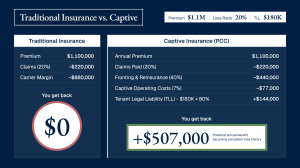
On the dividend side, the math is direct. RPC targets returning 50 to 60 cents on every unused premium dollar back to cell owners. A member paying $2 million in annual premiums who files $150,000 in claims has $1.85 million in unused premium. At that return rate, the owner receives between $925,000 and $1.11 million back — capital that under a conventional commercial policy would have been retained entirely by the carrier. Unused premium dollars are also invested, and investment income flows back to clients, creating a second layer of return on top of the underwriting dividend.

RPC Target 50 60 cents on every dollar As Insurance Premiums Surge, Sophisticated Property Owners Are Turning to Captive Insurance
Real Property Captive

The mechanics are straightforward. Premiums flow into each owner’s individual protected cell, legally segregated from all other participants. Reserves accumulate in the owner’s account and grow with each low-loss year. A fronting carrier — an AM Best-rated, admitted insurer — issues the policy and then reinsures the risk back to the captive and its reinsurers. This structure means every RPC member receives coverage on the paper of a top-rated carrier, satisfying even the most demanding lender requirements, while retaining the economics of captive ownership. There is no reduction in actual coverage from a member’s existing policy. The fronting relationship preserves the same coverage terms and limits while fundamentally changing who benefits from good loss performance. Independent actuaries set the rates. Global reinsurers cover major loss events.
captive scenario As Insurance Premiums Surge, Sophisticated Property Owners Are Turning to Captive Insurance
Real Property Captive

Governance is built around quality control. Existing members vote on who is admitted to the pool, a mechanism designed to keep the collective loss ratio low and protect the economics of every cell.

The alternative — building a stand-alone single-parent captive — is theoretically available to any operator, but practically out of reach for most. Formation alone typically runs $85,000 to $150,000, excluding the $250,000 to $500,000 in regulatory capital most domiciles require. Implementation takes six months to over a year, assuming fronting carriers and reinsurers can be secured at all. Many owners abandon the process midway after absorbing significant fees. RPC targets approximately 30 days from decision to activation.

The ideal participant owns a diversified scattered-site portfolio, with no single asset exceeding 10 percent of total insured value, with total insured values between $250 million and $2 billion, and a loss ratio below 30 percent. RPC also enables cell owners to offer tenant legal liability products through their captive, an additional profit center that conventional commercial placements do not provide.

Owners interested in evaluating fit can reach RPC at contact@rpcaptive.com or visit rpcaptive.com. Initial onboarding requires a portfolio schedule of values, five years of loss history, and current policy details.

rpc qualify As Insurance Premiums Surge, Sophisticated Property Owners Are Turning to Captive Insurance
Real Property Captive

Real Property Captive (RPC), Sponsored, sponsored-link, Real Property Capital
 
Trending Stories
Residential · Investments & Sales
New York City

Delshah Capital Pays $76M to Acquire LCOR’s 34 Berry Street in Williamsburg

Residential · Development
Florida

Alfonso Costa Jr. of Falcone Group: 5 Questions

Office · Leases
Florida

Tech Company Iru Inks 92K-SF Lease in Miami’s Coconut Grove

Residential · Finance
New York City

As Insurance Premiums Surge, Sophisticated Property Owners Are Turning to Captive Insurance

Avison Young's Oliver Petrovic (top), Colliers's Frank Wallach, and One Bryant Park.
Office · Leases
New York City

Manhattan Office Leasing Starts 2026 Strongly Amid Shrinking Class A Inventory

By Mark Hallum and Emily Davis
James Flaum.
Industry · Finance
National

Jim Flaum Retires After 32 Years Leading Morgan Stanley’s CRE Lending

By Andrew Coen
Henry Allman.
Industry · Players
New York City

Colliers Hires Former Related Exec Henry Allman as VP in New York

By Isabelle Durso

All posts loaded.


  • Industry
    • Residential
    • Office
    • Retail
    • Industrial
    • Hospitality
    • Healthcare
    • Life Sciences
    • Special Purpose
    • Infrastructure
    • Mixed-Use
  • Leases
    • Office Leases
    • Ground Lease
    • Sublease
    • Tenant Talk
  • Finance
    • Acquisition
    • Construction Financing
    • CMBS
    • Distress
    • Refinance
  • Investments
    • Development Site
    • Portfolio Sale
    • Sale-Leaseback
    • Value-Add
  • Development
    • Architecture
    • Construction
    • Conversion
    • Redevelopment
    • Sustainability
  • Capital
    • Alternative Lending
    • Earnings
    • Economy
    • Foreign Investments
    • Private Credit
    • Private Equity
    • Public Markets
    • REITs
  • Technology
  • More
    • Features
    • Columnists
    • Research & Analysis
    • Legal
    • Players
    • Transportation
  • About
    • Membership
    • Advertise
    • Newsletters
    • Contact
    • Reprints

Read the latest edition of the Commercial Observer online!

July 28th 2020 Magazine Issue Cover
© 2026 Observer Media Terms Privacy Cookie Settings Do not sell my data Sitemap