

Special Servicers Pivot Toward More Foreclosures
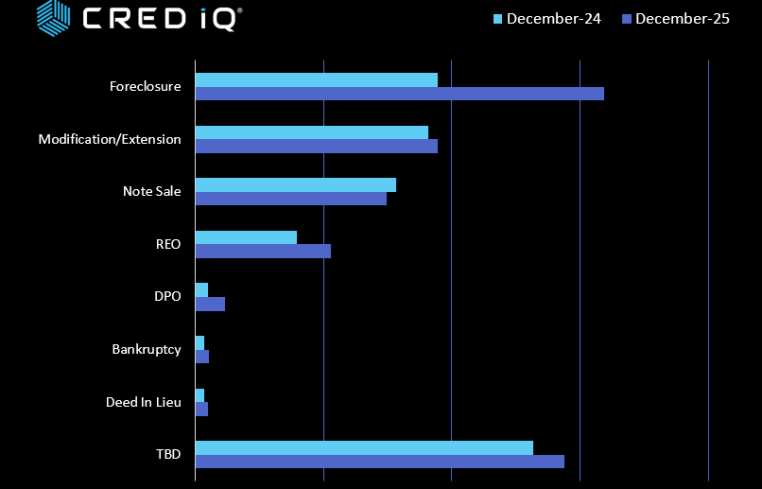
Special servicer workout strategies have shifted materially year-over-year, signaling a more decisive posture toward resolution rather than prolonged interim remedies, according to CRED iQ. Comparing December 2025 to December 2024, the most notable development is the sharp increase in foreclosures, which now dominate the workout pipeline.
Foreclosure balances rose from approximately $9.5 billion (17.3 percent) in December 2024 to $15.9 billion (29.1 percent) in December 2025, a year-over-year increase of more than 68 percent. This dramatic expansion suggests that special servicers are increasingly concluding that consensual resolutions are no longer viable for a growing portion of distressed loans.
Higher interest rates, persistent valuation pressure, refinancing challenges and sponsor fatigue have collectively reduced the probability of successful extensions or modifications in many cases. As a result, foreclosure has re-emerged as the primary mechanism for loss resolution.
Other liquidation-oriented strategies also expanded. Real estate-owned balances increased from $4 billion to $5.3 billion, rising from 7.3 percent to 9.7 percent of the pipeline, reflecting properties moving through the foreclosure process into owned status. Discounted payoff activity more than doubled, growing from 0.9 percent to 2.1 percent, indicating selective willingness to accept discounted payoffs where execution risk can be reduced.
By contrast, strategies associated with deferral or negotiation grew only modestly. Modification and extension activity increased slightly, from $9.1 billion (16.6 percent) to $9.5 billion (17.3 percent), suggesting that while servicers remain open to restructuring, this option is increasingly reserved for assets with clearer stabilization paths. Note sales declined both in balance and share, falling from 14.3 percent to 13.6 percent, signaling less appetite to offload exposure at prevailing bid levels.
Overall, the data points to a decisive pivot by special servicers. After years of extending, modifying and delaying outcomes, 2025 reflects a transition toward enforcement and asset-level resolution. For investors, lenders, and sponsors, the message is clear: the window for cooperative workouts is narrowing, and the market is entering a more execution-driven phase of the commercial real estate distress cycle.
Mike Haas is the founder and CEO of CRED iQ


