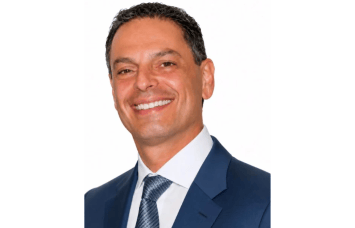
Scott Shepherd Was Called in to Straighten Out Flagstar Bank
He’s the head of commercial real estate lending at the company born out of 2023’s infamously messy regional banking crisis
By Cathy Cunningham November 17, 2026 12:00 pm
reprints
The regional banking crisis of 2023 feels in the rearview mirror in some ways, and not at all in others. Even now, three years later, the panic felt, and dislocation the period brought, still lingers here and there like Jacob Marley, clanking its chains.
One of the names synonymous with the bumps around that time was New York Community Bank (NYCB), now Flagstar Bank. Unlike First Republic Bank and Signature Bank, NYCB didn’t fail. Rather, it rescued some Signature assets. But it subsequently suffered a financial and leadership crisis that sent shock waves through the industry as fears swirled that it too would collapse.
In 2022, NYCB acquired Flagstar Bank in a $2.6 billion all-stock deal with a goal to transform itself from an originator of multifamily loans into a full-service commercial bank. When Signature Bank failed in March 2023, Flagstar stepped up to acquire $38.4 billion in assets, and all of its deposits. Those two substantial acquisitions pushed NYCB’s total assets to more than $100 billion, triggering higher capital, liquidity and reporting requirements, and things got ugly, fast.
By the fourth quarter of `23, NYCB reported a $2.7 billion loss and increased its loan-loss reserves to 790 percent from the third quarter of 2023 to $552 million to cover rising credit risks from its commercial real estate portfolio.
As NYCB’s stock plunged, its CEO, Thomas Cangemi, stepped down, and by March 2024, a group of investors led by former Treasury Secretary Steve Mnuchin stepped in with a $1 billion capital infusion to steady the ship. Joseph Otting was brought in as the new CEO. Still, NYCB’s multifamily delinquencies increased by 767 percent in the second quarter of 2024, and charge-offs (a declaration that a debt is essentially uncollectable) soared by 590 percent. By October 2024, NYCB had changed its name to Flagstar Financial and its stock symbol from NYCB to FLG.
Now, if you’re experiencing PTSD, or maybe dizziness, reading that last paragraph, imagine being the guy tasked not only with cleaning up and stabilizing that institution’s commercial real estate lending book, but also with restoring and bettering its position as a pre-eminent regional bank lender.
That guy is Scott Shepherd.
The same, but different
It wasn’t the first time Shepherd had been hired for such a mammoth role — and he doesn’t scare easily.
When Mnuchin acquired a failed residential bank, IndyMac, from the FDIC back in 2009 for $13.9 billion, Otting and Shepherd were hired to help turn that ship around — Otting as president, Shepherd as the head of commercial real estate banking.
Shepherd describes the turnarounds of IndyMac and Flagstar as comparable in some ways, “and, in some ways, not at all.”
At a high level, both institutions had gotten in trouble. They were both overloaded in one product type, and the recovery strategy for both included launching commercial real estate and commercial and industrial (C&I) lending businesses as they tried to convert themselves into full-size commercial banks. IndyMac was privately held and acquired from the FDIC, however, while Flagstar is a publicly traded company.
IndyMac, which later became OneWest Bank and later sold to CIT for $3.4 billion, peaked at about $30 billion in assets.
“IndyMac didn’t have a commercial real estate footprint. It was an Alt-A single-family lender, so the portfolio that we had to work out there was driven principally by broken single-family construction loans, which is a very different discipline. IndyMac also had no branch network,” Shepherd said. “Flagstar is a very different situation. We have a wealth of commercial real estate relationships focused in the East Coast, in the Midwest, but nationally as well. We have a robust branch and private banking network that is fueling access to deposits, which is the lifeblood of our business. We’ve already been able to build up the breadth of services of a regional bank, which was always going to be a challenge for OneWest to do without the size that Flagstar has.
“So the relationship history, the knowledge about CRE, the branch network, the private banking network, the relationships on both sides of the house were benefits that Flagstar had that were not available to us coming out of the IndyMac situation.”
Shepherd was drawn to the Flagstar restructuring opportunity as a chance to reunite with Otting and others from the management team, including Kris Gagnon, chief credit officer at IndyMac, who was hired for the same position at Flagstar.
“It was the A-Team [at IndyMac], and, when you have an opportunity to work on something of this scale and this magnitude with this team, it’s exhilarating,” he said. “Joseph [Otting] is a remarkable leader. I really try to emulate what he does, because he’s the best I’ve ever worked with.”
Second, Shepherd was pulled in by the expansive combined borrower relationships that NYCB and Flagstar had, which would be critical to the bank’s eventual relaunch. “They had a deep list of really good, high-quality names,” he said.
Up until his joining date in April 2024, Shepherd’s focus had been primarily on the West Coast, but he found himself quickly immersed in Flagstar and NYCB’s East Coast and Michigan borrower bases.
“I’ve got to give my predecessors at each institution a shoutout,” Shepherd said. “They can be criticized for a number of things, but one thing they can’t be criticized for is the relationships they formed that I inherited, which have just been a pleasure to get to know.”
Phase 1
To execute a recovery plan for Flagstar, which would involve shrinking its risk, selling off noncore assets and reducing commercial real estate exposures, Shepherd had to first get in the door and do a top-to-bottom review of its portfolio.
“We had to get our hands around the cards we were holding because they weren’t immediately clear,” he said. “We had to get data because there really wasn’t great data, and, with data in hand, we were able to develop a strategy around how we would tackle the problem.”
The No. 1 problem to tackle? Flagstar’s commercial real estate holdings as a percentage of Tier 1 capital, which was hovering around 501 percent before Shepherd came on the scene. (As of the third quarter 2026, that concentration ratio stands at 346 percent.)
“We’ve been pursuing a diligent strategy since I first arrived as a new management team to get that exposure right-sized,” Shepherd said. “Joseph’s view and the board’s view was that we should be a pre-eminent U.S. regional bank, with asset-based revenue drivers that were balanced directionally, like a three-legged stool between commercial real estate, a [commercial and industrial] business, commercial wholesale lending, and then a private bank and consumer business. The commercial real estate leg of a stool was way too long, and so we had to figure out a way to fix that.”
Next, Shepherd’s team developed strategies and methodologies throughout the bank to develop its own independent view of where it thought the risk was. “That meant on day one we had to improve the compliance around borrower financial reporting. Prior management had let that slip, and we were able to drive that up to 98 percent reasonably quickly,” he said. “Having real data allowed us to have a loan-by-loan view — by borough, by property type, 5 percent regulated, rent regulated — of our exposures and it gave us the ability to think through strategies about how to reduce our exposures and where our risks were.”
With strong data in hand, Shepherd and the management team set out on Phase 1 of Flagstar’s strategy to rebalance its portfolio and reduce its exposures — but there wouldn’t be any shortcuts. Instead, the team went loan by loan, borrower by borrower, conversation by conversation.
“We’ve reduced our commercial real estate exposures from $47 billion to about $32 billion in a little over two years,” he said, adding that “the great majority of that reduction comes from par payoffs, meaning 100 percent payoff upon maturity or upon an interest rate reset date, which was the way the old Signature and NYCB products were structured.”
Working through a portfolio of around 6,000 loans with a total balance of $47 billion and an $8 million average balance was no mean feat, but Shepherd found a natural prioritization schedule thanks to the loans’ maturity dates or rate reset dates.
“We focused on working with each wave about 120 days before it reached the beach, so to speak, and that made the prioritization and the task much more meaningful as we worked quarter through quarter,” Shepherd said. “We’ve now done this for 10 quarters. The good news is that — on top of the fact that we’ve been way more successful than I think we reasonably could have anticipated — we’re also now well through the concentrated activities in New York and the East Coast.
Part of that strategy was to move Shepherd to Los Angeles.
“Joseph and I had agreed from day one that there would come a point in time where, having righted the strategy and the exposures and the team in New York, it would make sense for me to go back out to California and then build out the business on the West Coast,” he said. “Our exposures to California in our portfolio are remarkably low. It’s a huge greenfield territory — and opportunity — for us.”
The opportunity speaks directly to Flagstar’s DNA as a regional bank. “We find there is a void, given recent changes in the market, where there’s a real opportunity for a regional bank that wants to offer white-glove service, with really senior executive attention, backed by a strong private bank reach,” Shepherd said. “There is a giant opportunity on our balance sheet to add asset exposure to that area of the country, and we’ve also hired bankers in other target regions. We’ve put a senior person in Washington, D.C., in Florida, in the Carolinas, in Texas, in Chicago. We’ve already added a banker here in Los Angeles, and we’ll add people in San Francisco and Orange County.”
Two and a half years later, it’s still not lending aggressively on NYCB’s home turf, New York City, “particularly in the rent-regulated space,” Shepherd said. “We’re really operating in all the primary food groups for commercial real estate. It’s probably easier to say what we’re not going to do, which is New York City multifamily, because we just have too much of it.”
That’s not to say the bank has exited multifamily lending.
“There’s a number of terrific loans on our balance sheet that we would be thrilled to keep [when they mature or reset]. So, I don’t mean to say in any respect that we are trying to eliminate New York City multifamily exposures. I think there are certain property types within that New York City multifamily, broadly defined, that we have less appetite for because of our existing exposures,” Shepherd said. “In particular, greater than 50 percent rent-regulated is very very tough for us right now, but show me a market-rate apartment on Central Park West, and I would love to do that, or even a market-rate apartment with a smidgen of stabilized units. We would be pleased to do that when those loans are hitting their reset date, or if they mature with existing borrowers where we have relationships.”
Flagstar is lending on multifamily in other markets across the country, however. And while there’s a high bar for office, Flagstar is lending on retail, select-service hotels, self-storage, industrial, student housing and it’s active in the homebuilder loan space.
This year’s originations target was $2 billion funded, and next year that will increase to $3 billion, Shepherd said, adding that his teams are busy differentiating itself from other bank lenders by being nimble. “Good ideas have legs; they move fast, and we have a very flat org chart. When we have good ideas, we figure out a way to implement them, not bury them in bureaucracy.”
And there’s an opportunity to grow bigger — to the $100 billion in assets that triggered scary headlines a few years back. But this time methodically and thoughtfully.
“[$100 billion] is what we were when we started,” Shepherd said. “We’re under that now [at $87.4 billion], but we have a plan to get back. We have the size and breadth of offerings to really cover our middle-market institutional client base, where we can do sophisticated hedges, we can do a forward swap. We have a very robust treasury management capital markets team, but at the same time, we’re small enough where, when my CEO comes to town, he’s going to drop in and say hello.”
That unique spot of being able to fulfill clients’ needs while being small enough to offer high touch is Flagstar’s opening, Shepherd said. “It affords us the opportunity to occupy a position with a sophisticated breadth of offerings where we can give white-glove service and attention that would be difficult to expect of the money center, very large banks.”
Otting called Shepherd “instrumental” in transforming Flagstar’s commercial real estate business. “Under his leadership, we established a new strategic direction as a relationship bank, attracted exceptional talent, and expanded our footprint to cover key markets across the U.S.,” Otting said in a statement to Commercial Observer. “Scott’s vision, leadership and ability to execute have positioned Flagstar’s commercial real estate group for long term-term growth and success.”
Shepherd isn’t the first in his family to enter the real estate industry. His father was a real estate developer who worked through an institutional path and then went out on his own, and his brothers also work on the development and legal sides of the business. “For me, it was a natural path because it was often a subject of conversation around the dinner table,” Shepherd said.
He’s a problem solver, as his current role may show.
“I’m drawn to complex situations that need thoughtful resolution, analytics and quantitative solutions.” Shepherd. “If you look at IndyMac and you look at Flagstar, when I first arrived, it was really about improving the data and asking, ‘What am I missing?’ and then figuring out how to execute a strategy. But I think the greatest joy I get in this business is working with clients. I want to go see people and talk to people because that is the fundamental core of relationship lending, and I think it’s why my skill set works here. Because I have both the quantitative analytical side, but also the relationship-building side that I don’t view as drudgery; I view it as luxury.”
Cathy Cunningham can be reached at ccunningham@commercialobserver.com.