In California’s Orange County, the New Direction Is Vertical
Developers starting to lean into density in the famously car-centric and suburban L.A. neighbor
By Patrick Sisson November 10, 2026 4:55 pm
reprints
For decades, California’s Orange County has undergone a significant demographic shift as the state’s master-planned, commuter-oriented, suburban bastion of modern conservatism became increasingly diverse and multicultural. And wealthy: The region “has superior demographics and lots of disposable income,” said Daniel Tyner, a managing director in JLL’s Orange County team focused on retail investment and development.
Now, another ongoing shift with more development and investment opportunities is again reshaping a county known for the fastidious master planning of the Irvine Company.
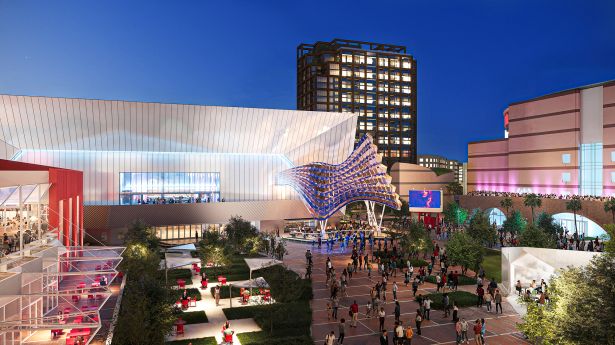
Orange County is transforming from a place focused on horizontal sprawl to one increasingly focused on placemaking and density, said Scott Frick, senior vice president for development at OCVibe, the Samueli Family’s under-development $5 billion, 100-acre private, mixed-use entertainment and residential district in Anaheim.
“Orange County was built around the car, everything was organized around vehicles, there’s big arterials and big surface parking lots,” said Frick. “Developers are starting to try and find what the highest and best use for these giant parcels is, and housing is obviously the highest and best use.”
The region isn’t becoming anti-suburban overnight — not by a long shot. Cities like Huntington Beach and Costa Mesa still run afoul of the state’s housing zoning goals, and NIMBYism remains strong. But as demand for housing grows and developable land sites become increasingly rare, the O.C. is being pushed to densify, which is creating a push to rethink parts of coastal California and build more mixed-use, walkable retail and rental housing. Through August this year, builders have more than 3,000 apartment units in development, up 31.2 percent from the same time in 2025, per Yardi Matrix.
“We’re not going out, we’re going up,” said Northmarq Senior Vice President Peter Hauser. “That’s why we’re getting more dense.”
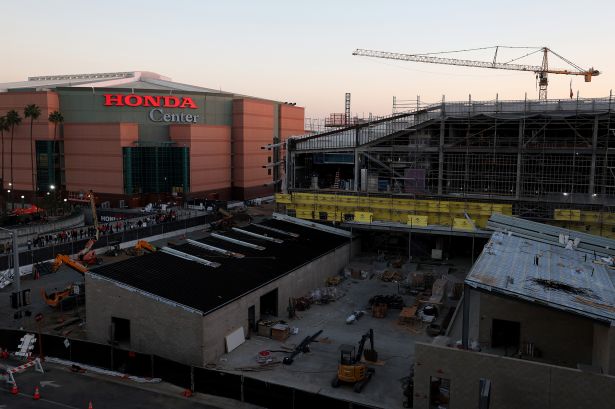
The massive OCVibe project, being developed adjacent to the Anaheim Ducks’ Honda Center, will contain rows of five- and six-story apartment buildings as well as two hotels plus office and retail space. Beginning next year, a mass timber office, market hall and concert venue will open. In addition, Rams owner Stan Kroenke, who has already transformed the area around SoFi Stadium in Inglewood, just purchased the Anaheim Angels baseball club for $4 billion, a deal expected to close early in 2027. It’s already creating excitement around another significant opportunity for Kroenke to leverage the team’s stadium and assets to redevelop.
This more dense product typically comes in the shape of moderate, mid-rise projects, such as five-story apartments, sometimes the fruit of redeveloping old and obsolete office or retail sites, or parking lots, such as the redevelopment of excess asphalt at the Fashion Island retail center.
Multifamily development will be a big part of the future of O.C.’s housing stock, said Frick, as low-density apartment developments, with 10 units to the acre, get replaced by projects like OCVibe, which has about 100 units per acre.
A string of housing redevelopment news underscores a shift toward a denser O.C. Related California is working on a $3 billion transformation of a former shopping center in Santa Ana near South Coast Plaza into a 41-acre district with up to 3,750 apartments, a hotel, senior housing, and as much as 350,000 square feet of commercial space.
The City of Newport Beach, meanwhile, approved hundreds of new housing units on the site of aging office buildings near John Wayne Airport this summer. Irvine Company continues to build out apartment options at Tustin Ranch, a former Marine air station, with plans for more than 1,300 units. Shopoff Realty Investments just commenced demolition and redevelopment of the Westminster Mall site this past April, aiming to transform the former mall into a $2.5 billion mixed-use, master-planned community called Bolsa Pacific.
Another development, Hive Live, which would have converted office space into more than 1,000 units of housing, was under consideration until defense tech firm Anduril swooped in last fall and purchased the space for its headquarters expansion.
“There hasn’t been any really significant building since the `80s and `90s,” said Hauser. “We’re finally seeing the fruits of some of this new construction helping out on the affordability.”
Orange County is also building very little new retail, so even with only a handful of new developments in the pipeline, this redevelopment push is keeping supply in check and sites in demand, said Tyner.
In some ways, Orange County can be the anti-Sun Belt. Where big metros across the southern half of the U.S. saw multifamily boom – and in the case of Austin, famously grew fast enough to significantly lower rents — the Irvine Company’s control over Orange County land and the pace of its development means the risk of overbuilding remains muted.
“You know they’re a good neighbor,” said Hauser. “There’s safety from a supply-demand standpoint.”
While other cities saw apartment inventory growth of 4 or even 5 percent per year, Orange County might be seeing its unit count grow at just 1 percent a year, said Frick. Rent growth has moderated slightly as new supply slowly comes online, said Hauser. But the factors creating this demand don’t seem likely to let up anytime soon.
At the same time, said Hauser, there’s the sense that Orange County has gotten behind the curve in building new supply. So any parcel where it’s possible to build vertically or add density has an immediate audience.
It’s also, in the eyes of many investors, the anti-L.A., or at least a more moderate version of Los Angeles multifamily. In Orange County, one can obtain the upside of Southern California rent growth without the challenge of more stringent tenants rights legislation and protections (or the cost of Measure ULA, which the industry blames for hurting new development). Those headwinds aren’t nearly as strong in Orange County, said Tyner. And while O.C. did see a slight population outflow last year of 0.3 percent, it pales in comparison to Los Angeles County, which had the biggest outflow in the nation.
Hauser is seeing many investors with money in Los Angeles attempt to sell and move their investments to Orange County as a bit of an exchange vehicle. Much of the investment dollars come from in state, he said, as out-of-state investors get scared away by the low cap rate, and miss the upside that comes from rent growth.
Recent Northmarq data found that transaction volumes in Orange County multifamily have reached their highest points since 2022, with per-unit prices up 20 percent. Hauser highlighted that Class C buildings were taking up a bulk of the transaction over the past quarter as a symbol of demand where investors are stretching as much as they possibly can to pick up anything in a California market deemed more safe and reliable than others.
“The only thing that could change is local city attitudes,” Hauser said. “We had Santa Ana vote on localized rent control. That’s really pretty punitive. You know, it’s hard if you can only increase rents 2 percent a year, and your insurance and utilities are going up at 5, 6 or 8 percent. As long as we don’t have that type of thing spreading around, this is a healthy place to be.”
Retail real estate tells a similar story. Vacancy is under 5 percent, and rent growth has hit roughly 32.5 percent over the last decade, per JLL figures, slightly above the U.S. average.
Investment is increasing with retail, too, said Tyner. His team’s retail investment sales volume is up 40 percent compared to last year.
“Orange County is always top of the list in terms of areas they want to be in, and a large part of that is just due to performance,” he said.
It doesn’t hurt that the region has also seen substantial diversification, both in its economy and its retail base. Even some of the space and defense tech tenants that clustered around the South Bay are starting to extend south to Orange County in search of more workspace. It’s leading to more investment in industrial space: BKM Capital Partners acquired a 231,000-square-foot business park in Westminster earlier this month for $62 million.
High-quality office – too valuable to be put to use for more housing – is also seeing slightly better numbers. The recent 250,000-square-foot Taco Bell HQ lease in Irvine, the largest in the county in five years, comes as vacancy declines and rent growth inches up.
That’s also indicative of the region’s shift toward a younger population with many more renters. Tyner has noticed retail tenants fighting for limited space, and more high-end brands seeking a location in Orange County to chase a younger, more affluent consumer. Ultra-high-end grocer Erewhon announced its opening a location in Orange County in Costa Mesa in 2027, underscoring that shift.
These shifts have increased demand for these new walkable neighborhoods, said Frick. Whereas amenity wars used to define apartment development, he’s seeing walkability become a big selling point, even in Orange County. It’s akin to redefining the master planning that created and defined the market in the first place.
“Tastes evolve and the way people live evolves, and you have to do more with the land you’re working with,” said Frick. “You can see renter tastes evolve, and what they want to be next to and what they’re willing to pay for.”