OCVibe’s Scott Frick On Building a $5B District Around Anaheim’s Honda Center
The project is due to include 170,000 square feet of office space, two hotels, 2,000 apartments and a lot of placemaking
By Greg Cornfield August 18, 2026 4:45 pm
reprints
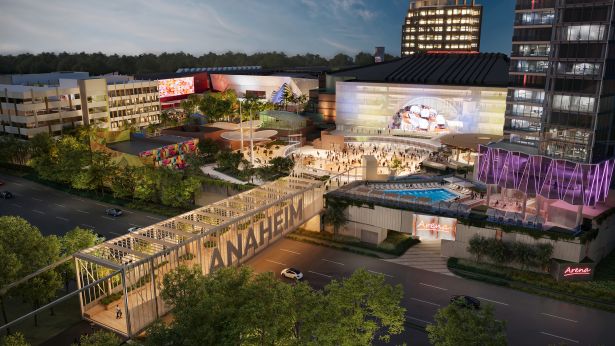
A 100-acre master-planned development is turning the sea of parking lots surrounding Anaheim’s Honda Center into a dense mixed-use district where people can live, work and eat whether or not the Ducks are playing.
Henry and Susan Samueli, owners of the National Hockey League’s Anaheim Ducks, are privately financing the large development named OCVibe. Scott Frick, senior vice president of real estate and district operations at the Samueli’s Orange County Sports & Entertainment, is managing the project, and described it as a $5 billion investment with 170,000 square feet of office space, more than 2,000 apartments, two hotels and more than 35 dining concepts. The broader plan also includes 20 acres of parks and plazas.
The first major public-facing pieces are scheduled to arrive in 2027, including Katella Commons, a 50,000-square-foot market hall, along with a 5,000-capacity concert venue, and The Weave, a six-story mass-timber office building where flexible-office operator Kiln has committed to a full floor.
Then the Honda Center will host indoor volleyball during the 2028 Olympics, when Frick expects roughly half a million people to pass through the arena in 11 days.
Commercial Observer spoke with Frick about how the absence of outside investors changes the economics, OCVibe’s office and residential strategy, and how to keep restaurants busy when the arena goes dark.
The conversation has been edited for length and clarity.
Commercial Observer: Can you give an overview of where construction stands today?
Scott Frick: We started construction about three years ago. We’ll be delivering phases through about 2030, 2031.
The first phase was really building parking structures to free up the surface lots. Honda Center is a very typical suburban arena. It’s kind of in the middle of nowhere, surrounded by surface parking and industrial uses. Over the last eight years, we’ve assembled almost 10 different parcels to create the 100-acre footprint.
Parking decks were delivered last year. One more was delivered this year, and that gave us the room to work.
What did you see missing in Anaheim or Orange County that convinced you this particular mix of uses would work?
Big picture, Anaheim gets 30 million visitors a year. Just with Disneyland and the convention center and all that’s going on around there, we’re right down the street. So we know there are visitors to the area looking for that third day and where to spend time.
At the site level, this had historically been kind of a two-stop arena. If you’re coming to a concert or a game, you’re stopping for dinner somewhere else, and then parking in the surface lot and walking in. So how do we create a much better experience for our guests?
It really starts with pre-puck drop, pre-event, a great collection of food and beverage, which this area may not historically have been known for. So how can we create that food destination first? Increase that dwell time pre- and post-event.
And then it expanded from there. You add hotel keys, then it could be a multi-day stay.
From a living standpoint, Orange County is very suburban. There aren’t these cultural centers, these nodes, that are exciting places to live like you see in larger cities. We saw a definite gap there in the market in Orange County, where rents are very high and we’re supply-constrained. Inventory growth has slowed to less than 1 percent a year, so there’s a great investment opportunity there.
And then the workplace: Office construction is dry. It’s really this flight to quality — to Class A-plus, A-plus-plus. We were originally entitled for over a million feet of office. Post-COVID, we reworked the entitlement to get a little bit more flexible zoning. We have options in future phases, but the family did still want to invest in 170,000 feet of great, very unique mass-timber office space.
Those apartments and the office — that’s our year-round customer and local people who live in the area. We learned at other districts: When it’s event night the place is overflowing. But, if there’s not an event there, it’s empty. How do we keep the restaurants healthy and active and full?
We want to make sure we still have that Monday-through-Sunday group of users on-site.
Most developments like this prioritize apartments and add the placemaking later. How did your strategy play out?
Usually you’d just get those units in first and get the cash flow going, and then deliver the fun and the infrastructure. That’s kind of why the Platinum Triangle looks like it does today. But the family really wanted to invest in the placemaking first and then follow up with those investment properties.
Starting at Phase Zero, we’re building 8,000 parking spaces total to replace the surface parking, and that will park both Honda Center, our 5,000-seat concert hall and then our new opportunities when we’re in surge mode — when all the venues are lit up.
Phase Zero is delivering half that parking so that we can get guests into Honda Center. We did not shut down. Ducks had a playoff run this year, so we were kind of threading the needle with construction and making sure we could get all those guests in and out of the arena.
Phase One is the 5,000-seat concert hall, an urban park, five restaurants in our 50,000-foot Katella Commons, and the office core and shell. That will all open next year, and then we’ll be tenanting that office building over the next 12 to 18 months.
What are you looking for from the restaurants and other tenants you bring into the district?
We just announced Roy Choi’s Best Friend will be our first announced full-service restaurant, which is super exciting. He’s homegrown, Kogi truck, just kind of born and raised down the street. So that’s a great coming-home story.
Then we’ll have a series of our next announcements coming soon.
Katella Commons was a really interesting deal. Ownership put in all the capital down to the kitchen equipment, so that’s really allowed us to reach. We’re not delivering a cold shell where you’ve got to come in with a few hundred thousand bucks to fit out your space.
We curated Katella Commons from day one. Any tenant that comes in doesn’t have to come in with capital to fit out the kitchen — basically bring in your own knives and we’ll turn on the menu boards. That’s allowed us to reach a great mix of culinary partners in Southern California and approach the curation of that space differently, which is very, very unique from a deal standpoint. It also allows us to get open quicker.
OCVibe has since announced multiple chef-driven concepts for Katella Commons.
The Samuelis also acquired Stadium Tower nearby. Does that property fit into OCVibe?
That’s a family investment. It’s just a belief that what we’re doing here at OCVibe is going to really anchor the neighborhood. But it’s wholly separate from OCVibe.
OCVibe doesn’t have outside investors. How does that allow you to operate differently from other sports-anchored districts?
Being 100 percent privately financed allows us to design and deliver on the placemaking the way the family wants to do it.
You can deliver those parks and that open space early on. You can make sure the guests have a place to park while we’re under construction. That’s been a real blessing.
There are a lot of great sports-anchored districts around the United States, but oftentimes you’ll find that the master developer, the owner of the team and the owners of the surrounding uses are all different parties.
Being under single ownership — we own the team, we own the real estate, we own the common areas, we own the parking decks, we’re operating those — allows us to go to our tenant partners and give them: “Here’s the run of show today. We’ve got staff arriving at 4. We’ve got guests that’ll start arriving at 5:30. Puck drops at 7. We’re doing a closing moment at 9:30. Here’s the game time so that you can get your second table turn in while guests are in the arena.”
That’s been kind of an eye-opener as I’ve been out leasing. The first question I get is, “Well, I hear you on event night, but what are you going to do when we’re dark? Or what do I do while there’s an event in the arena?”
I can go back and say, “Hey, we’re staggering showtimes. We’re doing all these things to keep you full and thriving and active.”
Real estate’s not known for its robust operating data, especially commercial, just because it’s not very transactional. But we’ve got about 2 million users — attendees at Honda Center every year — and we know how to reach them.
How do you view neighboring Angel Stadium, where baseball’s Los Angeles Angels play — and whatever eventually happens around it — as OCVibe develops? Is it competition or another traffic generator?
They’re great partners of ours. We have to share a lot of information with them just about events.
Their season and hockey’s season are generally opposing seasons, but we’ve got events, we’ve got concerts in Honda Center. If you’ve got that night where the Yankees are in town, or the Dodgers are in town, and we’ve got a full-house comedy show with 18,000 people in Honda Center, we’ve got to really be talking to them.
Beyond that, they’re great neighbors, and we collaborate with them often.
Gregory Cornfield can be reached at gcornfield@commercialobserver.com.