For Southern California, Defense Tech Is the Best Real Estate Offense
South Bay cities such as Torrance, Long Beach and El Segundo are drawing so many tenants and so much investment a spillover into other areas is inevitable
By Patrick Sisson August 24, 2026 6:00 pm
reprints
It’s easy to assume Los Angeles’ biggest contribution to the defense industry and any war effort has been the production of movies and films that celebrate the heroism of combat.
But, due to persistent geopolitical instability, combat that’s draining crucial weapon stockpiles, and ongoing efforts to adapt the United States military to the modern demands of high-tech warfare, defense spending is skyrocketing. And no place is benefiting from that more than Southern California, especially the South Bay, a grouping of small cities adjacent to Los Angeles, including Torrance, Hawthorne, Long Beach and El Segundo, that have seen their port-adjacent warehouse spaces transformed into hubs of military manufacturing activity.
“The growth curve we’re seeing for the South Bay right now is unprecedented,” said Mac Burridge, a managing director at JLL who leads the advanced manufacturing team. “It’s very akin to the Inland Empire during COVID, where there was just a frenzy for space and only a finite amount available.”
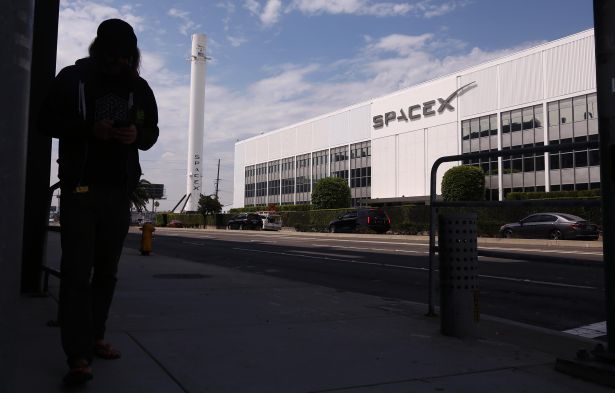
Historically, the South Bay has been a hotbed of aeronautics and space technology. Many of the largest traditional defense contractors, known as the primes, operate out of Greater L.A., and SpaceX, which held its blockbuster initial public offering earlier this year, was incubated in the small city of El Segundo, a nexus of startups and innovation just south of Los Angeles International Airport.
That tech activity has recently gone into overdrive, a mobilization that has become one of the bright spots of the Southern California economy. A record $366 billion was invested last year in California startups, driven by the AI boom. But the defense tech boom might be even more pronounced. Last summer’s One Big Beautiful Bill Act appropriated $153 billion in defense spending on top of record Pentagon budgets, with a proposed $1.5 trillion of spending for next year. National venture capital investment in U.S. defense tech hit roughly $70 billion over the last four quarters, per Pitchbook, a 63 percent jump from the four quarters prior.
In 2025, Los Angeles County brought in the most direct Department of Defense contracts in the U.S., said Chad Tredway, global head of real estate at J.P. Morgan Asset Management. The U.S. government sent a total of $8.9 billion in federal funding to Greater L.A., catalyzing a historic growth in startups and weapons companies.
“Los Angeles has the most significant manufacturing base in the country,” said Tredway, who has long steered investment into high-powered industrial assets. “The Rust Belt has the old ways of manufacturing, with a lot of people in a factory. Where the industry is going is highly specialized, tech-driven defense companies. And they were all co-locating in Southern California.”
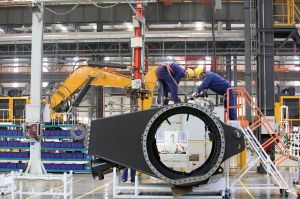
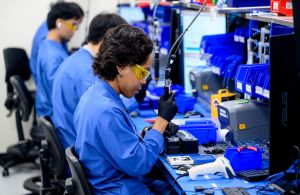
Startups are clamoring for certain kinds of next-generation workspaces, specifically large industrial warehouse buildings with floor space for heavy machinery, air conditioning, floors with vibration control, a lot of parking for large workforces and plenty of power. This expansion has juiced the region’s overall warehouse leasing, with CBRE reporting that the Los Angeles industrial market recorded 2.8 million square feet of net absorption in the second quarter of 2026, nearly triple the rate from last quarter.
Burridge estimated the demand for advanced manufacturing space in the South Bay is four times the current supply, creating a huge boom and a number of large deals, and no letdown in sight. El Segundo Mayor Chris Pimentel said the constant growth in the industry means there’s constant demand for incubation space as new waves of startups form and grow as technology evolves.
Funding and leasing news has come at a fast clip. Torrance-based weapons maker Hadrian raised $1.7 billion in a Series D round in early August. This summer, nuclear startup Valar Atomics signed a 512,000-square-foot lease in Torrance, while Divergent Tech, which makes Tomahawk missile parts, signed a 415,000-square-foot lease in Long Beach. Hermeus, an aeronautics startup making hypersonic jets, announced it would be relocating from Atlanta to El Segundo in April.
Landlords have typically waited to do tenant improvements until finding a tenant, said CBRE Senior Vice President John Lane, due to both the need for unique, custom outfitting for each firm, and the opportunities in the wider regional market. There’s still a lot of warehouse and logistics tenants in the market, so it makes sense to hold off on upgrades until a higher-paying tenant signs a lease. Typically, Lane said, these kinds of firms command a premium of 25 to 50 cents per foot per month in rent.
“The biggest challenge is power,” said Bob Dougherty, chief investment officer for Luminous Capital Management, which operates an industrial portfolio across Southern California. “You’re really dealing with utilities that are just crushed with the demand from data centers and other power users.”
As much as critics pillory the Golden State for being an expensive, high-regulatory environment, startups see a big benefit in being here. As Burridge and others say, all these groups recognize the need to headquarter their company in Southern California, a choice driven solely by the region’s unique talent pool. Anduril, the rapidly expanding defense tech startup, committed to a $1 billion, six-building, nearly 1.2 million-square-foot mixed-use campus in Long Beach earlier this year.
Demand has started to push firms, and even investors, to start looking past traditional markets in El Segundo, Torrance and Long Beach, to areas like Hawthorne and Inglewood. Tenants have even begun thinking about space on the other side of Interstate 405 in cities like Rancho Dominguez, Carson and Cypress.
Burridge believes the search for industrial sites will bleed down into Orange County. In June, a firm called New American Funding announced it is demolishing a 103,000-square-foot vacant office building in Tustin, with plans to rebuild as an advanced manufacturing site. Burridge can think of roughly 10 other projects in the South Bay making similar plans to turn an office site into industrial.
These types of advanced manufacturing assets — industrial sites in the right talent hubs with lots of power for hard tech firms — were excellent investments, said Tredway. They feature better liquidity and reuse potential than data centers, and have higher-margin tenants who can pay higher rent. J.P. Morgan found that industrial assets with 4,000 amps of power or more, ideal for manufacturing, outperform assets with half the power by 530 basis points annually.
A number of startups have even started buying space defensively, signing larger leases than they might need, and spending more now to guarantee they have room to grow. Landlords have become much more picky, Burridge said. With limited space and more options, owners are going with the startup with the most money raised, or seeking to diversify their leasing portfolios so they aren’t only taking in tenants that specialize in the same products, such as drone manufacturing.
At the same time, said Dougherty, these leases tend to be longer. Where third-party logistics firms will sign leases with shorter time frames, federal contracts give defense firms the ability to sign 10-year leases, giving landlords the chance to amortize their spending on tenant improvements and building infrastructure. He also believes that many of these tenants will eventually end up buying the mission-critical manufacturing building they lease, giving landlords an exit strategy on their investment.
“They’re going to realize that, ‘Hey, this landlord has too much leverage, let me control my own destiny,’” Dougherty said.
The web of defense, space and hard tech firms has significant runway as well, as more sub-industries arrive and diversify the region. For example, advanced nuclear technology, with firms such as Radiant in El Segundo, and the defense funding expansion isn’t slowing anytime soon.
As Burridge pointed out, these startups can supply tech and weaponry to the government at a fraction of the cost of the traditional primes. The demand for munitions replacement, and even increased funding for the Golden Dome missile shield concept, continues with bipartisan support, and continues to direct more investment to Southern California.
“The diversification of L.A. is pretty interesting,” said Burridge. “You have everything from nuclear and clean power to defense and rocketry. It allows for an incredible talent pool to hire from.”