Hangars-On: Aviation-Related Real Estate Investment Takes Off in 2026
Heartier planes and more air travel are driving big names like Blackstone, SomeraRoad and Bain Capital to up their miles in the niche sector
By Isabelle Durso November 12, 2026 6:00 am
reprints
It’s a bird! It’s a plane! No, it’s just another commercial real estate firm soaring into the aviation sector.
Lately, many companies — including private equity firms and development companies — are investing in a highly specialized niche of commercial real estate: the aviation industry. Whether it’s investments in airplane hangars, airport ground leases, development sites or commercial airlines, these firms are certainly snagging a first-class seat in the sector before anyone else.
“There’s clearly a class of investors that are interested in assets that have infrastructure-like cash flows and returns, so long-term steady returns over a long period of time,” said Nicholas Carney, a partner and head of the infrastructure sector at law firm HSF Kramer. “Airports are one example. It’s not easy for a competitor to go and build a rival to JFK Airport just down the road. It’s that steadiness and long-term predictable nature that makes it attractive.”
There’s been an abundance of investment in the sector just in the last year.
In August, Apollo Global Management acquired a significant stake from KKR in Atlantic Aviation, a private jet fixed-base operator (FBO), in a deal valued at nearly $10 billion. The deal gives Apollo access to Atlantic Aviation’s more than 100 fixed-base operations across the U.S., as well as its hangar and office space. (An FBO is a business granted rights to act as the primary service provider to general aviation aircraft operators.)
Meanwhile, Blackstone has Equator, a long-term global aircraft leasing investment program launched in April targeting a deployment of approximately $1.6 billion to purchase commercial aircraft on lease to leading global airlines. The program was formed in a joint venture between Blackstone and Dubai Aerospace Enterprise.
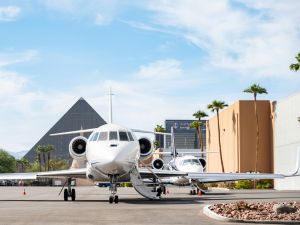
More recently, SomeraRoad, which operates its aviation real estate investments through its dedicated subsidiary SR Aviation Infrastructure (SRAI), broke ground in October on a hangar facility redevelopment in Las Vegas. SRAI works on both development and acquisition deals for airplane hangars.
That’s only the tip of the iceberg (or wing, if you will).
“From an investor standpoint, what [the sector] offers for a certain type of investor is stable, very long-duration returns,” said Marc Ricks, CEO of Avports, a U.S.-based airport management, operations and development company. “Over a very long period of time, air travel demand tends to grow at a pretty steady pace, and that steadiness tends to be correlated with fairly steady and growing revenues, and, importantly, many of those revenues have a good linkage to inflation. That’s the type of thing that lots of different types of investors look for.”
Besides aviation being a long-term predictable investment with steady cash flows, there’s other reasons for investors to keep their eyes on the sky.
Demand for suitable hangar space in the U.S., specifically, is growing rapidly — largely due to the fast-evolving needs and growth of commercial and private aircraft — while supply of that type of space, as well as the land on which it can be built, is quite scarce. There’s also very few companies operating in the airplane hangar acquisition and development field, making what Patrick Hanlon, a principal at real estate capital advisory firm Ackman Ziff, calls a “perfect storm.”
“It’s a better cash flow environment from the landlord side, and then there’s a dearth of land, so there’s a dearth of hangar space,” Hanlon said. “So landlords say, ‘I’m gonna provide that to these guys so that they can meet their business plans.’”
There’s currently about 2 percent availability in existing suitable hangar stock in the U.S., according to Hanlon. “When I say that, it’s because some of the older stock can no longer accommodate either the new planes or, frankly, the new technology that the maintenance, repair and overhaul companies need,” he said.
Those aircraft maintenance companies — known as MRO companies — are often the lessor of airplane hangar space at airports. MROs are experiencing a rapid surge in demand for regular maintenance checkups for both commercial and private airplanes, especially as the lifespan of today’s aircraft grows longer and longer with modern technology. (Many planes from even the 1970s are still operating today, according to Monte Koch, co-founder of SRAI.)
Private equity investors are seeing that demand and responding swiftly.
In 2024, Bain Capital acquired a strategic minority stake in MRO Holdings, a leading independent provider of MRO services for commercial and cargo airlines in the Americas. In September, aircraft supply provider AAR bought a controlling 65 percent interest in MRO Holdings for $1.8 billion, while Bain and several other investors retained a 35 percent stake.
Meanwhile, The Carlyle Group is a longtime investor in StandardAero, one of the world’s largest independent aircraft engine MRO providers. Also, Bridgepoint Group acquired SK AeroSafety Group, a global leader in MRO, in 2023.
Plus, Blackstone is a longtime debt and equity investor in Jet Support Services, the world’s largest independent provider of maintenance and technical support services for the aviation sector. There’s also Blackstone’s part ownership in Signature Aviation, the country’s largest network of fixed-base operators, private aviation terminals and hangar space.
“What we look for across our asset-backed finance (ABF) strategy are situations where you have a scarce asset and you have good supply/demand characteristics,” said Aneek Mamik, a senior managing director and head of financial services for ABF at Blackstone. “That can lead you to doing things in the ecosystem around major airports or major airlines, and to some extent the aircraft itself.”
The list can go on, all while the demand for maintenance and repair continues to skyrocket, and hangars and cargo continue to go without replacements or upgrades.
That’s where developers come in to build new hangar space, and sometimes even new airports. But it’s not so easy to enter the sector, and those that do have the means and resources to build are in the minority, meaning they’re looking at higher yields on their investments. Airplane hangar sale-leaseback deals, for example, often produce yields in the “high teens,” while new construction investments usually result in yields in the “mid-20s” because it’s opportunistic, according to Hanlon.
Avports is one of those few development companies with a solid footing in the industry. The company is currently developing a fourth airport in the Washington, D.C., region in Manassas, Va. The project won Federal Aviation Administration approval in August and is on track to start commercial service at the end of 2027.
In that development, Avports has a 40-year lease with the City of Manassas on a certain number of parcels and has the exclusive right to recruit passenger airlines and generate revenue from the project, according to CEO Ricks.

“Today, the Washington, D.C., region is served by three airports. When we’re done in about a year, there will be four, and that has a powerful impact on the aviation system,” Ricks said. “So whether or not there will be more opportunities to do these megabillion-dollar projects through public-private partnerships, I don’t know. But there’s a lot of demand for what we do, which is take an airport that may be busy and introduce passenger service to it. There’s a lot of bang for your buck in those projects.”
Those passenger services can include issuing security badges, keeping the airfield operating on behalf of users, ride share parking and retail offerings.
SRAI is another investment platform acquiring and building its own aviation assets, specifically hangar space. SRAI owns several multi-hangar complexes and airport development sites in the U.S., including a development site spanning more than 50 acres of developable land on Long Island at Republic Airport in East Farmingdale, N.Y., and a 118,000-square-foot hangar complex near Yellowstone National Park, where it’s building a 40,000-square-foot hangar. The firm also owns the 8.9-acre, seven-hangar business aviation complex near San Antonio International Airport in Texas.
SRAI’s most recent project brings it back to its roots. After SomeraRoad formed SRAI in 2024, the company acquired the 23-acre, more than 300,000-square-foot Quail Air Center at Las Vegas’ Harry Reid International Airport. The air center initially featured 37 airplane hangars and was fully leased out to high-profile private clients, casinos and Vegas billionaires.
Now, SRAI is returning to the site with a new redevelopment project, which broke ground this month and is set to create three 25,000-square-foot hangars that can house up to six moderately sized corporate aircrafts. The project is expected to be completed by the first quarter of 2028.
“In keeping with where the demand is right now for these newer, larger aircraft that are taller and have taller tail heights, we’re tearing down 60,000 square feet of space, and we’re putting up 75,000 square feet of bigger, taller space to accommodate those larger airplanes. That’s our latest groundbreaking effort,” said SRAI’s Koch.
But it’s hard to reach the scale those companies have achieved, as building in the aviation sector “requires a great deal of expertise,” Ricks said.
It requires massive capital requirements to either purchase aircrafts, set up maintenance hangars, or build physical airport infrastructure. There’s a reason airports and airplane hangars don’t pop up every day — it takes an abundance of time, money, space and workforce, not to mention the skills to handle regulatory complexities. Aviation is one of the most heavily regulated industries in the world, so safety and global security are aspects to factor in.
“It isn’t for the faint of heart, and it isn’t for the amateurs,” Ricks said. “You don’t have to read the paper for long to see safety incidents and safety issues to understand that you need to come to the table with a measure of expertise.
“The degree of attention and focus paid to compliance and safety in an airport environment is on another level from almost all of the real estate industry,” Ricks added.
Still, it’s a lot like real estate. Just like with more typical property, most deals in the aviation sector consist of physical space and charging people for the use of that space. Most of the same factors come into play: Choosing the right market, having the right size space for your tenant, and providing a compelling value proposition to customers.
“It’s also just like the retail real estate industry in that the more expensive the real estate, the harder it is for [the airlines] to turn a profit, and so we work hard to design and build our projects affordably,” Ricks added.
But there’s some differences in the lease structures for typical real estate versus airplane hangars, for example.
In most cases, local and state governments, which usually own the land beneath the airport, hand out a ground lease — typically around 40 years — to an operator. Then the operator hands out hangar leases — usually roughly 30 to 50 years — to tenants, whether they be MRO companies, FBOs or airlines themselves. The ground lease is the key difference.
In addition, from a financing perspective, investors in the aviation sector are often putting in place long-term — even 30-year — debt that’s fixed-rate, so it’s “locked in forever,” Ricks said. The real estate industry, on the other hand, often finances itself with short-term, floating-rate debt.
There’s also more opportunities for investors to come in later on airline investments — either midway through an aircraft’s lifetime or later — because of the length of the average plane’s life nowadays.
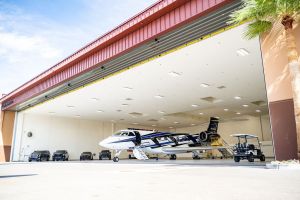
There are other investment tailwinds, too. Fleet utilization, meaning how often we’re able to use the same individual plane, has improved immensely over the last few years, according to the Federal Aviation Administration.
FAA and contact tower commercial operations are projected to grow by 1.6 percent annually this year, and the global commercial fleet average age has risen to roughly 15 years, compared to a pre-pandemic baseline of around 13 years, according to the FAA and Aerospace Global News.
It’s largely because many investors realized aviation was a “worthwhile investment” post-COVID, SRAI’s Koch said, in both the commercial and private sectors. That led manufacturers to have their hands full making new aircraft, while, at the other end of the spectrum, the existing fleet of aircraft were “reinvigorated” with new engines, avionics and interiors.
“All of a sudden, both new and existing fleets were growing, but what wasn’t growing was the infrastructure related to housing these airplanes, so that’s where you see this supply/demand problem that has occurred,” Koch said. “We were attracted to it because we saw that deficiency early on.”
The growth in fleet numbers and lifespans is also driven by a growth in air travel itself. The aviation sector has grown at almost twice the rate of the global gross domestic product, and the private aviation space is growing even faster than that, a source said.
U.S. airlines carried 90.5 million scheduled service passengers in July 2026 (the most recent data available), down 1 percent from June but up 4.1 percent from July 2019 (pre-pandemic), according to the most recent U.S. airline traffic report from the Bureau of Transportation Statistics.
Meanwhile, international travel is set to reach a new high this holiday season, with the most recent WTM Global Travel Report projecting a record 1.57 billion overnight arrivals worldwide in 2026, a 2 percent increase from last year.
“Demand for airports as long-term stable assets has not diminished, even through things like 9/11 and COVID-19,” HSF Kramer’s Carney said. “Very significant events that hit the aviation sector haven’t diminished the demand for infrastructure assets, and the interest in and the demand for airport assets has continued.”
Isabelle Durso can be reached at idurso@commercialobserver.com.