Can Nithya Raman Break L.A.’s Development Gridlock?
‘I'm a planner first and foremost’
By Patrick Sisson November 11, 2026 4:45 pm
reprints

After being sworn in as Los Angeles’s 43rd executive nearly four years ago, Mayor Karen Bass immediately declared a state of emergency, signaling her resolve to tackle the homelessness crisis and marshal the city’s resources to confront this long-standing issue.
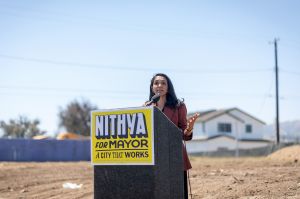
We don’t yet know what progressive Councilmember and Mayor-elect Nithya Raman will say on the day she officially assumes the role of Mayor on Dec. 14, but it’s certain that acting on housing — and acting fast — will be a key focus.
“If I am elected, my first 100 days will be about getting that work underway so that our city can once again build,” Raman said during a speech in October.
In an era where Los Angeles has been riven by ICE raids and slow to recover from devastating wildfires, and after an election where economic issues and accountability were paramount, it may be reductive to say housing is the key issue. But as Los Angeles continues to face a decades-long affordability crisis — as well as a crisis of confidence in city government and the ability to build — housing and real estate issues remain at the forefront. The same week as the election, news broke that Brookfield abandoned its $600 million luxury downtown high-rise, the Beaudry, a massive vote of no-confidence in Downtown Los Angeles highlighting a deep-seated development morass.
Policy has long been considered a Raman strength. The 45-year-old urban planner, a graduate of both Harvard and the Massachusetts Institute of Technology, has long been championed by pro-housing and YIMBY advocates as a wonk who can get in the weeds. “I’m a planner first and foremost, and a politician as a means to an end,” she told the American Planning Association in 2022.
The ambitious housing agenda she laid out on the campaign trail squares with many of the issues voters have prioritized. A poll taken in October of likely Los Angeles voters by U.C. Berkeley and the L.A. Times places affordable housing as the third most important issue, trailing homelessness and public safety. Raman was more aggressive about rezoning and adding more density, supporting SB 79, the state transit-oriented development bill Bass campaigned against. A precinct-level breakdown of voting patterns showed Bass won in areas typically dominated by homeowners.
Raman’s biggest challenges when it comes to housing and real estate will be threading the needle with her ambitious agenda and detailed policy platform. It’s a challenge faced by other recently elected progressive city leaders: Encourage more building and density, which means opening up zoning and accelerating housing production, while maintaining and expanding key tenant protections and tenants rights. Many real estate figures claim the approach makes it easier and cheaper to build, but more expensive to operate.

Raman’s initial political victory onto the City Council in 2020, which was labeled a “political earthquake,” showcased her tenacity in the face of incumbents and ability to campaign and win on a slate of new ideas.
“Ultimately, I think Raman should be judged less by the ideological labels attached to her and more by whether she can deliver tangible improvements in housing production, economic development, and basic city services,” said Joshua Baum, founding principal of research firm Hilgard Economics.
From the perspective of commercial real estate, a core challenge is demonstrating that Los Angeles is serious about being a place where people can actually build and invest, said Baum. That will require engaging directly with the development community, understanding what is preventing projects from moving forward, and being willing to make changes when the evidence shows something isn’t working. Raman supporters, such as Mott Smith and land-use attorney Dave Rand, believe she can “bring competency back” and impress skeptical developers.
“Developers don’t necessarily need to agree with a mayor on every issue,” said Baum. “But they do need predictability, consistency, and confidence that City Hall understands the economics of development.”
One relatively quick way for Raman to communicate her housing priorities is to put the city on the clock. The mayor-elect has spoken in the past about creating shot clocks that would push city agencies and planners to pass judgments on projects within a set time frame. Gary Benjamin, founder and principal of Alchemy Planning + Land Use, an L.A. consulting firm, said setting such deadlines would communicate to the development community that there’s a higher degree of certainty with these projects.
“That would go a long way to encouraging investors to continue thinking about investing here, and taking some of the wind out of the sails of those that are stating, ‘Redline L.A. for the next four years,’” said Benjamin.
Raman’s vision to expand and speed up construction, add more affordable units to the city, reform building inspections and utility hookups, and legalize more missing middle and single-stair buildings zeroes in on a number of key bureaucratic changes, seeking to streamline permitting and regulations.
Baum and others have advocated for better coordination between departments, clearer timelines, more predictable requirements, and fewer opportunities for projects to get stuck in administrative limbo. There will be plenty of factors outside of Raman’s control, such as high interest rates, construction costs and tighter lending conditions. But city operations remain within the mayor’s authority, along with a potential quick shift that underscores her seriousness about the issue.
The case of Measure ULA, the transfer tax that many multifamily developers blame for blunting new housing development — which she initially supported, and later advocated to reform — has been held up by some as a sign she should have been more careful about initially backing the measure. But it also shows a leader willing to learn, analyze the data, reconsider and adapt.
Significant portions of the real estate industry bristle at Raman’s support of measures designed to increase tenant rights and protections. The specter of what often gets called socialist policies raised alarms among many landlords, said Daniel Yukelson, head of the Apartment Association of Greater Los Angeles. He referred to her as Nithya “Nikita” Raman in an email exchange about her victory — in reference to Nikita Khrushchev, who led the Communist Party of the Soviet Union — and said her win may “galvanize the socialists and encourage even more radical and harmful policies.”
Yukelson does, however, have hopes that Raman can enact some policies that he believes would help landlords. First is repealing or reforming Measure ULA. Secondly, his members would like to see more balance when it comes to the array of challenges and regulatory roadblocks when it comes to collecting rent and evicting problem renters, and the combination of rent caps and rising costs, such as utilities and trash collection, adding to overall financial strain.
But proponents argue any ULA reform should avoid changing the successful program beyond recognition, said Joe Donlin, director of United to House Los Angeles. The transfer tax has already raised $1.5 billion since its passage in 2023, and has provided funding for 5,600 units thus far.
“What is the most needed kind of housing in the city of L.A.? There’s no question; it is affordable housing, and that is exactly the kind of housing that is being built and preserved in large numbers, thanks to Measure ULA,” said Donlin. “Any mayor that comes in is going to have the benefit of ULA as an economic engine.”
Raman will enter office at a time when voter sentiment about government dysfunction remains alarmingly high, offering perhaps a popular mandate to improve services, infrastructure and government functions. She also benefits from the passage of ballot measures, including one that invests in more park and green space and another that will get rid of limits on floor area ratio, potentially offering more opportunities to build vertically and increase density and development.
It’s been hard for pundits to resist making comparisons between Raman and New York’s new progressive mayor, Zohran Mamdani. Benjamin said the comparison is apt in one key way: While many observers were obsessed with Mamdani’s “socialist” label and how he would pursue his big ideas, he actually leaned into pragmatic, technocratic solutions once in office. It’s an approach that has served Mamdani well — recent polls showed his favorability rating is surging — and, considering Raman’s track record and policy chops, seems like one she’s likely to follow.
“Los Angeles has no shortage of plans, studies or policy proposals,” said Baum. “What we need is better execution and a willingness to measure whether our policies are working.”