

Data Centers: There’s So Much to Talk About
So Commercial Observer convened a forum to tackle the promise, the perils and the political fault lines in the controversial asset class
By Brian Pascus October 8, 2026 2:15 pm
reprints
All eyes were on the most controversial asset class in America during Commercial Observer’s Data Centers Development and Infrastructure Forum, held Oct. 6 in Midtown Manhattan at the City University of New York Graduate Center.
Experts across data center law, construction, investment and development discussed the past, present and future of the asset class, with particular emphasis on the innovations of AI technology and recent investment trends. They also discussed how the evolution of public opinion has made data centers a hot topic on Capitol Hill and regional statehouses alike.
The forum began with a presentation by Jeffrey Moerdler, partner at law firm Haynes Boones’ data centers and digital infrastructure practice group, who opened his remarks by calling data centers “the fourth and maybe the fifth industrial revolution.”
Moerdler compared the recent development of the asset class and AI technology to the discovery of water and steam power in the early 19th century, electricity and mass production in the late 19th century, and computing and digital technology in the 20th century.
He then zeroed in on a pair of trends. First, he emphasized that the future of AI is in urban and suburban inference data centers — low-latency data centers trained to deliver AI outputs to users in densely populated cities, rather than large campuses in rural locations.
“In the last year or so, I’ve seen my clients that have those kinds of facilities at capacity sell out the [computing] capacity faster to smaller users that need the end point of their AI network to be local,” he said.
Moerdler also dampened sentiments toward neocloud computing companies — specialized on-demand cloud networks for AI models, rather than general purpose internet, that lease space in data centers — which he described as a short-term business model without long-term income sources.
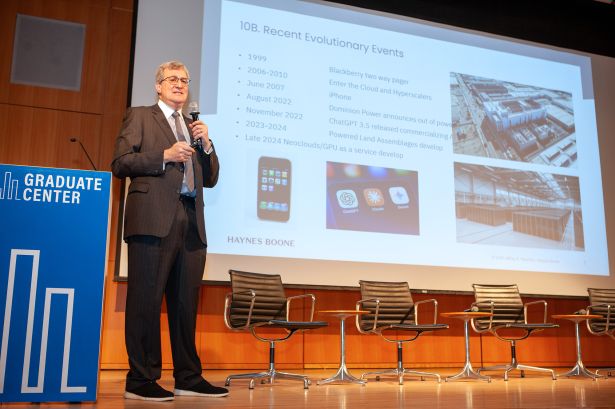
“Neoclouds are new companies, there are a zillion of them popping up everyday, they have a zero credit rating, and they usually have someone with a very deep pocket backing them,” he said. “I worry about whether this is WeWork 2.0.”
The first full panel of the day, moderated by Michael Vardaro, a managing partner at law firm Zetlin & De Chaira, examined where commercial real estate meets AI and what investing in the future of digital infrastructure will look like.
Sam Stockdale, managing director of power and infrastructure at Link Logistics, broke down the differences between data centers from as recently as seven years ago and those being built today. The older 30-megawatt or 40-megawatt facilities are now dwarfed by data centers that today demand one or two gigawatts of power.
“That’s the largest difference just because it, of course, commands a completely different scale of investment to achieve development and delivery of that type of infrastructure,” he said.
Stockdale added that the data center revolution is more than just about leasing the technology to firms like OpenAI and Anthropic, but it is “really about the digitization of the entire economy.”
Peter C. Lewis, founder and chairman of Wharton Equity Partners, said that in his four decades of investment experience, the growth of data centers and AI real estate has been “without a doubt the greatest change seen in my career, times 10.” Yet, Lewis warned that not every developer with experience in industrial real estate will be able to successfully make the shift into data centers due to the inherent complexity of the asset class.
“This is a really sophisticated game,” he said, comparing it to investing into a pie chart that keeps expanding and can go wrong at any minute. “This is the beginning of a major tidal wave, and I really think the Street, in general, is underestimating the demand and reach of this.”
Lewis added that data center development, while fraught with risk, creates “returns like I’ve never seen in my career, by many multiples.”
Amir Abdu, a managing director at BGO’s U.S. investments team, emphasized the increasing number of delays in data center developments. Abdu said the entire industry, including the capital markets side of the business, now must confront the changing winds of public opinion.
“Previously, power was the single dominant supply constraint in the industry, but the new issue that we’re all grappling with is this politically charged environment nationally,” he said. “It really runs the gamut across the political spectrum. … It’s not just a Democrat or Republican thing.”
The morning’s second panel, moderated by Nicole Fenton, partner at HSF Kramer, examined the data center transaction life cycle, with an emphasis on the land use conundrum.
Gavin Flynn, principal at Blue Owl Capital, said that powered land is the key to underwriting any data center deal, but permitting might be even more important, as powered land has “very little value” if you can’t build or operate a data center on it — an issue that puts utility players at the crux in any potential data center development.
“Some of the requirements from utilities today, around clawback provisions, you’re looking at minimum charges, letters of credit — on large campuses — these are probably hundreds of millions of dollars outlayed before you even have a tenant or a clear timeline to revenue,” he said.
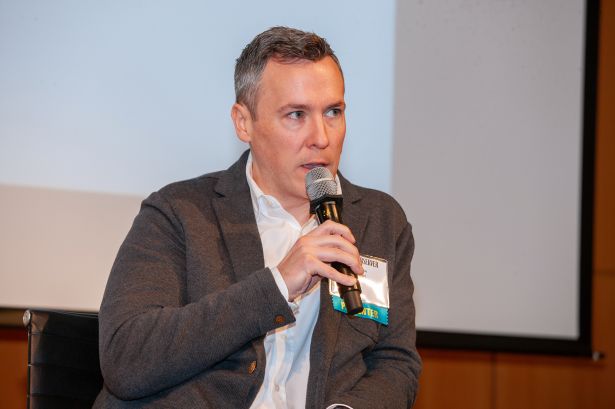
James Nemeroff, a director at capital markets firm Ackman-Ziff, speaking from an investor’s perspective, said that capital isn’t looking to solve a developer’s questions when it comes to data centers, and that those sponsors who have secured the necessary permits and leasing agreements are likely to have an easier time securing capital. That goes for both the short term and the long run.
“The people that can take things as far as possible and check as many boxes as possible — as ultimately you’re solving for an end user, a long-term lease — that’s what’s ultimately getting financed,” he said. “There are guys getting close to 100 percent financing on construction, if you can get to the point of leasing to an Amazon.”
Andrew Bernardin, a senior vice president at Starwood Capital Group, argued that data centers are more than a traditional real estate project and that the powered shell is “probably the true real estate investment,” as energy considerations are paramount when it comes to financing.
“You need to be really safe, and protect your downside, and, frankly, there’s been a ton of paper out there of really high investment-grade leases, and that’s helped us in terms of picking our spots,” he said.
Jack Sordoni, co-founder of 4-3 Consulting, decided to move the focus away from capital stack complexities to what he advises his data center developer clients to focus on. To wit, he said securing favorable public opinion, especially from landowners seeking to sell, supersedes investment financing.
“We understand the community needs at a visceral level and, to us, it’s very important to engage the landowners and the local governments,” he said. “Without that, we’re dead in the water.”
After a short break, the third panel of the day saw Sean Scuderi, partner at Tarter Krinsky & Drogin, moderate a discussion on which geographic markets are leveraging data centers as economic engines.
Aidan Hayes, managing director at Cedar Investment Group, spoke of how his firm has leaned into community benefit agreements — like one signed in Lancaster County, Pa. — that has promised to invest tens of millions of dollars and develop a broader ecosystem in the city, particularly around educating blue-collar workers for the 21st-century economy.
“What we’re trying to do is seed a whole new economy, based around AI, using the funds we have contributed as part of that agreement,” he said. “And we think that will be a phenomenal thing for them.”
John Hawkins, IBM’s global data center real estate lead, lamented the missed opportunities the data center industry has accumulated to communicate the economic benefits their developments bring to small cities, and he criticized developers as being “too secretive” for the last 20 years.
He pointed to Loudoun County, Va., as the prime example of a municipality that has received tremendous amounts of tax revenue from data centers.
“Many people in my life that live in Loudoun County absolutely love the trade-off between data centers and killer schools for their kids, new roads and safe roads,” he said, though he admitted: “I love the data center business. I wouldn’t necessarily want to live next door to one, but I’m glad people do.”
Bella Warwick, a director at real estate advisory Greysteel, spoke of the different pieces of the pie any developer needs to hit, no matter the locality, that makes public-private partnerships paramount for the asset class to succeed.
“It’s your local planning commission, local elected leaders, mayors and county commissioners, state elected legislators, the governor’s office … there’s a whole host of government bodies and entities that require different equities in the project, and being able to engage each of those different audiences is a discreet thing [for a developer to accomplish],” she said.
Terence Deneny, a senior vice president of STO Mission Critical, ended the discussion by noting that his development firm is now rejecting $500 million data center projects because they don’t check all his boxes.
“We ask the three questions: Do you have power? Do you have permission? And do you have the resources locally to build them?” he said. “That’s become the biggest hurdle to developing sites, the terms of these entitlements.”
The penultimate forum discussion was moderated by Gregory Jaske, a partner at Olshan Frome Wolosky, and examined the AI resource equation among electric power, water resources and community impacts.
MD Sakib, a director of strategy at energy company National Grid, admitted that the facilities operated by utility companies in New York, and across the nation, are being strained by data center developments because so much utility infrastructure is several decades old, if not more than 100 years old.
“Over the last four years, my large load queue has gone from one gigawatt to 13 gigawatts,” he said. “It’s not meant for such enormous growth going around upstate.”
Brian Schafer, principal of architecture and engineering firm Highland Associates, agreed on the state of U.S. utilities and said “the infrastructure isn’t there” to support 500-megawatt data center developments. He added that development “is not happening by clicking a switch — there’s capital costs and planning and that takes years and years in some cases.”
Andrew Warin, executive managing director at Newmark, said that as developers aim to meet regulatory thresholds set by skeptical localities, his advisory business has actually seen a new pipeline of smaller-scale data center projects that are less than 50 megawatts rather than one-gigawatt campuses.
“Our view is the regulatory challenges will be less pronounced and that power timeline is one you can hit,” he said.
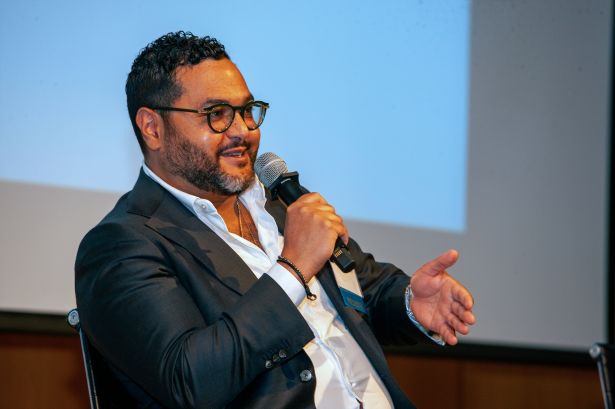
Turning toward public opinion, Justin Manaster, principal at Conversant Capital, said data center development is now about creating win-win outcomes between the private sector and localities. Still, he said it’s incumbent on developers to protect themselves with how they structure capital stacks in this current political environment.
“It will be state specific. I’m not sure you can define it by one political body,” he said. “But I think it’s very important for sponsors to maximize their optionality, as it applies to both equity and debt for capitalizing deals.”
Eric Rosenthal, co-founder and managing partner of Machine Investment Group, closed the conversation by noting the market will be defined, and will evolve, by how competitors value risk.
“Supporting utility infrastructure … is a topic that we’ll be talking about a lot. It isn’t talked about enough, and it will become more divisive and problematic as projects try to advance,” he said.
The final discussion of the day was a chat between Patrick DeMarco, executive director at Mission Critical at Holt Construction, and Jerry Martin, chief operating officer and co-founder of 1547 Critical Systems Realty.
DeMarco raised eyebrows when he admitted the industry has to modernize older, 15- to 20-year-old facilities in order to impact the physical environment, primarily water consumption, in a healthier way.
“We have to start with the data,” he said. “We need to get measurements and understand operating conditions, water use, cooling efficiency, and analyze the equipment that’s currently in place and the actual workload requirements that are needed.”
The two then offered their five-year predictions for the data center market, with Martin arguing that the growth of the industry will dissipate any negative public opinion and create greater public understanding.
“Five years from now, this will be a thing of the past, where people don’t know what we do,” he said, adding that the negative headlines around the industry are purely political. “My partners and I are part of the chambers of commerce, wherever we go, and are on the governor of Hawaii’s task force purely to educate people on what we do, what we need, and that we’re not the bad guys.”
DeMarco pointed to the construction side. “Five years from now, hopefully the supply chain integration gets worked out, that’s a big problem the industry has,” he said. “Cooling is a moving target … but that’s going to be changing,”
Brian Pascus can be reached at bpascus@commercialobserver.com.


