

Office CMBS Delinquency Rate at Highest Level This Decade
By Liam Mulcahy September 28, 2026 8:54 am
reprints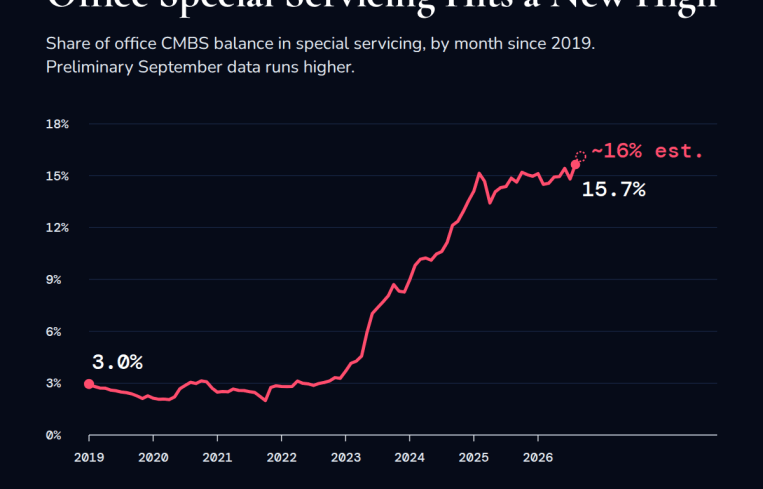
The office commercial mortgage-backed securities (CMBS) delinquency rate reached 13.2 percent in August 2026, the highest reading since at least 2019 and up from 8.1 percent in July 2024. That is roughly 1.6 times the 8.2 percent rate across all property types.
The office figure includes performing matured loans. Excluding those, office delinquency stands at 9.8 percent. The special servicing rate climbed to 15.7 percent, also the highest since at least 2019, up from 14.9 percent a year earlier and 10.6 percent in July 2024. The figures cover $189.6 billion of office debt across conduit, single-asset, single-borrower and commercial real estate collateralized loan obligation deals.
The climb slowed, then resumed with most of the increase between mid-2024 and mid-2025. From September 2025 through July 2026, office delinquency held between 11.5 percent and 12.5 percent before jumping in August.
Of the office deals that have reported so far in September, delinquency is running above 14 percent and special servicing above 16 percent. Conduit office loans remain the weakest CMBS segment at 14.4 percent delinquent and 18.5 percent in special servicing, compared with 10.7 percent and 11.5 percent for single-asset, single-borrower office. Maturity remains the main driver with 71 percent of distressed office balance tied to a failed or imminent refinancing rather than missed payments.
Over the past 12 months, 51 percent of office loans transferred to special servicing were still current at transfer, a median of about 11 months ahead of maturity, up from 42 percent in the prior 12 months. Borrowers and master servicers are increasingly moving loans before a payment is missed or a balloon date passes. Manhattan’s One SoHo Square, for instance, backed by roughly $469 million of CMBS notes, transferred in late August while current — nearly two years before its 2028 maturity.
CRED iQ tracked the 93 office loans that transferred while current and ahead of maturity between August 2024 and August 2025. Through August 2026, 72 percent went 60 or more days delinquent or matured without paying off at some point. As of August, 43 percent were still delinquent or matured unpaid, and only 15 percent had returned to the master servicer and were current.
Among loans already delinquent at transfer, the share that reached serious delinquency was 92 percent. A loan that looks healthy at transfer has proven only modestly safer than one that has already stopped paying.
Full buildings are not immune from the distress as several failed refinancings involve fully leased, single-tenant properties. Crossroads III in Sunnyvale, a $209 million loan on a fully leased property with Apple as its largest tenant, was extended once, went to special servicing in August and received a notice of default on September 1. In Rockville, Md., the $138 million GSK R&D Centre loan transferred ahead of its 2027 maturity as its sole tenant vacated, even though the property still reports full occupancy.
Large loans are the exception.
Among current-at-transfer loans under $100 million, 74 percent went on to default at some point, and 11 percent were back with the master servicer by August. Among loans of $100 million or more, the default rate was lower at 63 percent and about a third had returned to the master servicer by August, some after a period of default. Chicago’s Willis Tower and New York’s 1211 Avenue of the Americas both transferred while current and have since returned to the master servicer. For larger loans, an early transfer appears to work more as an entry point to a restructuring than as a precursor to foreclosure.
The 2015 and 2016 vintages explain the caution as 10-year office loans from those years paid off at maturity at 47 percent and 44 percent by balance, compared with 79 percent and 76 percent for other property types. Distress in the 2016 office vintage jumped 35 percentage points in a year to 51 percent of balance.
In Downtown Indianapolis, Salesforce Tower and PNC Center (both originated on the same day in August 2016) matured on the same day, Sept. 1. PNC Center went to special servicing days earlier and is now non-performing matured while Salesforce Tower is performing matured.
About $39 billion of office CMBS matures over the next 12 months. Of that, $13.9 billion is not yet distressed but already shows warning signs with debt service coverage below 1.25 times, occupancy down 10 or more points from securitization, or a recent watchlist addition. The largest include 3 Bryant Park ($1.13 billion, watchlisted in May) and 280 Park Avenue ($1.08 billion, debt service coverage of 0.72 times). If the past two years are a guide, many of these loans will reach special servicing well before they miss a payment.
Liam Mulcahy is senior product manager for CRE data and applied AI at CRED iQ.


