In Multifamily, AI Is What You Make It: Forum
A recent Commercial Observer virtual confab gathered experts from that industry to discuss what works in reducing human workloads and the bottom line
By Amanda Schiavo September 30, 2026 11:12 am
reprints
The age of artificial intelligence has real estate leaders rethinking how they address both the problems of the businesses they run and the clients they serve.
The multifamily sector particularly has embraced AI, resulting in questions about how owners in this field use it to scale, consolidate technology stacks, and preserve the human-centered business experience.
On Tuesday, Commercial Observer’s executive editor, Cathy Cunningham, hosted a virtual conference — AI & Innovation Forum: Reimagining Multifamily Through AI, Experience & Data — in which experts across multifamily real estate discussed their firms’ approaches to AI utilization and optimization.
The forum was broken into three sessions focused on how AI can be used to drive business efficiency and better serve residents. The first panel was moderated by Annie Laurie McCulloh, executive director of leasing and loyalty at Bilt, a rewards platform for renters and homeowners. McCulloh led a discussion between OJ Loor, vice president of systems and integrations at the Bainbridge Companies; Andrew Min, senior vice president of digital and strategic initiatives at RXR; and Don Oldham, vice president of information technology at developer Thompson Thrift.

“We’ve entered some uncharted territory given the pace at which we’re seeing AI reshape the ways we think about our business,” McCulloh said. “Today isn’t just about technology; it’s about what happens when we move AI beyond individual tools and pilots, and start thinking about it at portfolio scale.”
McCulloh asked the first session’s panelists where each company was in their respective AI journeys, with Loor noting that Bainbridge is just “scratching the surface” of its venture into AI, while Min and Oldham said RXR and Thompson Thrift are at midway points. But all agree that AI can help solve challenges they face in the multifamily sector, particularly when it comes to data.
“One thing we realized was, even though we had this mountain of data, that getting from a question to an answer required either going into raw data and doing a lot of analysis on your own, or building an infinite amount of customizable dashboards that we could just never quite get right,” Min said. “So, one of the things that we built this year was AI capabilities that actually work directly within our business intelligence layer.”
Those AI capabilities Min mentioned work in two ways: the first a one-off general chat interface where the user can ask data specific questions, and the other a data report generator.
When it comes to building AI tech, the panelists agreed it has to come with business value, and be engaging for employees to use. You can’t just offer people AI just for the sake of it, they said. Firms have to identify the problems they are trying to solve and determine how AI can help end users better serve the residents in their properties.
“We shouldn’t be going off in a vacuum and saying, ‘How can you use AI?’ We should be saying, ‘What are the problems you’re trying to solve?’ and then you work backward,” Min said. “We started literally with one report for one asset manager who was interested in technologies, and then we just kept on generating more and more reports.”
Thompson Thrift has a similar story to RXR’s, in that there was a need to centralize the data, Oldham said.
“When I started here, there was no data hosted anywhere,” Oldham said. “So immediately we started working on centralizing our data and building business intelligence platform reports to inform the business, and get them out of Excel. That’s given us a huge advantage with the advent of AI because our data is already staged. We understand it pretty well because of all the work we’ve done in the [business intelligence] space, and we’re using a lot of those lessons in our [Model Context Protocol] connectors, our connected apps that we’re building for AI to talk to that development stack within our platform.”
From the residents’ lens, AI tools can streamline their experiences at the properties where they live, creating greater connectivity to the building and neighborhood, which can result in greater tenant retention.
“The problem that multifamily has in general is just systems going all over the place,” Loor said. “AI can leverage all of that and connect all of that. Bilt has a neighborhood operating platform that has this concierge agent that can go out to all of these different systems and pull the data in. … They can just interact with one assist, one agent, one something that brings in all that data.”
The second session was moderated by Margette Hepfner, president of housing at Bilt, and featured a discussion between Devang Patel, senior vice president and head of technology at Morgan Properties; Elise Halter, co-chief operating officer at Post Brothers; and Sheri Killingsworth, vice president of marketing at TAM Residential.
The panelists focused on the residential experience and how AI tools can be leveraged to increase engagement and drive retention.
“In the first two months that I joined the company, I went and did site visits across a few of our properties to understand the resident experience,” Patel said. “I followed service and maintenance staff around.”
During one of those site visits, Patel learned maintenance workers were having such an issue with one of the apps that Morgan built to help facilitate the job of inspecting buildings that it was better for them to go back to pen and paper to ensure things were done correctly.
“That’s a lot more labor intrusive, a lot more manual, and a lot more time that he was spending doing that as opposed to really servicing our residents,” Patel said. “What we quickly realized was the application and the experience that he was having challenges with was an outdated version of an application that we had, and so we quickly worked with our vendor, deployed the new version of the app through our mobile management framework, and, within a matter of two weeks, we had 90 percent of our maintenance staff adopt the new version of the software.”
One of the bigger conversations surrounding AI — no matter the industry — is its potential to replace human workers. For the panelists, the technology is an opportunity to help humans work better to better enhance residents’ lives.
“It’s a tool, and it can only be as good as the user makes it,” Halter said. “For us, the most timeless point of brand loyalty is going to be executing wonderful products — great apartments, great amenities and great customer service. And I think that there are AI platforms out there that allow you to free up some bandwidth and focus your energies so that you can execute those things better.”
AI can be used to better reach residents and enhance that sense of community.
“We want to make that feel like an amenity,” Killingsworth said. “The communication and the relationships that our on-site team builds with residents — that needs to be the amenity.”
The virtual forum wrapped with a conversation around how to create the “perfect” multifamily tech stack that will allow real estate firms to take advantage of AI tools.
The panel was moderated by Raj Singh, CEO at Altrio, and featured a discussion between Chase Jensen, managing director of acquisitions at Stockdale Capital Partners; Art McCann, senior vice president of information technology at Bell Partners; and Brennen Degner, co-founder and CEO of Platte Canyon Capital.
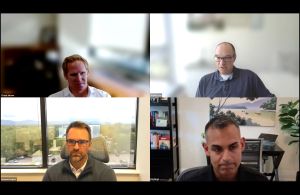
The discussion focused on when to buy external AI tools, when a firm should build its own internal system, how to keep information safe, and the importance of the human connection.
“We’re not in the build mode right now,” McCann said. “We’re typically going to [software as a service] providers and trying to find the best of breed, or we’re in the Yardi shop, trying to determine if Yardi has a solution that can help meet our needs.”
Going external was the right call, McCann said, because feedback from associate surveys found that the company has too much technology.
“In some cases, there might have been 10 to 15 logins in the properties, and we heard that loud and clear,” he said. “So, we started a simplified applications corporate goal. So it’s made aware throughout the whole company that we are trying to minimize our tech stack to help us be more efficient, have better data quality, and also better data analytics.”
On the flip side, Platte has been doing a lot of building in an effort to streamline the underwriting process as well as the upper-level asset management process, and invoicing, Degner said.
“On the buy side we rely on what’s available in the market at the property level,” he said. “So that’s EliseAI, Yardi or RealPage. Some of that is a byproduct of just not wanting to take on the risk of trying to create our own [property management system]. It makes me cringe just thinking about doing that for ourselves.”
At the heart of each of the day’s conversations was the theme of not losing the human connection, and using AI to enhance what individuals and firms in the multifamily sector can do to improve business performance and enhance the lives of the residents they serve.
AI is “not necessarily replacing people,” Jensen said. “It is just replacing friction.”
Amanda Schiavo can be reached at aschiavo@commercialobserver.com.