Institutional and Private Equity Investors: Their Commercial Real Estate Hot Takes
Interest rates, the war with Iran, inflation, the next assets ripe for institutionalization — all of it and more came up at a recent Commercial Observer forum
By Brian Pascus September 18, 2026 10:54 am
reprints
Commercial Observer’s annual Institutional Investor & Private Equity Forum took center stage at 237 Park Avenue in Midtown Manhattan on Sept. 16, when some of the biggest names in commercial real estate investment offered their thoughts on the state of capital markets.
Under the shadow of the Federal Reserve set to raise short-term interest rates for the first time in three years (which they did that very afternoon), Blackstone’s Katie Keenan, global head of core-plus real estate and CEO of Blackstone Real Estate Income Trust (BREIT), sat down with Jennifer Recine, partner at King & Spalding, to host the opening keynote.
Keenan enumerated reasons why the U.S. market is currently experiencing “a compelling backdrop for real estate” largely from an ongoing reset in asset values, a growth in cash flows, and the supply in asset classes such as multifamily and retail at the lowest levels in decades. She also touched on the accelerating demand from artificial intelligence, digitalization, and e-commerce.

“When you have growing demand and flat, or down, supply, it’s a meaningful impact on what you see from a cash flow and growth perspective,” Keenan said. “The debt capital markets … are as healthy as I’ve seen them in a long time. Capital is readily available and it’s well priced.”
Keenan noted that 90 percent of Blackstone’s core-plus portfolio consists of logistics, data centers and multifamily, and that these assets benefit from the conservative approach that core-plus investing uniquely prioritizes.
“It’s driven by that cash-flow growth, it doesn’t rely on leverage, it’s a lower leverage strategy,” she said. “And it’s not about cap-rate compression. … This is really about buying good assets that can compound over time and deliver a significant portion of their return along the way.”
Keenan closed her remarks by touting BREIT’s 15-year track record of market performance, noting that the private real estate investment trust has delivered 9.4 percent net return over the last 10 years, which is 35 percent higher than the public REIT market.
“It really does what real estate is supposed to do in a broader portfolio: It provides diversification, non-correlation, cash flow, stability, and compounded returns,” she said. “The proof is in the performance.”
The morning’s second panel, moderated by King & Spalding’s James Stull, examined the state of institutional real estate and where capital is moving today.
Greg MacKinnon, head of research at Pension Real Estate Association, began by offering a humorous assessment of the market, which he compared to a patient “out of intensive care, but still in the hospital undergoing observation.”
He emphasized that CRE is well past the worst of the higher interest rates and regional banking crises that plagued 2022 and 2023, and that bright spots can be found in senior housing and retail, due to supply shortages.
“But all other sectors are clumped together with expected unlevered returns of low sixes [6 percent], which is fine, but it’s not exactly exciting,” he said. “You’re not going to write a letter home to your mother about 6 percent returns in real estate.”
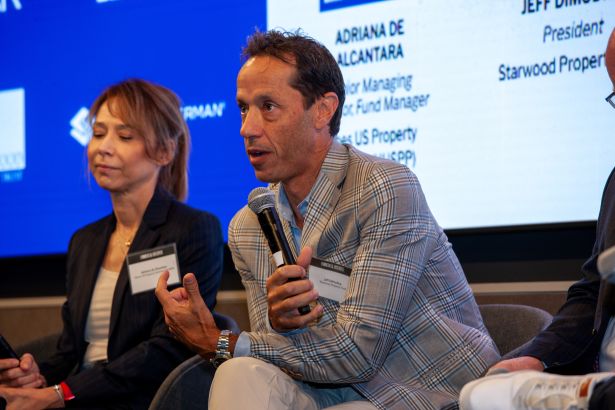
Adriana de Alcantara, senior managing director and fund manager at Hines U.S. Property Partners, boasted of an aggressive approach her firm has taken in the last two years, noting that Hines has invested $1 billion into its open-ended institutional fund and another $1 billion into its non-traded REIT.
“It’s all about income and basis, buying the right assets at the right basis,” she said. “Real estate is less complicated than people think: As long as you buy in the right location and at the right price, you’re going to be fine.”
Miles Treaster, president of Americas capital markets at Cushman & Wakefield, outlined what he described as “a paradigm shift” in the current market, as CRE investment participants are gradually starting to accept that the go-go times of the 2010s — when asset values constantly went up and the cost of capital and raising funds always went down — is not returning anytime soon.
But he pointed to alternatives like data centers and senior housing as examples of strong performance.
“There’s been a lot of resiliency in this market, which, if you told me oil would be above $100 per barrel and rates would be above 5 percent on the 10-Year, I’d say you’re crazy,” he joked. “But the S&P 500 and the companies in it are doing quite well, and real estate usually follows.”
Starwood Property Trust President Jeff DiModica took a decidingly more cautious tone, stating outright that the move of long-term interest rates into 5 percent territory is something the market will need to digest while dealing with hundreds of billions of dollars worth of debt tied to data center development, which he called “a big driver to this 5 percent — there’s just not enough buyers of duration in the market.”
DiModica said that in previous eras the market could still perform well under high interest rates because of strong growth, property cash flows, and rising incomes. But he’s afraid the party is now over in that respect.
“I’m a little afraid we might not have that here,” he said. “Rate moves are typically bad for real estate, as real estate is typically very levered to interest rates, and I think that will show its teeth. We haven’t worked through a lot of the problems of the post-COVID, 2022 [era].”
The third panel of the morning, moderated by Dan Berman, partner at HSF Kramer, focused on the difference between domestic and foreign investment trends and where emerging opportunities can be found.
Shawn Lese, chief investment officer and head of funds management at Nuveen Real Estate, said that it has only been in the last 18 months that it’s been possible to raise institutional capital in generous amounts, and that his firm has been able to secure investment from different corners of the globe.
“We’ve been raising money from Canada, from Germany, from Australia,” said Lese. “What we’ve consistently heard from those large state plans, sovereign wealth funds, superannuation funds, is basically, ‘We’re underallocated, we’re underallocated [into commercial real estate].’”
Gordon Black, executive vice president and portfolio manager of private equity at Heitman, argued that the investment climate has “gone from paralysis to selectivity,” and that traditional CRE now needs to compete with more products in the real assets space, namely infrastructure development and assets tangentially related to data centers.
“It’s a relative world and real estate has to perform, it’s got to be somewhere between fixed-income and equities, and right now that’s a problem,” Black said. “There’s been a lack of new capital in lower-risk strategies, and I think a lot of that’s tied to [a lack of] transaction volume.”
Dwight Angelini, co-founder and managing partner at Longpoint Partners, said commercial real estate might be awash in capital today, but it is still weighed down by the reputational harm it suffered from the exuberance and poor underwriting that occurred after 2019 and before 2023.

“You had all this capital come in, it was easy, everyone is raising [capital] and getting into different sectors, and real estate was the new venture capital or private equity,” said Angelini. “So a lot of dumb things were done between 2019 and 2023, and real estate, on some level, has reputation problems that need to be fixed.”
Richard Prokup, U.S. CEO of Mapletree, cataloged where he’s seen aggressive foreign investing, singling out Australia, Japan, South Korea, Malaysia and Singapore as countries that have been willing to pour capital into domestic CRE. Conversely, he noted that in recent years Middle Eastern nations have pulled out of U.S. investment, but the war in Iran has now caused them to seek safe haven in the States.
“The war in the Middle East has actually helped us because money that those organizations had earlier earmarked locally now can’t be deployed,” Prokup said. “So that money has to shift somewhere, and, if it has to shift, a portion of it, very likely, has come to the U.S.”
Lese added that “the U.S. is the only solid, investable place on the planet right now.”
After a short break, discussion resumed with Commercial Observer Executive Editor Cathy Cunningham and Citrin Cooperman’s Mark Mindick holding a keynote discussion with Bert Crouch, partner and head of real estate equity at Apollo Global Management.
Crouch began by outlining the reasons behind his firm’s August 2025 take-private acquisition of Bridge Investment Group, a move that transferred $50 billion in assets from Bridge’s alternatives business to Apollo. It ended up as the largest inorganic expansion that Apollo has ever made, doubling its real estate equity assets to over $110 billion.
“That was really the catalyst for me to appreciate that Apollo was now all-in on real estate,” said Crouch. “There’s a complementary nature of the platform. … [Bridge] is middle market, so if our bold bracket [debt] business under Scott Weiner and Apollo is doing $130 million average loan size, Bridge is doing $30 million, so their middle-market business complements it really well.”
Crouch emphasized that Apollo’s “secular thematic convictions” are in senior living and housing, namely the demographic shifts into senior housing, health care real estate, and industrialization in e-commerce and logistics as well as defense contracting and semiconductor chip production.
“When we settled on those themes, they’re not just real estate themes, they’re Apollo themes, across real estate equity and private credit,” said Crouch.
The fourth discussion centered around private credit and new fund formation and was moderated by Frank Ditta, director at law firm Goulston & Storrs.
Brian Flax, executive vice president at Meridian Capital Group, noted that special situation deals that needed to be financed before the interest rates increase will still seek rescue financing in the months ahead, and that opportunistic buyers looking to pounce on distress will also be in the market for acquisition credit.
“There is going to be no shortage of private credit available, because the capital has been raised and needs to be put to work,” Flax said. “It will all be a matter of where it will go.”
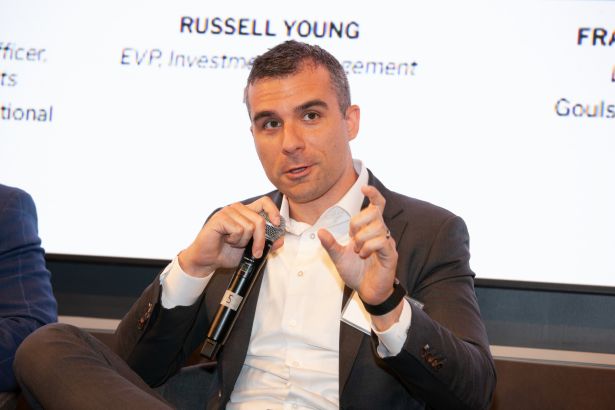
Russell Young, executive vice president of investment management at RXR, outlined how his firm is both an owner-developer as well as a capital solutions provider, and emphasized in his own remarks that the credit landscape is changing very quickly, creating room for hybrid players.
“The definition between equity and debt is blurring at this point,” said Young. “We’re really charting new territory in that regard.”
Nicholas Baccile, director at Canyon Partners Real Estate, pointed out that creativity is paramount in forming capital stacks, especially in an era when private credit competes with traditional lenders.
“It’s not just cut and dried like your debt is 65 percent and you have common equity. It’s maybe you’re going up to 80 percent loan-to-cost and you are competing with other debt funds and therefore your cost of capital is a certain way,” explained Baccile. “That creativity is what will differentiate a lot of groups going forward.”
Matt Jones, chief investment officer at Harbor Group International, used his time to emphasize that now is the moment for private capital to win business over traditional lending groups.
“Maybe rates go up and agencies and insurance companies stick to a sizing program and can only offer a B note,” explained Jones. “So this is where private capital should get paid a premium to provide a solution — I think the opportunity set over the next 12 months is tremendous.”
The morning’s final discussion, hosted by Andrew Dansker, CEO of mortgage brokerage Dansker Group, examined shifting allocations and how institutional investors are rebalancing their real estate portfolios.
Trisha Connolly Horowitz, head of CRE finance at Catal Capital, admitted that her firm has gone from seeing 10 to 15 deals per day to four or five amid the interest rate hikes, but said she believes there’s money to be made within the middle market.
“For me, as a lender, there’s always a good borrower for a $10 million to $15 million size deal,” she said. “We continue to see transaction volume in the middle-market space.”
Morris Betesh, founder and managing partner at Arrow Real Estate Advisors, said most of the business he has seen these days has been on maturing loans and motivated sellers.
“Specific to us, 70 percent of our business in the last 12 months was floating-rate [debt],” he said. “We represent a lot of developers doing value-add financings, where the outlook is two to three years from now, and there’s still optimism in the market that the experience we’re having today … is short term.”
Stephany Chen, senior vice president of investor relations at Trinity Investments, used the hospitality space as an example of rebalancing, emphasizing the operationally intense nature of those assets and how much they require experienced operators to reach outperformance.
“We’re definitely seeing more interest in the hospitality space,” she said. “The trend is those who are understanding the fundamentals, the operational focus of the asset, are being able to invest in the sector.”
The forum closed with observations by William Pattison, head of real estate research and strategy at MetLife Investment Management, on which sectors he believes will become institutionalized in the coming years.
“I think 10 years from now senior housing and medical office will be as institutionalized as apartments and industrial areas are today,” he said. “Diversified funds that are not in those segments probably won’t survive.”
Brian Pascus can be reached at bpascus@commercialobserver.com.